Support
Trailing stop loss explained: how to protect profits in trading
The trailing stop loss is a dynamic order that automatically tracks favourable price movements to protect gains and limit losses. Its placement requires evaluating the asset's volatility, technical analysis levels, or market economic information, always considering operational risks such as slippage.

The trailing stop loss adjusts the exit level when the price moves in favour and locks in the event of pullbacks to capitalize on accumulated profits.
Unlike the fixed stop loss, which maintains a static price, the trailing stop evolves with the trend to progressively reduce risk.
Its correct placement requires evaluating the asset's volatility, key supports and resistances, or the economic calendar to avoid premature closures.
Although it reduces the emotional burden in trading, it does not guarantee the exact exit price due to slippage or low liquidity.
What is trailing stop loss in trading?
The trailing stop loss is a complementary order to an active market order that automatically accompanies the favourable price movement, respecting a predefined distance in the number of ticks, pips, points, or percentage. However, if the movement turns against the trading stance, the trailing stop loss is locked in order to capitalize on the profit achieved up to that point in the movement.
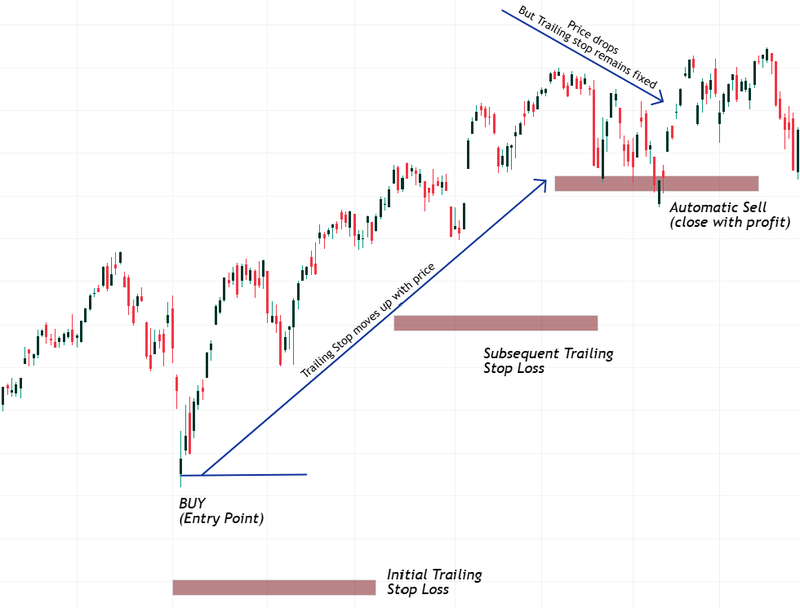
Figure 1. Trailing Stop Example. Source: Own analysis conducted via TradingView.
Why is relevant trailing stop loss for risk management?
The trailing stop loss is a powerful tool in risk management in trading because it involves a defensive limit that improves as the position moves toward the predicted direction.
Trailing stop loss example
Let's imagine a bullish trade with an entry price of $100. In this trade, a trailing stop loss with a distance of $5 is used, so the first update is made at a stop price of $95. Subsequently, the market price rises to $105, which automatically adjusts the trailing stop loss to $100 — because the fixed distance is $5 below the market price (as long as it moves toward the forecast direction).
Periods later, the market price goes to $110, which automatically updates the trailing stop loss to $105, so the management tool is already in profit territory. However, subsequently, the market price experiences a correction, dropping to $107. It is worth noting that, since the correction moves in the opposite direction to the position, the trailing stop remains unchanged at $105.
Finally, the market correction sharpens and the price falls to $105. This causes the trailing stop loss to be executed, implying a $5 or 5% profit over the entry price (even though the exit was at a stop price).
This example describes how trailing stop loss works, as well as its profits when the tool accumulates earnings. However, not every time the use of trailing stop loss is capitalized on profits; this tool can also close in losses, especially if it is misused due to psychological or technical factors.
Differences between trailing stop loss and fixed stop-loss
The main difference between trailing stop loss and fixed stop loss is that the latter involves a predefined price that remains static, while trailing stop loss moves automatically if the market price converges with the forecast direction.
Calibration and risk-sizing methods
The placement of a trailing stop loss should not only be a fixed amount or percentage relative to the entry price, since financial assets and underlying markets have different characteristics, which should influence the decision to place this tool.
Trailing stop loss on different asset characteristics
Volatility is a key factor regarding the proper placement of the trailing stop loss. If it is placed relatively close to the entry price, and the asset is highly volatile, it is most likely that the trailing stop loss will be reached in a natural market variation, causing the trade to end at a loss.
Thus, it is important to consider that there are differences in implied volatility between markets and financial assets. Stocks or cryptocurrencies tend to be more volatile markets than currencies or commodities. Additionally, within each financial market, assets tend to have different volatility.
For example, a retail stock tends to be less volatile than a technology company stock. Therefore, it is important to analyse both the market and the financial asset when placing the trailing stop loss. Against this backdrop, if the asset is highly volatile, experienced traders tend to place the trailing stop loss farther from the entry price to avoid an early exit due to volatility.
What factors influence the placement of a trailing stop loss?
The placement of the trailing stop loss depends on various factors that must converge with the trader's goals and strategy, so they are not unique factors. The following are common factors regarding proper placement:
- Volatility: Volatility is a fundamental factor in placing trailing stop loss. In highly volatile assets, experienced traders tend to move the tool away from the starting price, aiming to give the price more room to move, in order to avoid an early exit.
- Technical Analysis: Technical analysis helps identify support or resistance levels where the price is likely to respect and reverse. Whether the trailing stop loss is placed at the start or after the entry, technical analysis helps the tool follow a potential trend that adjusts over time, aiming to maximize the accumulated gain before the position closes.
- Market News: Market news is a relevant factor as it can drive an adverse price movement, causing substantial losses. Traders tend to monitor this news through tools like the economic calendar with the aim of reducing the probability of trading during volatility spikes, as this can affect the position even if a trailing stop loss has been properly placed.
Advantages and weaknesses of trailing stop loss
Using trailing stop loss has various advantages in risk management in trading, although it also involves some weaknesses that are important to consider.
On one hand, one of the main advantages is the improvement in traders' emotional factor since the tool itself automatically adjusts to a favourable movement. This means that as the trailing stop loss progresses, the risk of loss decreases until reaching a profit margin that will likely be capitalized. Moreover, the trailing stop loss is a powerful tool when used in trends maintained over time.
In contrast, trailing stop loss is not a reliable tool if volatility factors and market structure are not properly considered. Additionally, the risk of loss can be worsened by operational factors such as slippage or low market liquidity, which can cause exits beyond the price specified in the trailing stop loss. Therefore, it is important to emphasize that trailing stop loss does not guarantee an exact exit at the predefined price, a situation the trader must anticipate in their risk management.
If you're interested in trading indices, foreign exchange, or commodities, consider exploring the CFD contracts offered by Equiti Group. Please note that trading leveraged derivatives involves a high level of risk and may not be suitable for all investors.
FAQs
What is the main difference between a trailing stop loss and a fixed stop loss?
The fixed stop loss sets a default price that remains static throughout the trade. In contrast, the trailing stop loss is a dynamic order that automatically accompanies the price as it moves toward the forecasted direction, maintaining a fixed distance in ticks, pips, points, or percentage.
Why does asset volatility influence setting a trailing stop loss?
Each market and financial asset has different implied volatility; for example, cryptocurrencies or tech stocks tend to fluctuate more than currencies or some commodities. If a trailing stop loss is placed too close to the entry price on a highly volatile asset, a natural market variation can trigger it prematurely and close the trade at a loss.
What factors, besides volatility, determine the ideal location for a trailing stop loss?
In addition to volatility, placement must align with the trader's strategy through key factors: for instance, technical analysis and market news. Technical analysis allows identifying support and resistance levels where the price could bounce or reverse, helping to adjust the stop following the trend. On the other hand, monitoring the economic calendar avoids trading on publications that trigger abrupt volatility spikes capable of causing substantial losses.
Does trailing stop loss always guarantee closing with profits or at the exact price set?
No. Although it improves emotional management and protects profits in sustained trends, it can close in losses if set up poorly due to technical or psychological factors. Furthermore, it does not guarantee exact execution at the predefined level: in scenarios of low liquidity or high volatility, slippage can occur, executing the order beyond the established stop price and extending the expected loss.