Support
 UK inflation returns above 3% as energy shock tests the Bank of England
UK inflation climbed back above 3% in August, but the rise was driven mainly by energy and transport rather than a broad acceleration in underlying prices.
UK CPI inflation rose from 2.9% to 3.1% year on year in August, matching expectations.
Consumer prices increased 0.5% month on month, compared with 0.3% in August 2025.
Core inflation held at 2.6%, below the 2.7% forecast.
Services inflation remained unchanged at 3.4%, an important signal for the Bank of England.
The data complicates the Bank of England’s decision on Thursday, but does not clearly establish a case for an immediate rate hike.
UK inflation is back above 3%
UK inflation returned above the 3% threshold in August, adding pressure on the Bank of England one day before its latest interest-rate decision.
Headline CPI rose 3.1% from a year earlier, up from 2.9% in July and exactly in line with market expectations. Prices increased 0.5% month on month, also matching forecasts and running above the 0.3% increase recorded in August last year.
CPIH inflation, which includes owner-occupiers’ housing costs, climbed from 3.1% to 3.3%.
At first glance, the numbers appear clearly hawkish.
The composition tells a more complicated story.
Fuel prices drove most of the acceleration
Transport was the dominant source of August’s inflation increase.
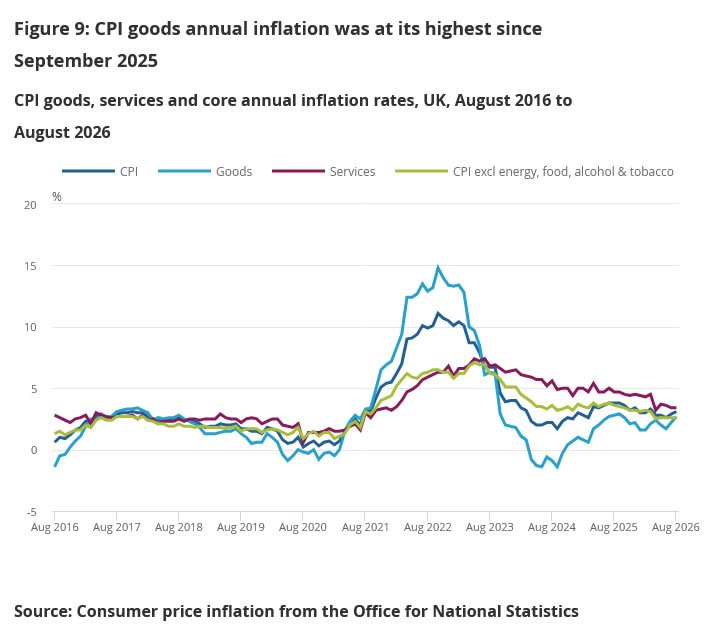
Transport inflation jumped from 3.6% to 4.6%, while motor-fuel inflation surged from 15.5% to 23.0%.
Petrol prices increased by 9.1 pence per litre during August, while diesel climbed by 14.2 pence.
That pushed annual goods inflation from 2.2% to 2.7%, its highest level since September 2025.
The increase reflects the renewed energy shock hitting the UK economy as geopolitical tensions continue to support global oil and gas prices.
Oil has climbed to around $109 a barrel, while UK fuel prices have moved sharply higher. Average petrol prices are approaching 170 pence per litre, with diesel above 191 pence.
For households, that means another squeeze on disposable income.
For the Bank of England, it creates a more complicated inflation problem.
Core inflation did not accelerate
The most important detail for monetary policy may be what did not happen.
Core CPI remained unchanged at 2.6%, below market expectations for 2.7%.
Services inflation also stayed at 3.4%.
That distinction matters because services prices tend to reflect domestic wage pressures, labor costs and persistent demand more directly than petrol or diesel.
If services inflation had accelerated alongside headline CPI, the data would have provided much stronger evidence that inflation was broadening across the economy.
Instead, the August report looks much more like an energy-led shock.
That does not make it harmless.
But it changes the policy response.
The BoE faces an energy shock rather than a broad inflation surge
The Bank of England now has to decide whether the rise in headline inflation represents the beginning of a more persistent problem or a temporary external shock.
Energy inflation can spread.
Higher petrol and diesel costs increase transportation expenses for businesses. Higher gas and electricity prices raise production costs. Companies may eventually pass some of those increases on to consumers.
If that process becomes embedded in wages and services prices, the BoE would have a much stronger reason to raise rates.
For now, the August data provides limited evidence that this is already happening.
Core inflation is stable.
Services inflation is stable.
Food inflation is also relatively subdued at 1.3%.
That leaves policymakers with a familiar dilemma: respond immediately to the headline number or wait to see whether the energy shock spreads into underlying inflation.
Housing costs are also moving higher
Housing and household-services inflation strengthened from 4.6% to 4.9% on the CPI measure.
On the broader CPIH measure, the equivalent category increased from 4.1% to 4.3%.
Part of that rise reflects higher owner-occupiers’ housing costs and domestic energy prices.
This is another area the Bank of England will watch closely.
Housing-related inflation tends to be more persistent than fuel prices and can interact with wage growth, rents and broader household costs.
If housing inflation continues accelerating while energy prices remain high, the headline pressure could become more difficult to dismiss as temporary.
The Bank of England has less room to sound dovish
The August CPI report probably does not force the BoE into an immediate rate increase.
It does, however, make a dovish shift more difficult.
Headline inflation is now above 3%, oil prices remain elevated, and the Middle East conflict continues to create upside risks for energy costs.
That means policymakers who already favor tighter policy have additional evidence supporting their position.
The counterargument is equally clear.
Underlying inflation has not accelerated.
Core CPI held at 2.6% and services inflation remained at 3.4%, meaning there is little sign yet that the energy shock is turning into a broad domestic inflation problem.
That should make it harder for the hawkish side of the committee to build a much larger coalition for an immediate rate hike.
Why services inflation matters more than petrol prices
For the BoE, services inflation is one of the most important indicators in the entire report.
Petrol prices can rise rapidly because of geopolitical events and then fall just as quickly if oil prices retreat.
Services inflation behaves differently.
It is heavily influenced by wages, labor shortages and domestic demand. Once elevated, it tends to be more persistent.
That is why the unchanged 3.4% services reading provides some reassurance.
If services inflation had moved toward 4% while headline CPI jumped above 3%, the case for tighter policy would have strengthened considerably.
Instead, the Bank faces a headline problem without clear confirmation from the underlying domestic inflation data.
The oil shock remains the biggest risk
The real danger is what happens next.
The Bank of England has previously warned that a severe Middle East escalation could eventually push UK inflation toward 4.5% by the middle of 2027.
That scenario remains relevant because Britain is highly exposed to global energy prices.
If oil and gas stay elevated for several months, the inflation effect will no longer be confined to petrol stations.
Businesses would face higher transportation and production expenses. Utilities could pass through additional costs. Households could demand stronger wage increases to compensate for falling real incomes.
At that point, an external energy shock could become a domestic inflation problem.
The BoE therefore needs to distinguish between the current increase and the second-round effects that may follow.
Higher bond yields are already tightening financial conditions
The Bank also has to consider what financial markets are doing independently of official policy.
Global government bond yields have risen sharply as investors react to inflation, heavy sovereign borrowing and changing rate expectations.
Long-term UK borrowing costs have climbed to levels not seen in decades, while U.S. Treasury yields have also moved sharply higher.
That tightening matters.
Higher gilt yields feed into mortgage rates, corporate borrowing costs and broader financial conditions.
So even if the Bank leaves its policy rate unchanged, households and businesses may still experience tighter monetary conditions.
This reduces the need to respond mechanically to every increase in headline inflation.
The cost-of-living squeeze is returning
For households, the distinction between headline and core inflation offers little immediate comfort.
Fuel, housing and energy costs are among the most visible expenses in household budgets.
Even if the Bank views part of the increase as temporary, consumers still feel the impact directly.
- Higher petrol and diesel prices raise commuting costs.
- Higher domestic energy prices increase utility bills.
- Housing-related inflation adds further pressure.
This creates a difficult backdrop in which inflation can weaken household spending even before the BoE raises rates.
That may eventually become important for growth.
What the Bank of England is likely to focus on
Thursday’s decision will probably come down to three questions.
First, does the Bank believe the energy shock will persist long enough to affect inflation expectations?
Second, are wages and services prices starting to respond?
Third, are higher market yields already providing enough tightening without another move in the Bank Rate?
The August CPI report gives policymakers mixed answers.
Headline inflation is clearly uncomfortable.
Underlying inflation is considerably less alarming.
That makes the policy decision more nuanced than the 3.1% headline suggests.
What UK inflation at 3.1% means for the BoE rate outlook
The return of UK inflation above 3% increases pressure on the Bank of England, but the composition of August’s report does not yet point to a broad resurgence in domestic inflation.
The jump was concentrated in energy and transport.
Motor-fuel inflation accelerated to 23%, transport inflation rose to 4.6%, and goods inflation reached 2.7%.
At the same time, core inflation remained at 2.6% and services inflation stayed at 3.4%.
That is the critical distinction.
If the Bank believes the energy shock will fade without spreading into wages and services, it has a credible argument for waiting.
If oil prices stay high and second-round effects begin appearing in domestic prices, the case for another rate increase will strengthen quickly.
For Thursday, the 3.1% headline keeps the hawkish pressure alive.
The unchanged core and services numbers keep the decision from becoming straightforward.