Support
US jobs report could break the 50-50 split on a September Fed rate hike
The August jobs report arrives with markets almost perfectly divided over a September Fed rate hike, making any major payroll, unemployment or wage surprise potentially important for rate expectations.

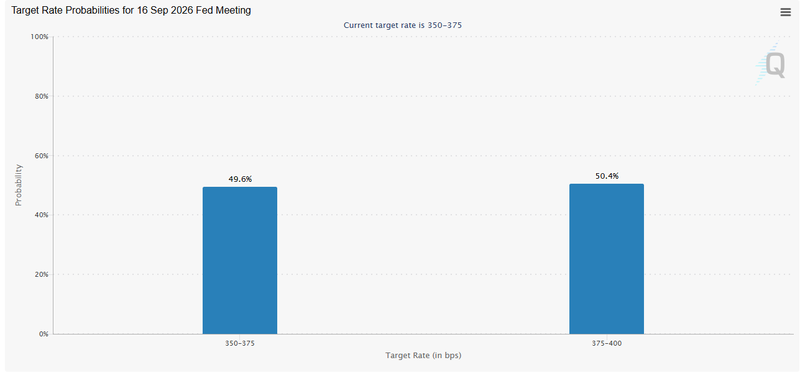
Markets currently price a 50.4% probability of a 25-basis-point September rate hike, against a 49.6% probability of no change.
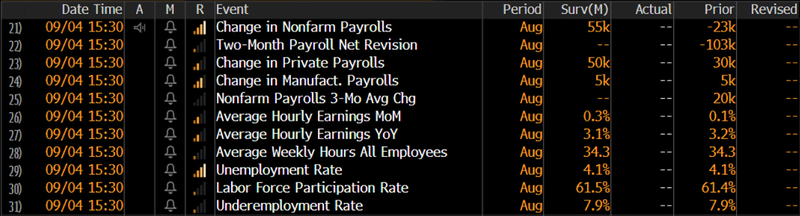
August nonfarm payrolls are expected to rise by 56,000, following a 23,000 decline in July, while unemployment is forecast to remain at 4.1%.
This week’s data has sent conflicting signals: hiring remains weak, but services demand and input prices have strengthened sharply.
A strong jobs report could push hike expectations back toward the 60%-plus levels seen earlier this week, while a significant downside surprise would strengthen the case for holding rates steady.
Payrolls arrive with the Fed decision almost a coin toss
Friday’s US employment report could become an important test for markets after expectations for the Federal Reserve’s September meeting swung sharply over the past several days.
Futures currently assign a 50.4% probability that the Fed raises interest rates by 25 basis points to 3.75%-4.00%, leaving markets almost evenly divided between another increase and keeping the policy rate unchanged at 3.50%-3.75%.
Source: CME Group
That is a considerable shift from earlier in the week. Rate-hike expectations had climbed into the mid-60% range as resilient economic activity and persistent price pressures strengthened the argument for further tightening. By Friday, those expectations had fallen back toward 50% after Fed Governor Christopher Waller signaled he could support leaving rates unchanged if incoming inflation data confirms that price pressures are easing.
Against that backdrop, payrolls now have the potential to move a market that has almost no directional conviction going into the September 15-16 meeting.
What markets expect from the August jobs report
Economists expect the US economy to have added around 56,000 jobs in August, following a surprise decline of 23,000 in July. The unemployment rate is expected to remain unchanged at 4.1%, while annual average hourly earnings growth is forecast to slow to 3.0% from 3.2%.
Source: Bloomberg
The headline payroll figure will matter, but markets are likely to pay particular attention to unemployment, wages and revisions to previous months.
That is because the economy may no longer need the kind of job creation seen in previous years simply to keep unemployment stable. Estimates suggest the monthly break-even rate for employment growth has fallen to roughly zero to 50,000 jobs, partly because immigration has slowed and labour-force growth has weakened.
A payroll gain close to 50,000 therefore may not be as weak as it would have appeared historically.
This week’s US data has sent a mixed message
The data leading into NFP has done little to resolve the Fed debate.
Private employers added only 38,000 jobs in August, below expectations for 48,000, while manufacturing lost 17,000 jobs and professional and business services shed 16,000. That reinforced the view that companies remain cautious about expanding headcount.
The JOLTS report told a similar story. Job openings edged up to 7.271 million, but remained slightly below expectations, while hiring dropped by 278,000 to 5.054 million. Layoffs, however, fell to only 1.666 million, reinforcing the unusual combination of weak hiring and very limited firing.
Weekly jobless claims also remain exceptionally contained. Initial claims rose only slightly to 206,000, close to the lower end of this year’s range. Continuing claims increased to 1.779 million, suggesting finding a new job may be becoming more difficult even though companies are still reluctant to dismiss workers.
The labour data therefore points toward cooling, but not a breakdown.
The inflation and growth signals have been considerably more hawkish.
The ISM services index climbed to 55.4 in August from 54.1, beating expectations of 54.2, while new orders jumped to 60.9, their highest level in three and a half years. More importantly for the Fed, the prices-paid index climbed to 72.6, its highest since August 2022.
Manufacturing showed a similar inflation problem. The ISM manufacturing index eased to 54.6, but input prices remained elevated at 71.1, suggesting cost pressures are becoming increasingly broad rather than being concentrated in one part of the economy.
This creates the Fed’s dilemma: employment growth is weakening, but demand remains firm and inflation pressures have not disappeared.
How NFP could move September rate-hike pricing
A strong payroll report would strengthen the argument that the Fed has room to concentrate on inflation.
If job creation materially exceeds expectations, unemployment remains at or below 4.1%, and wage growth surprises higher, markets could quickly rebuild September hike expectations toward the 60%-plus territory seen earlier this week. Short-dated Treasury yields and the dollar would likely be particularly sensitive to such a repricing.
A weak report would produce the opposite effect. Another negative payroll reading, a meaningful rise in unemployment or further downward revisions to previous months would make it more difficult for policymakers to justify tightening monetary policy while labour demand is deteriorating.
The most complicated outcome may be a payroll number near the 56,000 consensus. That would probably leave the September decision close to its current 50-50 pricing because the labour market would still look soft but broadly stable.
In that case, the focus would shift almost immediately to next week’s inflation reports.
Fed officials have made clear that inflation remains the critical variable, and recent ISM price data has increased the importance of the upcoming CPI and PPI releases. Even a weak payroll report may therefore fail to completely remove a September hike if inflation surprises higher again.
The NFP may move the odds, but inflation could decide the meeting
The August employment report arrives at a rare moment when the market is almost perfectly divided over the Fed’s next move.
That gives payrolls considerable power to shift short-term pricing, particularly if the result falls well outside the expected range.
But the broader picture remains more complicated than a simple strong-jobs-equals-hike equation. This week’s data points to an economy where hiring is losing momentum while demand and inflation remain surprisingly resilient.
Payrolls may therefore determine which side of 50% the September hike probability moves to on Friday. The inflation data that follows could determine whether that move lasts.