
 Support
Bitcoin ETF outflows deepen as Strategy buys the dip and miner stress rises
Bitcoin is facing one of its clearest confidence tests since spot ETFs launched in 2024. US spot Bitcoin ETFs suffered $4.4 billion in net outflows across 13 straight sessions, while Strategy moved in the opposite direction by buying another 1,550 BTC.

The Puell Multiple has fallen to 0.74, showing pressure on miner revenue.
Bitcoin ETFs face their worst outflow streak since launch.
Strategy bought 1,550 BTC for about $101 million.
Bitcoin ETFs face their worst outflow streak since launch
Bitcoin spot ETFs are no longer enjoying the one-way inflow story that defined much of their early market life.
Across 13 straight sessions, US spot Bitcoin ETFs posted roughly $4.4 billion in net outflows. That marks the worst outflow streak since the products launched in 2024 and shows that institutional demand has become more selective as Bitcoin trades under pressure.
That matters because the ETF channel has been one of the most important sources of support for Bitcoin’s public-market narrative. When ETFs are attracting steady inflows, the story is simple: regulated capital is entering the market, institutions are building exposure, and Bitcoin is gaining a stronger place inside traditional portfolios.
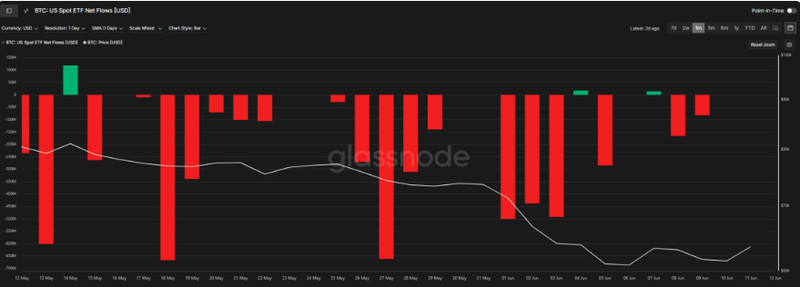
Source: Glass node
Outflows change the tone
Investors are now more sensitive to price weakness, macro uncertainty and the risk of holding Bitcoin after a large rally. The market is no longer only asking how much money Bitcoin can enter through ETFs. It is asking how stable that money is when volatility rises.
Strategy buys as ETF investors reduce exposure
While ETF investors were pulling money out, Strategy bought the dip. The company acquired 1,550 Bitcoin for about $101 million, increasing its total reserve to 845,256 BTC.
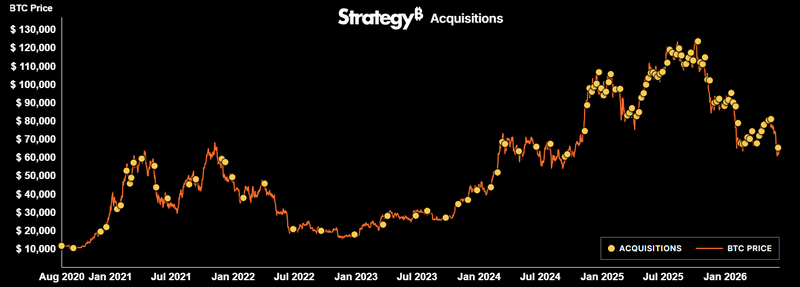
Source: Strategy
That is not a small signal
Strategy has built its identity around Bitcoin accumulation. Every new purchase reinforces the idea that the company is not treating Bitcoin as a short-term trade, but as the core of its treasury strategy. In a weak market, that kind of buying can help sentiment because it shows that one of Bitcoin’s most aggressive public-market holders is still willing to add exposure.
The signal is not risk-free
Strategy’s position is already enormous. The bigger the reserve becomes, the more closely investors will watch the company’s funding model, balance sheet structure and sensitivity to Bitcoin price moves. Buying the dip can look powerful when prices recover. It can look much more complicated if weakness continues.
That is the trade-off
Strategy’s purchase supports the long-term conviction story, but it also increases the company’s exposure to the same volatility that is now pushing some ETF investors to reduce risk.
The Puell Multiple shows miner pressure is building
The miner side of the market is also sending a warning.
The Puell Multiple 30-day moving average has dropped 11% to 0.74. A reading below 1.0 means miner revenue is running below its annual average. The lower the reading falls, the more pressure miners face from weaker income relative to normal conditions.
This matters because miners are one of Bitcoin’s most important economic groups.
When miner revenue falls, operators with higher costs can come under pressure. Some may reduce expansion plans, delay upgrades, raise capital, or sell part of their Bitcoin holdings to support cash flow. That does not always create immediate market stress, but it adds another layer of fragility when price momentum is already weak.
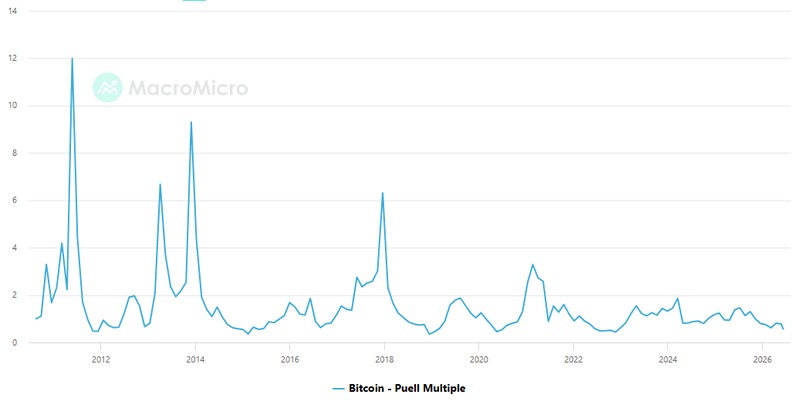
Source: MacroMicro
Bitcoin’s market structure is becoming more mature
The bigger lesson is that Bitcoin is now more tied to traditional market behavior than before.
Spot ETFs brought Bitcoin closer to mainstream portfolios. That helped during periods of strong inflows, but it also means Bitcoin is more exposed to the same risk-management decisions that affect equities, bonds and other liquid assets. When investors cut risk, ETF flows can reverse quickly.
At the same time, corporate buyers like Strategy continue to create a separate source of demand. That makes Bitcoin’s structure more complex. The market is not driven by one group anymore. It is shaped by ETF investors, long-term holders, corporate treasuries, miners, leveraged traders and macro funds.
This is what a more institutional Bitcoin market looks like.


