
 Support
Bitcoin faces new pressure as Strategy sells and ETF outflows continue
Between June 29 and July 5, Strategy sold 3,588 BTC, raising about $216 million. The proceeds were used to support preferred dividend payments and rebuild dollar reserves, according to company filings and market reports. After the sale, Strategy’s holdings fell to roughly 843,775 BTC, bringing the company below the 844,000 BTC mark that many traders had been watching.

Strategy sold 3,588 BTC between June 29 and July 5.
The sale raised about $216 million to support preferred dividends and dollar reserves.
The sales were more than 100 times larger than the small BTC sales reported in May.
Why the sale surprised the market
The surprise was not only the size of the sale. It was a break in behaviour.
Strategy has long been viewed as the corporate face of Bitcoin conviction. Michael Saylor built the company’s market identity around accumulation, leverage and belief that Bitcoin would outperform cash over time. That made MSTR more than a software company. It became a high-beta Bitcoin vehicle with a capital-markets machine built around it.
That is why this sale hit differently
Reports noted that Strategy sold 3,588 BTC in one week after selling only a much smaller amount earlier in June. Investopedia said the pace of sales had picked up sharply under the company’s Bitcoin monetization program, which is designed to support preferred dividends, buybacks and liquidity needs.
The market can understand a company selling an asset to pay obligations. What it struggles with is the change in narrative. If Strategy is no longer only an accumulator, then investors must start valuing it less like a one-way Bitcoin bet and more like a leveraged treasury company with recurring cash demands.

Source: Strategy
The balance-sheet question is getting louder
The sales have pushed the focus back to Strategy’s balance sheet. Strategy disclosed a major Q2 loss tied to its Bitcoin holdings, including large unrealized losses, while selling Bitcoin to support shareholder payouts and replenish reserves. The same report noted that the company’s average purchase price was well above where Bitcoin was trading at quarter-end.
This is where the pressure sits
Strategy’s model works best when Bitcoin rises, the stock trades at a premium to net asset value, and capital markets stay open. In that environment, the company can raise funds, buy more BTC, and keep the flywheel alive. But when Bitcoin falls, the preferred dividend burden becomes more visible. The question becomes less about conviction and more about liquidity.
The company still holds a huge amount of Bitcoin, but the sale showed that the balance sheet is not untouchable. If cash is needed, BTC can become a funding source.
Strategy’s sales add pressure to ETF
The timing also matters because Strategy’s sales are happening against a weaker ETF backdrop. Since May, Bitcoin ETF outflows have deepened, and the market has struggled to rebuild consistent net inflows.
That makes Strategy’s sales feel more important than the dollar amount alone. In a stronger ETF-flow environment, the market could probably absorb the selling with less concern.
But when listed Bitcoin products are already seeing weaker demand, any sale from the most visible corporate holder adds to the feeling that institutional appetite has cooled. Bitcoin does not need Strategy buying every week to stay supported, but it becomes harder for sentiment to recover when ETF flows are negative, and the market’s best-known corporate accumulator is selling rather than adding.
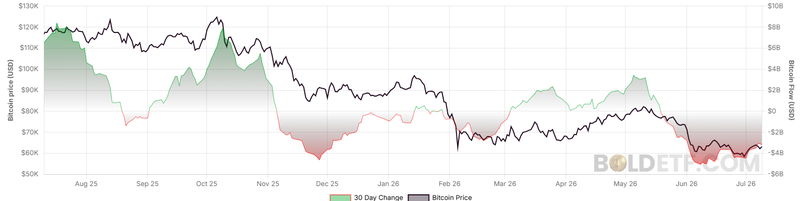
Source: Bold report
The bullish argument: clearing uncertainty
There is a bullish counterargument. Grayscale argued that the sale may help Bitcoin form a more durable bottom by reducing uncertainty around Strategy’s funding needs. The idea is simple: if Strategy builds enough dollar reserves to meet preferred dividend obligations, the market has less reason to fear sudden forced selling later.
Markets often handle bad news better when the risk becomes visible. A known sale can be easier to absorb than weeks of speculation about whether a large holder may need to liquidate. If Strategy has raised cash and reduced near-term financing pressure, some investors may treat the move as a cleanup rather than a warning.
But that argument depends on Bitcoin stabilizing
If BTC holds key support and Strategy’s stock stops widening its discount or losing premium relative to its Bitcoin holdings, the sale may be remembered as a difficult but necessary liquidity move. If Bitcoin breaks lower, the same sale could be read as the first sign that the model is becoming more fragile.


