Support
 Cryptocurrencies at a turning point: The key themes shaping Q3
After a sharp pullback, cryptocurrencies enter Q3 searching for direction. Bitcoin is trading near a key technical level, institutional demand has weakened and ETF flows continue to point to cautious investor sentiment. With risk appetite still fragile, the market’s next move may depend on how investors respond to economic uncertainty, equity market volatility and increasing regulatory pressure.

Total spot Bitcoin ETF holdings have declined by approximately 57% from their peak in October 2025.
A rolling correlation analysis of Bitcoin's weekly returns and the S&P 500's weekly returns shows significant correlation (r > 0.40).
Bitcoin is trading around $60,000, which represents a drawdown of approximately 51.6% from its peak of around $124,000 in October 2025.
Bitcoin spot ETFs see outflows as institutional confidence weakens
After months of heightened volatility, the cryptocurrency market is approaching a critical point. The total market capitalisation is around $2 trillion, placing the market at a level where it could either recover or decline further. Meanwhile, Bitcoin is trading near $60,000, a significant technical zone that previously acted as key resistance in 2021.
Investor flows tell a similar story. Bitcoin-linked spot ETFs have shown gradual outflows since the end of 2025 and have not yet seen a meaningful recovery. Total spot Bitcoin ETF holdings have declined by approximately 57% from their peak in October 2025, according to Glassnode's US Spot ETF Balances metric (as of 1 July 2026). This trend suggests weakening institutional investor confidence amid ongoing global economic and geopolitical uncertainty, which has affected investment in higher-risk assets such as cryptocurrencies. The chart below shows how selling pressure on Bitcoin spot ETFs has intensified since May 2026, with only limited net inflows observed.
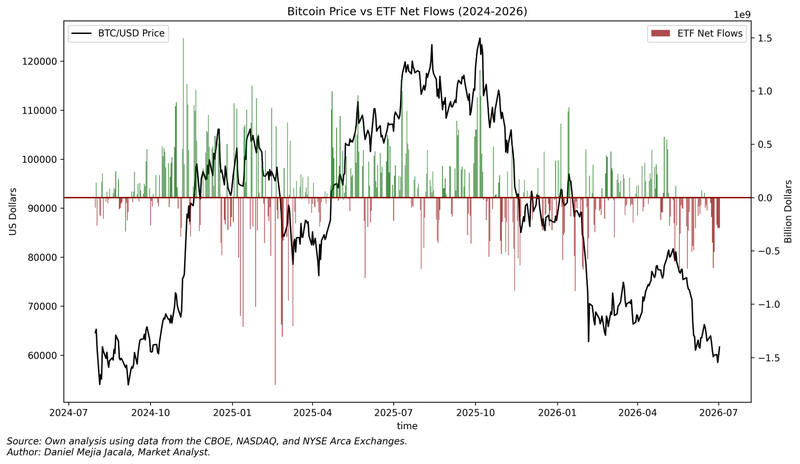
Figure 1. Bitcoin Price vs Bitcoin Spot ETF Net Flows (2024–2026). Source: Own analysis using data from the CBOE, NASDAQ, and NYSE Arca Exchanges.
Bitcoin and the S&P 500 move more closely during volatile markets
Historically, there has been considerable discussion about the correlation between cryptocurrencies and the stock market, particularly US equities. This hypothesis is mainly based on the fact that both markets are considered higher-risk assets due to their elevated volatility. However, statistical evidence shows that, although periods of high correlation do occur, the relationship is not always as strong or consistent as many market participants expect.
A rolling correlation analysis of Bitcoin's weekly returns and the S&P 500's weekly returns, using a six-month comparison window, shows that periods of high and statistically significant correlation (r > 0.40) mostly coincide with declines in both markets. This timeframe is intended to balance long-term dynamics with shorter-term market movements. The findings suggest that Bitcoin prices may be negatively affected if stock markets fall, representing a significant risk, particularly given the sensitivity of equity markets to concerns about the potential overvaluation of companies associated with artificial intelligence. The chart illustrates this relationship.
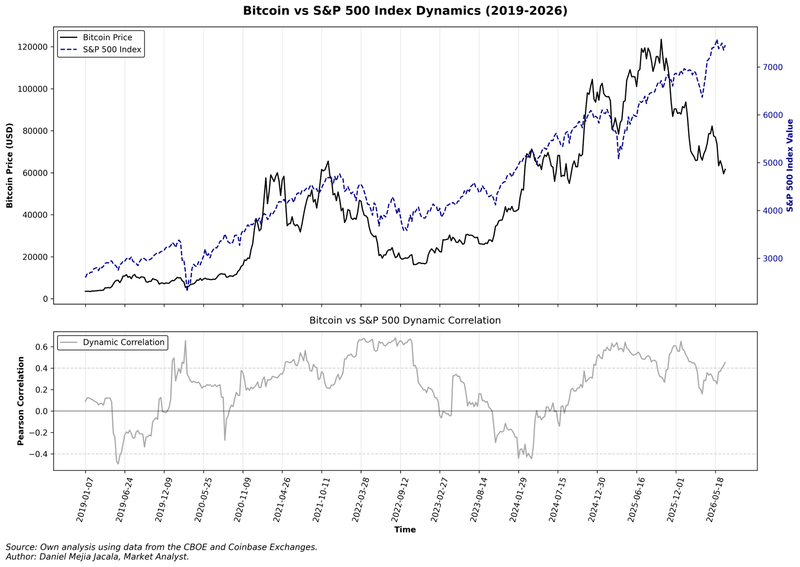
Figure 2. Bitcoin vs S&P 500 Values and Dynamic Correlation (2019–2026). Source: Own analysis using data from the CBOE and Coinbase Exchanges.
Bitcoin tests a key support level after a 50% decline
History shows that sharp market corrections are a recurring feature of the cryptocurrency market. Bitcoin has experienced drawdowns of more than 50% on several occasions, including a maximum drawdown of 84.27% in 2019. Currently, Bitcoin is trading around $60,000, which represents a drawdown of approximately 51.6% from its peak of around $124,000 in October 2025.
Understanding this history helps traders assess the risk-reward ratio of their positions more clearly. While cryptocurrency prices may fall further, given their history of deep drawdowns and high volatility, they have also demonstrated significant return potential over time. The key is to define an appropriate risk tolerance and investment horizon based on individual objectives, whether short term or long term.
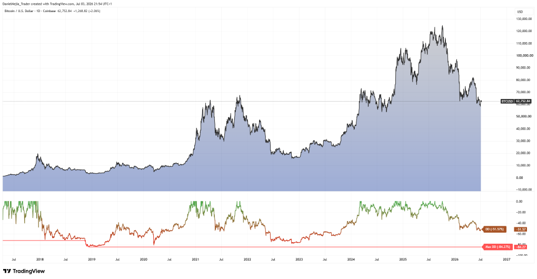
Figure 3. Bitcoin’s Historical Drawdown (2018–2026). Source: Own analysis using data from the Coinbase Exchange.
Finally, it is important to recognise the key risks facing cryptocurrencies. Geopolitical and economic uncertainty can increase risk aversion, encouraging investors to shift towards defensive or safe-haven assets. At the same time, cryptocurrencies face growing competition from other risk assets, including companies linked to artificial intelligence and technological innovation, as illustrated by investor interest in high-profile companies such as SpaceX. The regulatory environment is also evolving, particularly in the United States and Europe, where the continued development of tokenisation and central bank digital currencies (CBDCs) may reshape the competitive landscape.