
 Support
 Ethereum drops as inflation stays high and geopolitical tensions escalate
Ethereum fell by 1.2% to $1,619 as persistent inflation, renewed tensions in the Middle East, and expectations of prolonged Federal Reserve tightness weakened appetite for crypto risk. Investors may also be rotating towards more defensive assets and higher-return technology plays.

Ethereum slipped by 1.2% to $1,619 as inflation and tensions in the Middle East pushed investors away from riskier crypto assets.
US CPI rose to 4.2%, the highest level since April 2023, reinforcing expectations that the Federal Reserve will keep interest rates higher for longer.
Conflict risks increased following renewed US–Iran attacks, a closure of the Strait of Hormuz, and continued strikes between Israel and Hezbollah.
Ethereum weakens on persistent inflation and rising geopolitical uncertainty
Ethereum experienced persistent selling pressure during the trading session amid rising geopolitical tensions and the prospect that the Federal Reserve could maintain a higher-for-longer policy stance.
According to Reuters, US President Donald Trump stated that the United States would attack Iran again “very hard” if a peace agreement with Tehran were not reached. In addition, media outlets such as France 24 reported that the US had resumed its attacks against Iran, while Tehran had ordered the complete closure of the Strait of Hormuz, while bilateral strikes between Israel and Hezbollah continued.
Concurrently, the US Bureau of Labor Statistics (BLS) reported that headline inflation accelerated from 3.9% in April to 4.2% in May on a year-on-year basis, in line with analysts’ expectations. This marks the highest inflation reading since April 2023. CME’s FedWatch Tool indicates a higher implied probability that the Federal Reserve could maintain its hawkish higher-for-longer stance during 2026. Market participants are now focused on next week, when the Fed is scheduled to announce its monetary policy decision on Wednesday, 17 June. At present, FedWatch implied probabilities suggest that the US central bank will leave interest rates unchanged at the 3.75% level at its next meeting.
This combined backdrop has affected the cryptocurrency market, as investors move away from riskier assets and towards more defensive alternatives. In addition, some market participants appear to be reallocating capital towards technology companies and initial public offerings (IPOs) in large-cap technology, which, although also high-risk investments, have delivered stronger returns in recent months. Ethereum closed the trading session with a marginal decline of 1.20% at $1,619.
Technical analysis of Ethereum
From a technical perspective, Ethereum maintains a clear downward trajectory. A more detailed assessment of the current market structure reveals several key observations:
- Trend context: Within a long-term framework, Ethereum continues to trade below its 50-day, 100-day, and 200-day Simple Moving Averages (SMAs). This sustained position beneath major moving averages reinforces the prevailing bearish sentiment.
- Resistance levels: Should the immediate psychological resistance near the $2,000 threshold be breached to the upside, the primary technical ceiling is identified at $2,380—a level at which the 200-day SMA converges. Reclaiming this structural pivot point would be a prerequisite for re-establishing a sustained bullish trend.
- Support levels: If the long-term structural support at $1,500 is breached, the next critical floor lies at the $1,000 mark—a prominent psychological zone. A sustained close below this threshold would likely intensify selling pressure and significantly increase the probability of a deeper market correction.
- Momentum indicators: The Moving Average Convergence Divergence (MACD) indicator is currently following a downward slope, suggesting that bearish forces remain in control of price action. Conversely, the Relative Strength Index (RSI) is trading deep in oversold territory, indicating that although the trend remains strongly bearish, traders should exercise near-term caution regarding potential oversold rebounds or a price recovery.
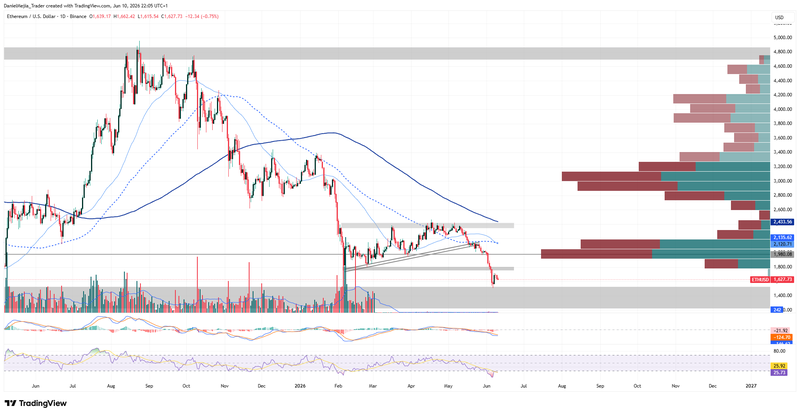
Figure 1. Ethereum Prices (2025–2026). Source: Data from the Binance Exchange; own analysis conducted via TradingView.


