
 Support
 Major central banks advance digital payments project; Bitcoin retreats
Led by the Bank for International Settlements (BIS), the Agora Project is expanding testing of its tokenised payment infrastructure alongside major monetary authorities to enhance cross-border payment efficiency. This advancing regulatory alternative continues to exert structural pressure on traditional cryptocurrencies, including Bitcoin, which subsequently retreated by 2% to trade at $74,298.

The initiative seeks to integrate tokenised central bank reserves with tokenised commercial bank deposits, drawing active participation from key jurisdictions, including the US, European countries, South Korea, Mexico, and Japan.
Central-bank-backed tokenised assets leverage institutional trust and robust regulatory certainty, presenting steep structural competition to decentralised crypto-assets.
Bitcoin’s 2% drop to $74,298 keeps the digital asset trading below its 200-day Simple Moving Average (SMA), reinforcing a prevailing bearish bias within its broader market structure.
Central Banks push tokenised payment infrastructure; Bitcoin retreats
According to reports from Reuters, a coalition of leading central banks and more than 40 global commercial banks are expanding testing for a major digital payments initiative known as "Agora Project". Led by the Bank for International Settlements (BIS) and supported by central banks from Europe, the United States, South Korea, Mexico, and Japan, the project aims to integrate tokenised central bank reserves with tokenised commercial bank deposits. This unified architecture is designed to make international payments faster, cheaper, and materially more efficient. Reuters further noted that participants have described initial prototype testing results as encouraging, and that the Bank of Canada would also join the project.
Crucially, while the Agora Project highlights the expanding structural utility of tokenised assets, it simultaneously introduces potent competition for established, decentralised cryptocurrencies such as Bitcoin and Ethereum. Financial instruments backed by central bank reserves offer international institutional investors enhanced transparency, systemic trust, and regulatory finality—attributes that could diminish the long-term utility and demand for decentralized alternatives. Consequently, the project could represent a relevant advancement in the development of Central Bank Digital Currencies (CBDCs) and unified ledgers, escalating both commercial competition and regulatory pressure within the broader cryptocurrency market.
In response to these developments, Bitcoin retreated by 2% to close at $74,298, with short-term price action exhibiting a steady amplification of selling pressure at the close of the session.
Technical analysis of Bitcoin
From a technical perspective, Bitcoin has recently challenged its long-term bullish structure. A closer inspection of the current market architecture reveals several key technical nuances:
- Trend Context: On longer timeframes, Bitcoin continues to trade beneath its 200-day Simple Moving Average (SMA), a technical positioning that reinforces a prevailing long-term bearish bias. In the short term, however, price action has returned to a well-defined consolidative range that has pinned the asset for approximately three months.
- Resistance Levels: Should immediate resistance near $83,000 be surpassed—a level where a vital short-term structural pivot point converges with the descending 200-day SMA—the next significant technical ceiling is identified at $96,000. A decisive weekly close above the $96,000 zone would invalidate the current macro-downtrend and imply the potential for substantially higher valuations.
- Support Levels: If primary structural support at $72,000 is compromised, the next critical floor is situated at the $60,000 mark, which serves as a prominent psychological barrier. A sustained move below this level would likely heighten the probability of a more profound market correction.
- Momentum Indicators: The Moving Average Convergence Divergence (MACD) is currently signalling a bearish crossover on the daily timeframe. Simultaneously, the Relative Strength Index (RSI) is mapping a downward structure characterized by a sequence of lower highs. In both instances, these momentum metrics suggest a potential short-term market retracement or an extended phase of range-bound consolidation.
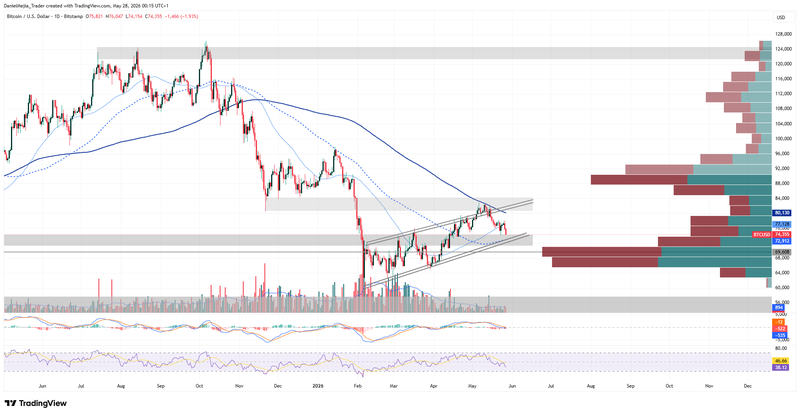
Figure 1. Bitcoin Prices (2025–2026). Source: Data from the Bitstamp Exchange; Own analysis conducted via TradingView.


