Support
 BOJ raises rates to 31-year high as weak yen keeps inflation risks alive
The Bank of Japan lifted rates to 1.25%, accelerating its normalization cycle even as inflation remains below 2% and the yen continues to trade near historically weak levels.

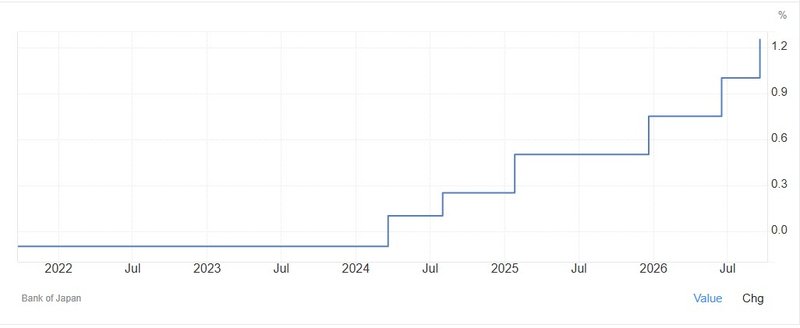
The BOJ raised its policy rate by 25 basis points to 1.25%, the highest level since 1995.
The decision passed 7-2, with Toichiro Asada and Ayano Sato dissenting in favor of keeping rates unchanged.
The hike came only three months after the previous move, compared with six-month intervals earlier in the cycle.
The yen weakened after the decision, trading around 156.6-157 per dollar, while the 10-year Japanese government bond yield fell toward 2.95%.
The BOJ is accelerating its exit from ultra-low rates
The Bank of Japan raised its benchmark interest rate by 25 basis points to 1.25%, taking borrowing costs to their highest level in 31 years and signaling that Japan's monetary normalization is moving into a faster phase.
Source: TradingEconomics
The decision was widely expected, but the timing remains significant.
Only three months have passed since the BOJ's previous increase. Earlier moves in the normalization cycle were typically separated by around six months.
That shortening of the interval suggests policymakers are becoming less comfortable with waiting for inflation risks to become visible in the headline data before responding.
The BOJ is increasingly acting on where it believes inflation is going rather than where it stands today.
Why did the BOJ hike when inflation is below 2%?
This is the most important question surrounding the decision.
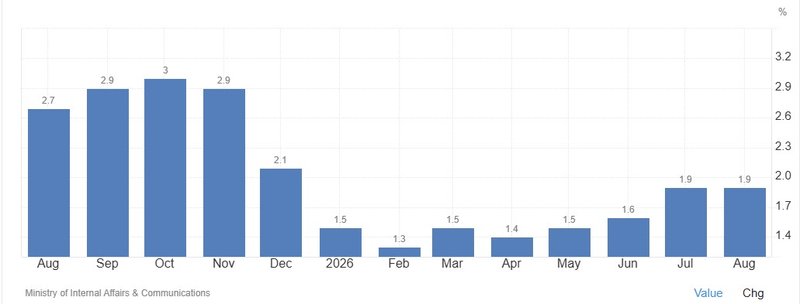
Japan's headline inflation rate stood at 1.9% in August, while core inflation eased to 1.7% from 1.8% in July.
Both readings are below the BOJ's 2% target.
Source: TradingEconomics
On the surface, that would normally argue against tighter monetary policy.
The central bank is looking beyond the current numbers.
Its concern is that inflation risks are increasingly skewed upward, particularly because of the historically weak yen and the possibility that higher import costs feed through into domestic prices.
Japan depends heavily on imported energy and raw materials. When the yen weakens, those imports become more expensive even if global commodity prices remain unchanged.
A renewed increase in oil or other raw-material prices would amplify that effect.
The BOJ is therefore trying to prevent another inflation upswing rather than waiting for one to appear fully in the data.
The pace of tightening is becoming the bigger story
The hike itself was almost entirely anticipated.
Nearly 90% of economists expected the BOJ to raise rates by a quarter point.
The more significant development is how quickly the bank is moving.
Japan began normalizing monetary policy in March 2024 after decades of extraordinarily loose settings. For much of that process, Governor Kazuo Ueda emphasized patience and gradualism.
The latest move suggests that gradualism remains intact, but the definition is changing.
A three-month interval between hikes means the BOJ is now willing to respond faster when inflation or currency risks justify it.
That raises a new question for markets: could 1.25% simply be another step rather than the end of the cycle?
Two dissents show the tightening debate is not settled
The vote was 7-2, with board members Toichiro Asada and Ayano Sato opposing the increase.
Both are generally associated with a more reflationary policy stance and were appointed earlier this year by Prime Minister Sanae Takaichi.
Their objections highlight the tension inside the BOJ.
Asada argued that with core inflation below 2%, economic conditions may not be strong enough to justify another increase.
Sato similarly argued that growth and inflation dynamics have not accelerated materially enough to warrant tighter policy.
Those concerns are important because Japan is tightening before current inflation has clearly moved above target.
The majority is effectively betting that the risks of waiting are greater than the risks of moving early.
Yen weakness remains the BOJ's biggest complication
The currency remains central to the inflation outlook.
USD/JPY traded around 156.64 shortly after the decision and later moved above 157, meaning the yen weakened even though the BOJ had just raised rates.
That reaction tells investors something important.
A 25-basis-point hike was already heavily priced into the market and, on its own, is not enough to reverse the structural pressure on the currency.
Japan still offers considerably lower interest rates than the United States.
That differential gives investors an incentive to hold dollar assets and continues to support carry trades funded in yen.
Unless markets believe Japanese rates will rise materially further, a single quarter-point move may provide little durable support for the currency.
Why did the yen weaken after a rate hike?
Currencies respond to changes in expectations rather than simply to whether rates rise or fall.
Markets were already almost certain the BOJ would increase rates to 1.25%.
That means the hike itself contained little new information.
The absence of a more aggressive signal can therefore be interpreted as relatively dovish.
If traders had positioned for hints of faster tightening, the lack of those signals would give them a reason to sell yen after the announcement.
This is a classic example of a market reaction being driven by the difference between the decision and expectations rather than by the decision alone.
The next move in USD/JPY will therefore depend more heavily on the expected path beyond 1.25%.
Japanese bond yields also fell
The 10-year Japanese government bond yield declined by roughly 5 basis points to around 2.95% after the decision.
Like the yen reaction, this suggests the market had already absorbed the immediate hike.
If investors had interpreted the decision as the beginning of an aggressive tightening cycle, longer-term yields would normally face stronger upward pressure.
Instead, the decline indicates that traders remain uncertain about how quickly the BOJ is prepared to go from here.
That makes Governor Ueda's guidance increasingly important.
A policy rate of 1.25% is historically high for modern Japan, but it is still low relative to rates in many other developed economies.
The terminal rate matters more than today's rate.
The BOJ is trying to prevent inflation from overshooting again
The central bank said its objective is to stabilize underlying inflation at around 2% and avoid a situation in which price pressures overshoot the target and damage the economy later.
That reveals a subtle shift in policy thinking.
For years, the BOJ's problem was generating enough inflation.
Now it is increasingly focused on controlling it.
This does not mean Japan has suddenly developed the same inflation problem as the United States or United Kingdom.
The starting point is very different.
But the combination of higher wages, currency weakness and imported inflation creates a risk that Japan's price environment becomes more persistent than policymakers previously expected.
The central bank would rather normalize gradually now than be forced into larger moves later.
Washington has become unusually involved in Japan's rate debate
The decision also comes after increasingly direct attention from U.S. officials.
Washington has encouraged Japan to pursue monetary and market policies capable of limiting excessive currency weakness.
That pressure gained importance after the United States joined Japan in coordinated yen-buying intervention earlier this year.
The underlying logic is straightforward.
Currency intervention can temporarily support the yen, but it cannot permanently overcome a wide interest-rate differential.
Higher Japanese rates address part of the fundamental cause of yen weakness.
This creates tension with Prime Minister Takaichi's preference for relatively accommodative monetary policy and expansionary fiscal settings.
The BOJ therefore finds itself balancing domestic economic concerns, currency stability and international pressure at the same time.
The 7-2 vote matters for future hikes
The dissenters may become more important if inflation continues softening.
If core inflation falls further below 2%, opposition to additional hikes could grow.
If the yen weakens materially or energy prices rise, the opposite could happen.
More board members may decide that waiting creates too much inflation risk.
The vote therefore gives markets a useful framework.
The BOJ has a clear majority willing to tighten pre-emptively, but there is still a meaningful bloc concerned that policy could be moving faster than domestic inflation justifies.
Future data will determine which camp gains influence.
The next question is whether the BOJ can hike again
A policy rate of 1.25% is unlikely to settle the debate.
The BOJ now needs to assess whether this level is enough to keep inflation around 2% while gradually reducing pressure on the yen.
Several variables will matter.
Services inflation will show whether price pressure is becoming more domestically generated.
Wage growth will determine whether companies can continue raising prices without crushing household demand.
Oil and import costs will influence headline inflation.
And USD/JPY will remain a crucial measure of whether the interest-rate gap with the United States is still creating excessive pressure on the currency.
If these factors remain inflationary, another rate increase becomes increasingly plausible.
Why the next BOJ move could matter more than the September hike
The September decision takes Japan's policy rate to 1.25%, its highest since 1995, but the market reaction suggests investors were prepared for it.
The yen weakened rather than strengthened.
Japanese government bond yields fell.
Both moves indicate that the debate has already shifted beyond today's decision.
The question now is whether the BOJ is approaching the end of normalization or entering a faster tightening phase.
The central bank has shortened the gap between hikes from six months to three, even with headline inflation at 1.9% and core inflation at 1.7%.
That tells markets the BOJ is increasingly focused on future inflation risk, particularly the danger posed by a weak yen.
If the currency remains under pressure and imported inflation rises again, 1.25% may not be enough.
The most important signal from this meeting is therefore not Japan's new interest rate.
It is that the BOJ appears increasingly willing to move before inflation forces it to.