Support
 ECB rate outlook: Eurozone inflation, French debt and rising bond yields
The European Central Bank is facing an increasingly difficult trade-off. Higher energy prices are pushing inflation further above target, but the resulting squeeze in households and businesses could weaken demand enough to reduce the need for additional rate hikes.

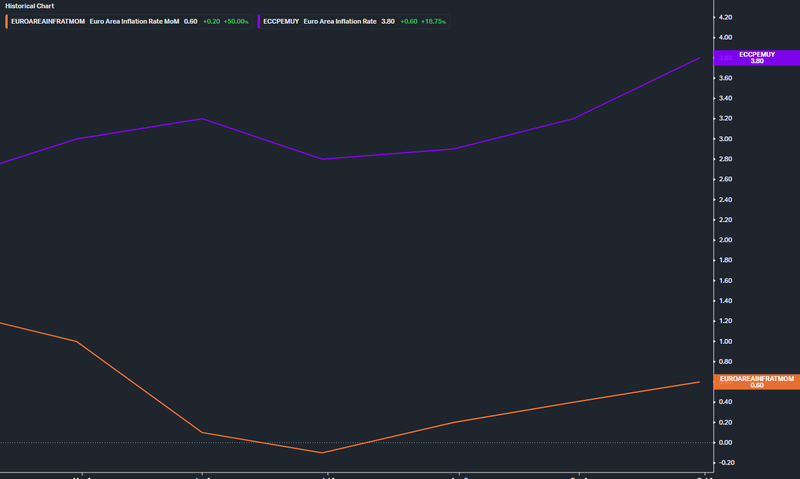
Inflation reached 3.8% in September, nearly double the ECB’s 2% target.
France is planning approximately €340 billion in bond issuance in 2027.
ECB must preserve the transmission of monetary policy without taking responsibility for national budget decisions.
Energy inflation could reduce the need for further tightening
Inflation reached 3.8% in September, nearly double the ECB’s 2% target, increasing pressure on policymakers to maintain a restrictive stance. Yet higher energy prices do not automatically justify further rate increases. They raise consumer prices directly while reducing households’ purchasing power and increasing businesses’ operating costs.
Higher interest rates cannot restore lost energy supplies or lower import costs. Their role is to limit the secondary effects, preventing higher energy prices from feeding into wages, services and longer-term inflation expectations.
ECB Philip Lane has acknowledged this interaction
He said that rising energy costs, higher market yields and declining fiscal support could weigh on economic growth, potentially reducing the need for additional tightening. If households cut spending and businesses struggle to pass higher costs on to consumers, demand could weaken enough to contain some of the inflationary pressure.
However, if inflation spreads beyond energy and becomes embedded in domestic prices, further tightening may be necessary. If weaker demand instead limits those second-round effects, another rate increase could place unnecessary pressure on an economy already absorbing higher costs.
Source: Koyfin
Rising bond yields are tightening financial conditions
The ECB is not the only force influencing borrowing costs. Government bond yields have risen as investors demand greater compensation for inflation uncertainty, increased debt issuance and the withdrawal of support associated with years of quantitative easing.
That matters because sovereign yields influence financing costs across the economy. Higher yields can feed into bank funding rates, corporate borrowing costs and investment decisions, tightening financial conditions even when the ECB leaves its policy rate unchanged.
Germany illustrates the pressure from rising debt supply
Planned federal sovereign issuance is expected to reach approximately €512 billion in 2026, up from €425 billion in 2025. The increase means investors must absorb more government debt, although gross issuance also covers refinancing rather than representing entirely new borrowing.
Greater supply can push yields higher if demand does not keep pace, but Germany has benefited from its status as the eurozone’s benchmark safe-haven market. During periods of uncertainty, investors have continued to favour German Bunds over debt issued by countries facing greater fiscal or political risks.
That divergence points to a more important development than the general rise in yields. Investors are increasingly distinguishing between governments according to their fiscal outlook, and France has come under pressure.
France’s fiscal outlook is widening the OAT-Bund spread
France’s borrowing costs are rising not only because interest rates are higher, but also because investors are demanding a larger premium for fiscal uncertainty. The deficit is expected to remain around 5.4% of GDP in 2026, above the government’s target, while parliamentary divisions have raised doubts about the durability of any budget consolidation.
Investors must assess whether the government can implement measures to control borrowing while maintaining sufficient political support. France is also planning approximately €340 billion in bond issuance in 2027, increasing the importance of restoring confidence in its financing outlook.
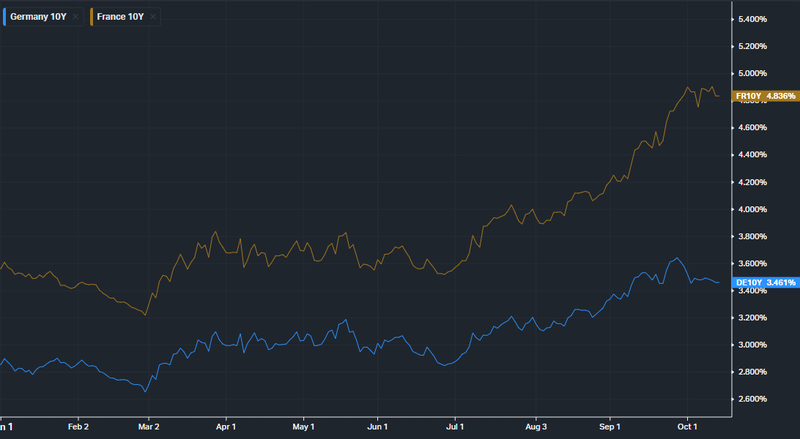
French 10-year government bond yields have approached 4.8%, their highest levels since 2002. Meanwhile, the spread between French OATs and German Bunds has widened towards 140 basis points, approaching levels last seen during the 2012 eurozone sovereign debt crisis.
Source: Koyfin
Could France’s problems spread across the eurozone?
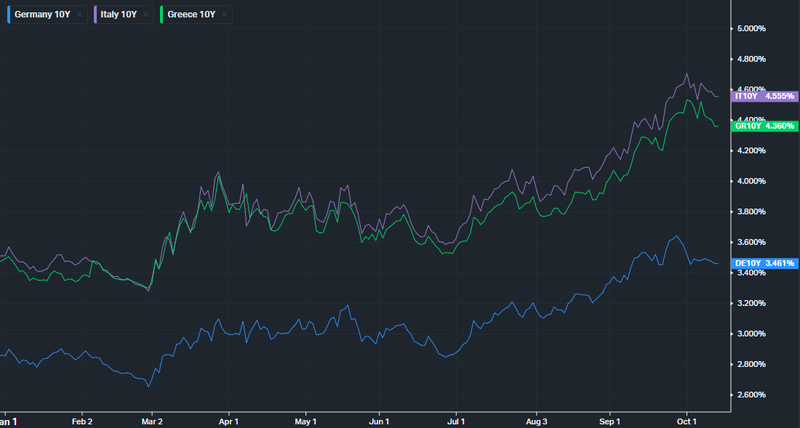
The pressure has not been limited to France. Italian and Greek government bond spreads have also widened; the risk extends beyond France through the close link between sovereign debt and domestic banks.
European banks hold substantial amounts of government bonds, meaning a sharp fall in their value can weaken bank balance sheets and, where losses are recognized, erode capital. Falling bond prices can also reduce the value of collateral banks use to secure funding, making it more expensive or difficult to borrow precisely when financial markets are under pressure. Banks may respond by restricting lending, transmitting sovereign stress to households and businesses.
The more dangerous development is the feedback loop this can create
If weakened banks require government guarantees or public capital, the cost of supporting the financial system adds to the state’s existing fiscal burden. Investors may then demand higher yields to compensate for the government’s deteriorating position, pushing bond prices lower and placing further pressure on banks holding that debt. This sovereign-bank link explains how a selloff initially concentrated in one country can spread through the eurozone, tightening credit conditions and complicating the ECB’s efforts to transmit a common monetary policy across the bloc.
Source: Koyfin
For the ECB the concern is monetary fragmentation
A single policy rate applies across the currency union, yet widening national risk premiums can leave businesses and households facing very different financing conditions. French borrowing costs could rise materially relative to German costs even without another ECB rate increase.
This complicates monetary policy. Higher yields may help restrain demand across the eurozone, but a disproportionate increase in borrowing costs in vulnerable countries can tighten conditions unevenly and weaken the transmission of the ECB’s decisions.
What will determine the ECB’s next move?
The ECB faces two competing pressures. Energy inflation could require further action if it spreads into underlying prices, but weaker demand and rising market yields may already be restraining the economy. At the same time, wider sovereign spreads are creating additional financing pressure that monetary policy cannot directly resolve.
If underlying inflation moderates as financial conditions tighten, the case for holding rates becomes stronger. If price pressures remain persistent, another increase may still be necessary despite weaker growth.
The decisive question is whether inflation is becoming entrenched or whether the combined effect of weaker demand and tighter financing conditions is already doing enough to bring it down. For the eurozone, the parallel question is whether France can restore fiscal credibility before higher borrowing costs begin to reinforce the very concerns driving its bond-market selloff.