Support

Fed holds rates as Kevin Warsh signals December hike without a clear commitment
The Federal Reserve held interest rates unchanged, but Kevin Warsh's confidence in economic growth and concern over persistent inflation strengthened expectations for another hike in December.
The Fed held its benchmark interest rate at 3.75%-4.00% in a 10-2 vote, with two policymakers favoring an immediate 25-basis-point increase.
Warsh highlighted stronger economic growth, robust investment and low jobless claims, suggesting the economy can absorb additional monetary tightening.
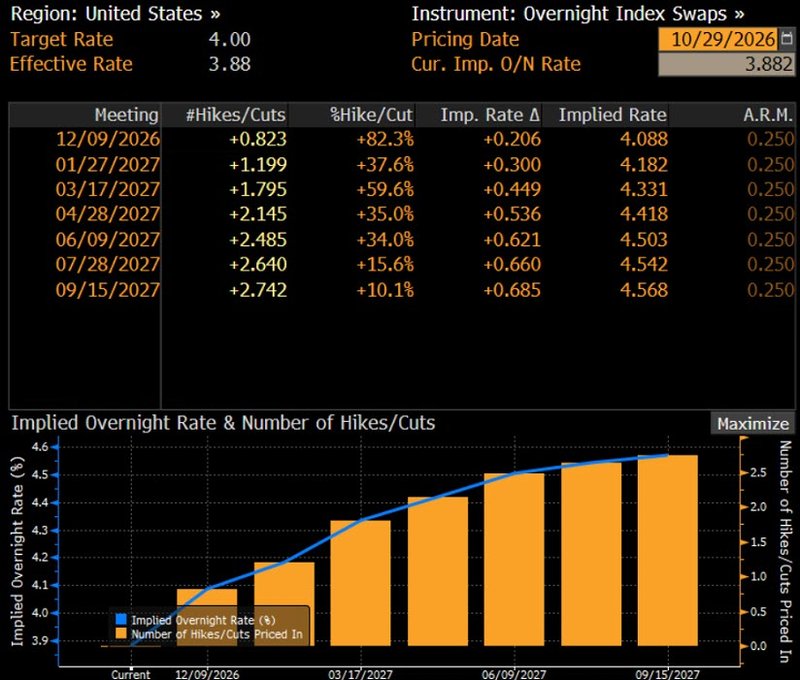
Investors continue to anticipate another Fed rate hike in December, with a further increase potentially following in early 2027.
The Fed chair acknowledged tighter financial conditions but stopped short of describing them as restrictive enough to slow economic activity.
Two-year Treasury yields fell to around 4.7% after the announcement, highlighting the gap between hawkish policy expectations and the market's immediate reaction.
The Fed's October pause leaves December firmly in play
The Federal Reserve kept interest rates unchanged on October 28, but Chair Kevin Warsh delivered a message that suggests the current pause may be temporary. While avoiding an explicit commitment to further tightening, his assessment of the US economy offered a strong indication that policymakers remain prepared to raise borrowing costs again before the end of 2026.
The Federal Open Market Committee voted 10-2 to maintain the federal funds target range at 3.75%-4.00%, following September's unanimous quarter-point increase, the first rate hike since 2023.
The distinction between the two meetings is important. September established the Fed's willingness to resume tightening, while October offered an opportunity to assess how the economy was responding. Warsh used that opportunity to emphasize stronger growth, resilient employment and inflation that remains above the central bank's 2% target.
His message effectively preserved the case for another increase without committing the committee to a particular date. That flexibility is central to Warsh's approach to monetary policy communication, which favors decisions based on incoming information over detailed forward guidance.
Strong growth gives the Fed room to focus on inflation
The strongest indication of Warsh's policy bias came from his description of economic conditions.
US GDP growth for the first half of 2026 has been revised upward to 2.4%, while third-quarter growth estimates are running above 3%. Business investment has expanded at a double-digit pace, productivity remains strong and initial unemployment claims are close to historical lows.
These figures suggest the economy has absorbed higher borrowing costs more effectively than many investors anticipated.
For the Fed, that resilience changes the balance of risks. When growth is slowing sharply and unemployment is rising, further rate increases become difficult to justify. With economic activity continuing to expand and hiring remaining relatively stable, policymakers have greater flexibility to prioritize inflation.
That helps explain why the October discussion focused primarily on price stability, even though the Fed's mandate also includes maximum employment.
Inflation has remained above the 2% objective for nearly six years, and the committee appears increasingly concerned that prolonged price pressures could become harder to reverse if policy remains insufficiently restrictive.
Warsh sees strong growth without necessarily seeing overheating
One of the more significant elements of Warsh's press conference was his refusal to equate stronger economic growth automatically with higher inflation.
That distinction matters because much of the current expansion is being supported by capital expenditure, particularly investment in artificial intelligence, technology infrastructure and productivity-enhancing equipment.
AI spending can initially create inflationary pressure by increasing demand for electricity, semiconductors, construction and computing infrastructure. Over time, however, successful investment could expand productive capacity and improve efficiency, allowing the economy to grow faster without generating equivalent increases in prices.
Warsh appeared willing to give that supply-side argument greater weight than a traditional interpretation in which strong GDP growth necessarily signals excessive demand.
The implication is that the Fed may tolerate stronger economic activity if productivity improvements are helping absorb demand pressures. Its concern is whether inflation remains persistent despite those gains.
This creates a more selective approach to monetary tightening. Policymakers want to restrain inflation while preserving the investment and hiring that could improve the economy's long-term productive capacity.
The 10-2 vote reveals a stronger tightening bias
The committee's voting pattern offers another indication of where policy may be heading.
Fed Governor Lisa Cook and Cleveland Fed President Beth Hammack dissented from the decision, preferring an immediate 25-basis-point increase.
Other officials who have expressed concern about inflation, including Dallas Fed President Lorie Logan and Minneapolis Fed President Neel Kashkari, supported the hold.
That does not necessarily indicate their concerns have diminished. Their willingness to pause may reflect confidence that the Fed can gather more evidence before tightening again.
This distinction is important when assessing December expectations. A committee can agree to wait at one meeting while still broadly supporting additional tightening over the following months.
Warsh also emphasized that the period before December would provide valuable new information about economic growth and inflation.
For investors, the resulting policy outlook remains relatively clear despite the absence of formal guidance: another increase is possible, and the incoming data must provide a convincing reason for the Fed to remain on hold.
Why Treasury yields fell despite the hawkish message
Financial markets delivered a mixed reaction to the decision.
The yield on the policy-sensitive two-year Treasury declined approximately four basis points to 4.7%, while longer-term yields moved slightly higher.
That response suggests some investors had expected a more forceful signal about immediate tightening. Warsh maintained a hawkish assessment of inflation but avoided endorsing a predetermined sequence of rate increases.
The divergence across maturities is also meaningful.
Short-term Treasury yields respond closely to expectations for the Fed's next decisions. Longer-term yields reflect additional factors, including inflation uncertainty, growth expectations and the compensation investors require for holding government debt.
A decline in two-year yields alongside modestly higher long-term yields can therefore reflect expectations for a measured tightening path rather than a rapid sequence of increases.
The distinction is especially relevant when longer-term borrowing costs are already elevated. Additional pressure on mortgage rates, corporate financing and Treasury yields could tighten financial conditions independently of further Fed action.
Financial conditions remain the critical uncertainty
Warsh acknowledged that financial conditions have tightened since September but declined to characterize them as sufficiently restrictive to threaten economic growth.
That assessment may become one of the most consequential judgments heading into December.
Higher Treasury yields and borrowing costs are already affecting refinancing decisions, housing affordability and the valuation of long-duration assets. Their economic impact often appears with a delay, creating the risk that monetary policy becomes more restrictive before the effects of earlier tightening are fully visible.
The Fed's challenge is determining how much additional restraint the economy actually needs.
If inflation remains elevated while growth continues above 3%, another hike becomes easier to justify. If financial conditions begin weighing more heavily on consumption, credit availability or employment, the argument for additional tightening weakens.
Warsh's confidence in the economy suggests he currently sees sufficient capacity to withstand further policy adjustments. The next set of data will test that assumption.
What could change the December Fed rate hike outlook?
Interest-rate futures continue to point toward a potential increase in December 2026, followed by another move around March 2027. Some economists consequently expect two additional quarter-point hikes, effectively reversing the rate reductions delivered in late 2025.
The December decision will depend on whether inflation provides evidence of sustained improvement and whether growth remains resilient.
Source: Bloomberg
Another strong inflation report, particularly one showing persistent services or underlying price pressures, would reinforce the case for tightening. Continued strength in business investment and employment would give policymakers greater confidence that the economy can absorb higher rates.
Conversely, softer inflation combined with weakening labor-market indicators or a further tightening in credit conditions could justify extending the pause.
This makes the upcoming economic releases particularly important. The Fed has deliberately preserved flexibility, leaving financial markets to reassess the policy path as new information arrives.
Why December may matter more than the October decision
The October Fed meeting was primarily about preserving policy flexibility while maintaining inflation-fighting credibility.
Warsh offered no explicit promise of another hike, but his economic assessment made clear that the central bank considers its work unfinished. Strong growth and resilient investment have reduced the urgency to support employment, while persistent inflation continues to justify a restrictive policy stance.
The most important analytical distinction is that the Fed appears increasingly comfortable with stronger growth if productivity is improving alongside it. That allows policymakers to pursue price stability without treating every acceleration in economic activity as evidence of overheating.
The risk is whether existing financial tightening eventually begins affecting the economy more severely than current data suggest.
For now, the December meeting remains the key policy event. Unless incoming inflation figures improve convincingly or economic activity deteriorates, the balance of the Fed's communication continues to favor another increase.
Warsh has avoided telling investors exactly what the committee will do next. His description of the economy, however, has made the conditions for another rate hike increasingly clear.