Support
Gold rally finds stronger support as ETF buying returns
Gold is attracting buyers again, but the bigger story is where the money comes from. The metal climbed to $4,641 on August 24, its highest level in more than three months, while precious-metals funds pulled in more than $4.5 billion during the week. That came even as the world's largest gold ETF briefly lost much of a billion-dollar inflow only a day after receiving it.

Gold climbed to $4,641, its highest level in over three months.
Precious metals funds attracted more than $4.5 billion during the week.
GLD briefly lost about three-quarters of a $1 billion inflow before buyers returned.
ETF money is coming back but not quietly
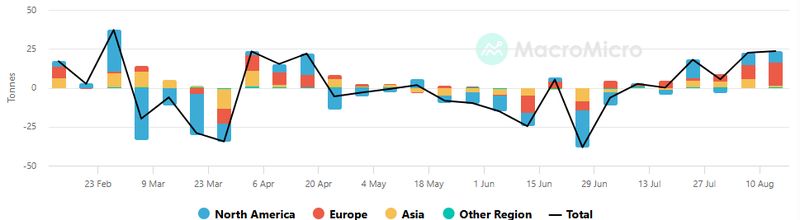
The strongest signal came from weekly fund flows rather than a single trading session. Precious metals funds attracted more than $4.5 billion during the week, accounting for almost all the $4.9 billion that moved into commodity funds. That is a noticeable change after months when investors were far more comfortable putting fresh money into equities than defensive assets.
The shift suggests investors are beginning to rebuild gold exposure without abandoning risk assets altogether. Instead of treating gold as an emergency hedge, many appear to be bringing it back into portfolios while uncertainty around interest rates, fiscal policy and global growth continues to build.
Source: MacroMicro
GLD's whipsaw showed how active this market has become
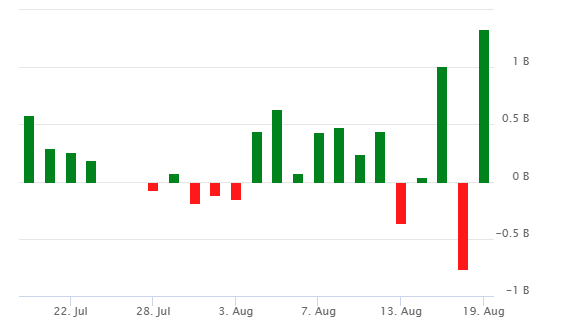
The biggest surprise came inside the week's strongest buying. SPDR Gold Shares (GLD) attracted nearly $1 billion on August 17, only to give back roughly three-quarters of that amount through redemptions the following day. On paper, that looks like hesitation.
The broader picture looks different
The reversal did not stop the week's overall inflow from remaining exceptionally strong, which suggests the selling looked more like profit-taking or position adjustments than a broad retreat from gold. Large funds often see that kind of activity when traders reposition around major macro events, especially after a strong move in price.
Source: ETFdb
Gold is pulling ahead of the broader commodity trade
Energy markets remain tied to geopolitical risks and supply disruptions, while industrial metals continue responding to questions around global growth. Gold has started following a different path, supported by renewed ETF demand, central-bank buying and growing doubts about long-term debt markets.
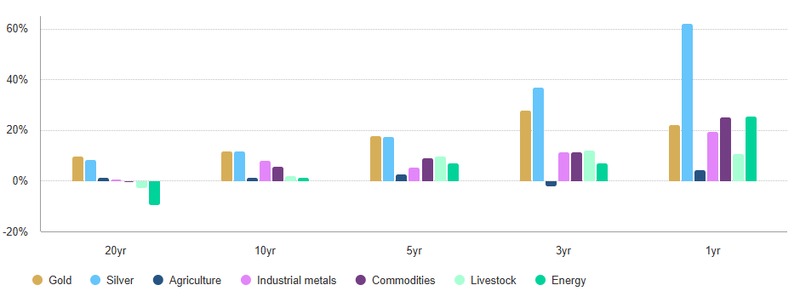
That helps explain why the metal has outperformed much of the commodity complex across multiple investment horizons. Over the past 3, 5, 10 and 20 years, gold has beaten not only broad commodity indices but also most of their sub-indices.
It has also continued delivering positive long-term returns through very different economic environments, from periods of strong growth to inflation shocks and market downturns. That record is one reason many investors are treating gold less as a tactical trade and more as a long-term portfolio anchor when uncertainty begins to build.
Source: World Gold Council
Why Treasury yields still matter
The bond market has become one of gold's biggest tailwinds again. Washington's decision to expand long-dated Treasury buybacks pulled yields lower and changed the mood across the market almost immediately. Investors did not just buy more gold, they also poured fresh money into gold ETFs, helping drive one of the strongest weeks of inflows the sector has seen this year.
That does not guarantee the rally continues its own
But it does make gold easier to own. If real yields stop climbing while Washington keeps looking for ways to manage borrowing costs, investors have another reason to keep adding exposure to the metal rather than waiting on the sidelines.
The bigger trend is becoming harder to ignore
Gold has now outperformed the broader commodity complex across several investment horizons, and that leadership is becoming more noticeable as money returns to ETFs.
The latest rally is not relying on a single catalyst. Central-bank demand remains firm, fund flows have turned positive again, and the bond market continues giving investors reasons to look beyond traditional safe assets.
For now, that combination is keeping buyers engaged even after a sharp move higher. The bigger question is no longer whether gold can attract fresh capital. It is whether those flows continue building as investors reassess where they want to hide when confidence in bonds and fiscal policy becomes less certain.