
 Support
 Japan likely sold Treasuries to fund record yen intervention
Japan’s record yen intervention appears to have been financed partly through sales of foreign securities, most likely short-dated U.S. Treasuries.

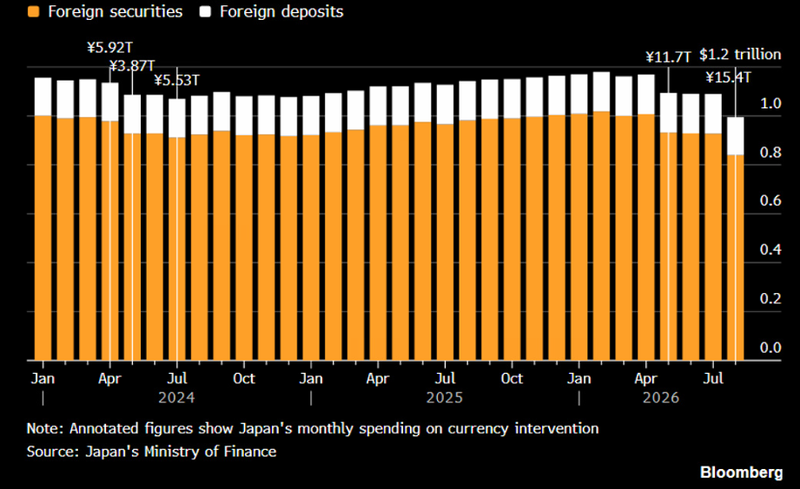
Japan’s foreign securities holdings fell by a record $87.8 billion in August.
Authorities spent about ¥15.4 trillion, or $98.6 billion, intervening to support the yen through August 26.
Japan’s total foreign-currency reserves fell $94.6 billion to $995 billion at the end of August.
Japan could also access up to $60 billion per day through the FIMA Repo Facility if it wants to intervene without selling Treasuries.
Japan’s reserve data points to Treasury sales
Japan likely sold part of its U.S. Treasury portfolio to finance the largest currency intervention campaign in its history.
Foreign securities held in Japan’s reserves fell by $87.8 billion in August, the biggest monthly decline on record. The scale of that drop closely matches the roughly $98.6 billion authorities spent buying yen during the month through August 26.
Source: Bloomberg
The Finance Ministry has acknowledged that intervention contributed to the decline in reserves, although it has not confirmed which securities were sold.
The numbers nonetheless point strongly toward U.S. Treasuries. Japan holds one of the world’s largest foreign reserve portfolios, and market estimates suggest approximately 70% of those reserves are invested in Treasury securities.
The important question for bond markets is not simply whether Japan sold Treasuries. It is which maturities were sold.
Short-dated Treasuries were the most likely source of cash
Reserve managers generally prefer highly liquid securities that can be converted into cash quickly without creating large market moves.
That makes short-term Treasuries the most logical assets to sell first.
Market participants expect Japan to have focused on securities with maturities of five years or less, rather than 10-year or 30-year bonds. Short-dated government debt offers considerably greater liquidity and is already a natural part of central-bank reserve portfolios.
That choice would also reduce the potential impact on U.S. long-term borrowing costs.
This matters because Washington has become increasingly sensitive to upward pressure on longer-dated Treasury yields. Selling large amounts of 10-year or 30-year bonds while U.S. policymakers are trying to stabilize the long end of the curve could have created an awkward conflict between Japan’s currency objectives and American debt-management priorities.
Concentrating sales at shorter maturities offers Japan access to dollars while reducing that risk.
The scale of the yen intervention was unprecedented
Japan spent approximately ¥15.4 trillion, equivalent to $98.6 billion, supporting the yen during the month through August 26.
That was the largest monthly intervention on record.
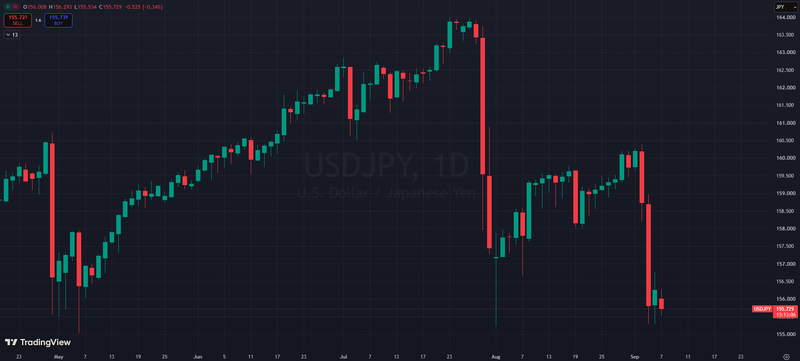
The operation followed a sharp deterioration in the currency that eventually brought USD/JPY close to four-decade extremes. The United States also participated in the campaign at the end of July, joining Japan in buying yen on July 31 for the first coordinated intervention between the two countries since 1998.
The joint action helped establish that Washington was broadly aligned with Tokyo on the need to prevent a disorderly currency decline.
But intervention on this scale creates a financing issue.
Japan must obtain foreign currency to buy yen. Selling reserve assets is one of the most straightforward ways to do it.
August’s reserve data now provides evidence that this mechanism was probably used extensively.
Japan still has almost $1 trillion in foreign-currency reserves
Despite the size of the intervention, Japan retains substantial financial firepower.
Total foreign-currency reserves fell by $94.6 billion to $995 billion at the end of August. Foreign-currency deposits, another possible source of intervention funding, declined by $6.9 billion.
The remaining reserve stock means Japan has significant capacity to intervene again if yen volatility returns.
The constraint is therefore not simply whether Tokyo has enough reserves.
The more difficult issue is how those reserves can be mobilized without creating unwanted pressure elsewhere in global markets.
Repeatedly selling Treasuries becomes more complicated if U.S. officials are simultaneously trying to contain long-term yields.
That creates an increasingly important link between Japanese currency intervention and the U.S. bond market.
Why Washington cares about how Japan funds intervention
The United States supported Japan’s yen intervention, but it also has a strong interest in preserving stability in the Treasury market.
Treasury Secretary Scott Bessent recently expanded buybacks of longer-dated U.S. debt, doubling purchases for two months through November 4.
Those operations are aimed partly at improving liquidity and reducing pressure in the long end of the curve.
That makes the maturity profile of Japanese Treasury sales particularly important.
Selling short-dated bonds is relatively manageable because the market is highly liquid and the direct impact on long-term yields should be limited.
Large sales of longer-duration bonds would be more sensitive. They could put upward pressure on yields at exactly the point where U.S. borrowing costs have already become a major market concern.
Japan therefore has an incentive to structure any future Treasury sales carefully.
FIMA gives Japan another option
Japan does not necessarily need to sell Treasuries every time it intervenes.
Authorities can potentially use the Federal Reserve’s Foreign and International Monetary Authorities Repo Facility, known as FIMA.
The facility allows foreign central banks and monetary authorities to temporarily pledge U.S. Treasury securities to the Fed in exchange for dollars.
For Japan, this could provide up to $60 billion per day without requiring outright Treasury sales.
That makes FIMA attractive in theory. Japan could obtain the dollars needed for intervention while avoiding pressure on Treasury prices and yields.
There is one important limitation.
Japan has never used the facility.
That lack of precedent may make policymakers reluctant to rely on it during a fast-moving currency episode. For now, references to FIMA may therefore be more useful as a signal that Japan possesses additional intervention capacity than as evidence that authorities are preparing to use it immediately.
Still, the facility becomes increasingly relevant if Tokyo needs to defend the yen again while Washington becomes more sensitive to Treasury sales.
The yen’s rebound reduces the immediate need for action
Currency markets have recently moved in Japan’s favor.
The yen strengthened from around 160.39 per dollar on Wednesday to as high as 155.30 on Friday, before trading near 155.96 on Monday afternoon in Tokyo.
That move reduces the immediate probability of another large intervention.
It also gives authorities time to see whether monetary policy can take over some of the burden.
Markets are now fully pricing a Bank of Japan rate hike in September, while some investors have started considering whether the central bank could accelerate the pace of tightening afterward.
That matters because interest-rate policy offers a more durable solution to currency weakness than repeated reserve sales.
Intervention can interrupt momentum.
A narrower interest-rate differential can change the underlying incentive to sell yen.
Source: Tradingview
BOJ tightening could reduce the need to sell reserves
The BOJ has become increasingly concerned about upside inflation risks, including persistent service-sector inflation, higher import costs and the impact of a weak currency.
A September rate increase would help address several of those issues simultaneously.
Higher Japanese rates make yen assets more attractive, reduce some of the incentive behind carry trades and provide support for the currency without requiring the Finance Ministry to keep spending tens of billions of dollars in the foreign-exchange market.
This is especially important after authorities used almost $100 billion in a single month.
Japan still has substantial reserves, but repeated intervention is not an efficient long-term substitute for monetary-policy adjustment.
If the BOJ delivers the rate path markets currently expect, the pressure on reserve assets may begin to ease.
If the central bank disappoints and the yen returns toward 160 or weaker, Treasury sales could quickly become relevant again.
Are Japan’s Treasury sales a threat to U.S. yields?
For now, the evidence does not suggest that Japan’s intervention created a major problem for the U.S. bond market.
The most likely explanation is that Tokyo concentrated its sales in short-dated Treasuries, where liquidity is deepest and the impact on long-term yields is smallest.
That approach allows Japan to defend the yen without directly challenging U.S. efforts to contain borrowing costs further out the curve.
The larger issue is what happens if intervention becomes persistent.
Japan’s foreign-currency reserves have already fallen to $995 billion, foreign securities dropped by a record $87.8 billion, and authorities spent almost $99 billion supporting the currency in only one month.
Japan clearly has enough resources to act again.
But the more often it needs to do so, the more important the funding method becomes.
If BOJ tightening succeeds in stabilizing the yen, August’s Treasury sales may prove to be an unusually large one-off adjustment.
If the currency resumes its decline, Tokyo may eventually have to choose between selling more Treasuries, drawing down deposits or making greater use of FIMA.
That is when yen intervention could become a much bigger story for the U.S. bond market.


