
 Support
SpaceX IPO retail orders top $100 billion as record listing reshapes private markets
Retail investors have submitted more than $100 billion in orders for SpaceX shares, highlighting the extraordinary demand behind what could become the largest IPO in history. The company is seeking to raise about $75 billion at a valuation near $1.8 trillion, while the listing is also set to unlock billions for early backers and reset valuation benchmarks across private technology markets.
Retail orders for SpaceX IPO shares have topped $100 billion.
SpaceX is expected to allocate at least 20% of available shares to retail investors.
The IPO targets a $75 billion raise at $135 per share.
SpaceX could list at a valuation near $1.8 trillion under the ticker SPCX.
SpaceX IPO retail demand crosses $100 billion
Retail demand for the SpaceX IPO has surged past $100 billion, underscoring the scale of investor interest in Elon Musk’s rocket, satellite and artificial-intelligence company before its Nasdaq debut.
The figure rose from more than $70 billion earlier in the same day as orders continued building during the marketing period. The total includes domestic and international retail demand, making individual investors one of the most important forces behind the deal.
SpaceX is expected to allocate at least 20% of the available IPO shares to retail investors. But with the company targeting a $75 billion offering, the retail allocation will still fall far short of demand. In practical terms, many individual investors are likely to receive only a small portion of what they requested, while others may receive no shares at all.
That imbalance could matter once trading begins. Unfilled retail demand may create additional buying pressure in the open market, especially if investors who missed out on IPO allocations rush to buy the stock after listing.
SpaceX IPO terms: price, shares and valuation
SpaceX is expected to sell 555.6 million shares at $135 each, raising about $75 billion. Based on the outstanding shares in its filings, the deal would value the company at around $1.8 trillion.
The offering terms, including the $135 share price and the 555.6 million shares, are not expected to change materially. The company is preparing to trade on Nasdaq and Nasdaq Texas under the ticker symbol SPCX.
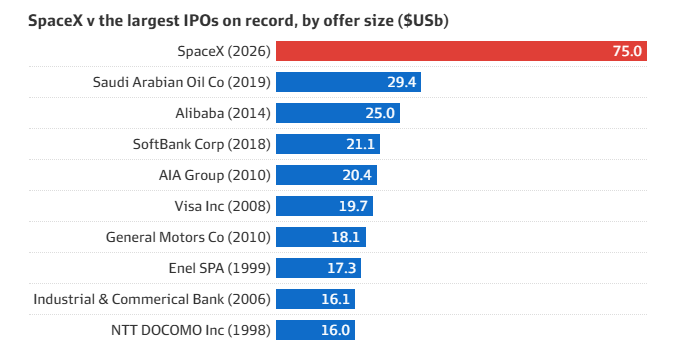
If completed at the planned size, SpaceX would become the largest IPO ever, surpassing Saudi Aramco’s $29.4 billion listing in 2019 by a wide margin.
Source: Financial Review, Bloomberg
The institutional order book was expected to close on Wednesday, with pricing planned for later Thursday and trading expected Friday.
Institutions and sovereign funds compete for shares
Retail investors are not the only source of demand.
SpaceX has received orders from about 1,000 institutional investors. Several large institutions, including sovereign wealth funds, are expected to receive allocations of more than $1 billion each.
Saudi Arabia’s Public Investment Fund and Kuwait Investment Authority have placed sizable orders, while Qatar Investment Authority is also expected to make a significant commitment.
International allocation remains limited. SpaceX is expected to allocate less than 10% of IPO shares to international orders, although Japan’s allocation was increased earlier this month to $2.5 billion from $2 billion.
That mix of strong domestic retail demand, large sovereign interest and limited international supply makes the allocation process one of the most closely watched parts of the IPO.
Musk’s retail investor base becomes a major force
The retail frenzy around SpaceX reflects the strength of Elon Musk’s investor following.
Tesla has long had one of the most loyal retail shareholder bases in the market, with individual investors estimated to own about 40% of the company’s shares. SpaceX is now drawing from the same culture of enthusiasm, long-term belief and willingness to buy into Musk-led technology stories.
The company’s appeal goes beyond rockets. Retail investors are buying exposure to Starlink, satellite communications, artificial intelligence, data centers, defense contracts and the long-term vision of commercial space.
That is why the SpaceX IPO is being treated less like a traditional aerospace listing and more like a mega-cap technology event.
SpaceX IPO could mint billions for early investors
The IPO is also a massive wealth event for early backers and private-market investors.
SpaceX has raised more than $9 billion in venture funding over the last 24 years. Its public listing is expected to return billions of dollars to venture funds, employees, early investors and private-market vehicles that gained exposure before the company reached public markets.
Some of the numbers are extraordinary. One early space-focused investor first bought into SpaceX in 2017 at a valuation of roughly $25 billion and invested 13 more times. That position is expected to return well over $1 billion to investors.
Valor Equity Partners, which invested in SpaceX in 2008, owns about 4% of the company, worth almost $70 billion at $135 a share. Founders Fund holds roughly 3%, valued at more than $50 billion at the IPO price. Sequoia Capital is also set to reap tens of billions from a stake of nearly 1.5%.
These gains will not all turn into immediate cash because lockups will limit when investors can sell. But the listing creates one of the largest liquidity events the venture market has seen in years.
Private markets get a long-awaited liquidity event
The SpaceX IPO comes after a long dry spell for venture-backed technology listings.
Only 23 venture-backed tech companies went public in 2025, compared with 77 four years earlier. That slowdown has left venture funds and private investors short of distributions, making it harder to return capital and raise new funds.
SpaceX could change that.
As shares are distributed and lockups begin to expire, capital from the IPO may flow back into venture funds, space-tech startups and late-stage private companies. Funds that backed SpaceX early could use the gains to strengthen their position in the next funding cycle.
Venture fundraising has been under pressure since peaking at $413 billion in 2022. A successful SpaceX listing would not fix the market overnight, but it could provide a fresh source of liquidity and confidence.
Space-tech startups may benefit from the IPO
SpaceX has also helped turn space technology into a serious investment category.
US space-tech companies received about $260 million in venture investment in 2015. By mid-May this year, that figure had reached $5.1 billion, showing how far the sector has moved from niche funding to mainstream venture interest.
Investors are already positioning for the next wave. Satellite startup Starcloud is reportedly closing a funding round of $200 million or more at a $2 billion pre-money valuation, double its previous value.
Former SpaceX employees may also become an important source of new startups. Venture investors are actively targeting companies created by current and former SpaceX staff, expecting the IPO to create both capital and talent spillovers across the space economy.
SpaceX sets the benchmark for OpenAI and Anthropic
The SpaceX IPO is not happening in isolation.
OpenAI and Anthropic have also moved toward public listings, creating a potential IPO pipeline that could add about $3.6 trillion in market value to US exchanges. SpaceX’s trading performance could influence how investors price those future deals.
Current valuation benchmarks are already massive. SpaceX is targeting around $1.765 trillion, compared with Saudi Aramco’s roughly $1.706 trillion valuation at its listing. Anthropic has been valued around $965 billion, OpenAI around $852 billion, and Alibaba listed at about $168 billion.
That makes SpaceX a test case for the next generation of mega-IPOs. If the stock performs well, private investors may feel more comfortable pushing high valuations for AI leaders. If it struggles, pricing expectations for OpenAI, Anthropic and other late-stage firms may need to come down.
SPVs and private-market access face a credibility test
The SpaceX listing also matters for investors who bought exposure through special purpose vehicles, or SPVs.
Demand for privately held SpaceX shares has fueled a rush into SPVs in recent months. Some of these vehicles may deliver strong returns if they hold real shares at favorable prices. Others may carry higher fees, limited transparency or complex terms that make outcomes less attractive.
A strong SpaceX debut could validate parts of the SPV market by showing that private access to elite companies can produce major gains. But it could also encourage investors to chase similar structures in future deals without fully understanding the risks.
History argues for caution. Meta, then known as Facebook, raised $16 billion in its 2012 IPO but struggled after listing, cooling the market for major technology IPOs for more than a year.
SpaceX valuation remains the central risk
The biggest question around SpaceX is not demand. Demand is clearly strong.
The real question is whether a valuation near $1.8 trillion can hold in public trading. SpaceX is targeting valuation multiples that are extremely high for a company of this scale, above even some of the richest software and AI-linked public-market benchmarks.
That leaves little margin for error.
Investors will be watching Starlink growth, AI revenue, data-center ambitions, launch economics, capital spending, government contracts and profitability. Any disappointment could pressure the stock and affect sentiment toward the entire mega-IPO pipeline.


