Support
The ECB is buying time as lending returns and inflation stays uncomfortable
The European Central Bank has reached an uncomfortable point. The economy is still losing momentum in places, but inflation is refusing to cool fast enough to give policymakers much room to relax. That is why markets have become far more confident than the ECB's own communication suggests, with traders now pricing roughly 98% chance of another rate hike in September.
Europe corporate lending accelerated to 4.4% in July from 4.0%.
Markets now show a 98% chance of a September rate hike.
Latest minutes showed every policymaker backed holding rates in July, but several still saw more tightening coming.
Inflation risks remain tied to energy, supply chains and geopolitical tensions.
Credit is still flowing despite higher rates
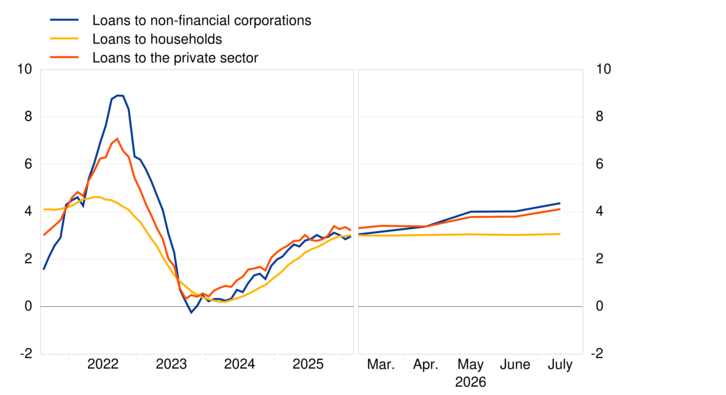
One number changed the conversation. Corporate lending picked up instead of slowing after June's rate hike. Loans to businesses grew 4.4% in July, suggesting companies are still willing to borrow despite noticeably higher financing costs.
Normally, tighter policy starts showing up through weaker credit demand. Instead, businesses continue spending on manufacturing, supply-chain investment and energy-related projects, making it harder to argue that higher rates are already cooling the economy enough. For the ECB, that weakens the case for waiting.
Source: ECB
The minutes showed more confidence than caution
The July meeting looked unanimous from the outside. Inside the room, the tone was firmer.
Everyone agreed to leave rates unchanged, but the minutes revealed that several policymakers were already comfortable with tightening again. The discussion was less about whether inflation remained too high and more about whether another meeting would materially improve the outlook.
Officials kept coming back to the same risks: energy prices, supply-chain disruption, the Middle East and the war in Ukraine. At the same time, they deliberately avoided tying those concerns to a September decision. Markets did that for them.
Schnabel and Cipollone are looking at different risks
The divide inside the Governing Council has become easier to read through two voices. Isabel Schnabel is looking at an economy that is holding up better than expected. Stronger activity and fresh supply risks make it harder, in her view, to assume inflation will drift back to target without more restraint.
Piero Cipollone is looking at what happens if the ECB pushes too far. His concern is that another round of tightening could start weighing on productivity and investment before inflation has fully come under control.
Neither side is arguing over the destination
They are arguing over how much pressure the economy can still absorb. The ECB's own forecasts explain why the debate is not over the central bank expects headline inflation to average around 3.0% this year before easing to 2.3% in 2027 and finally reaching 2.0% in 2028. That is progress. It is just not fast enough to make policymakers comfortable today.
If inflation is expected to stay above target for another two years, every strong lending report or resilient growth number makes another rate hike easier to defend.
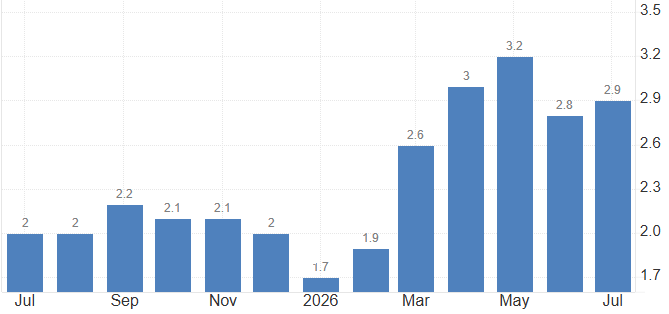
Source: EUROSTAT
Europe's bond market is making Frankfurt's job harder
The pressure is not coming only from inflation anymore. Europe's bond market has become part of the tightening story.
The UK's 10-year gilt has climbed above 5%, its highest level since 2008. Germany's 10-year Bund recently touched a 15-year high, while France's borrowing costs have risen to their highest levels since 2009 as investors become increasingly uneasy about widening deficits and political uncertainty.
That changes the backdrop for Frankfurt
The ECB is trying to tighten financial conditions through policy rates, but markets are already demanding higher returns to lend to governments. Unlike the years of quantitative easing, investors are no longer treating sovereign debt as an asset that automatically deserves low yields. That means borrowing costs are tightening across Europe before the next ECB decision has even arrived.
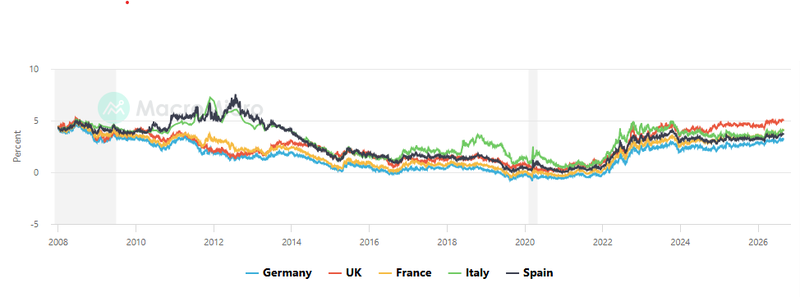
Source: MacroMicro
September looks priced in. The next question is what comes after
With markets assigning roughly a 98% chance to another hike, September itself is no longer the biggest uncertainty. The real debate is whether that move would mark the end of the tightening cycle or another step in a longer fight against inflation.
The answer is well beyond the ECB
It will shape the euro, corporate borrowing costs and investor confidence across European markets. More importantly, it will determine whether the ECB can finally convince markets that inflation is moving toward its end or whether this cycle still has another chapter left.
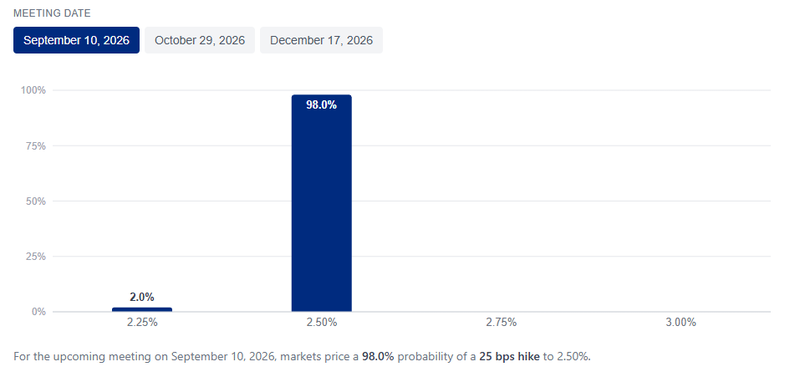
Source: ECB-watch