
 Support
Anthropic surges after solid IPO; Palo Alto beats; Australia unemployment rises
Anthropic achieved a record $81.3 billion IPO debut and Palo Alto Networks shares jumped after beating quarterly revenue and earnings expectations. Meanwhile, Australia's unemployment rate hit a five-year high of 4.9%.

Anthropic shares closed up 17% at $97.17 after raising $81.3 billion in its IPO debut.
Anthropic reported 1,200% nine-month revenue growth, reaching $33.24 billion amid strong AI demand.
Palo Alto shares rose 6.44% as earnings beat estimates and the firm announced a $4.5 billion AI security acquisition.
The Australian unemployment rate rose to 4.9%, weighing on the Australian dollar and complicating RBA monetary policy.
Date: 20 November 2026 (GMT+3)
Anthropic achieves record IPO as shares surge above offer price
Anthropic launched its initial public offering (IPO) to considerable success, marking the largest market debut in history. The company raised $81.3 billion through share issuance (excluding option contracts), a figure that could increase to as much as $93.5 billion if over-allotment options are exercised, according to a Reuters report.
Against this backdrop, Anthropic priced its IPO at $83 per share, exceeding the $70–$78 range indicated in its prospectus. Subsequently, the shares opened at $111.50 in today's market session, reaching the $2 trillion mark during intraday trading. However, the stock closed at $97.17, representing a 17% increase over the offer price and an approximate market capitalisation of $1.7 trillion.
Crucially, Anthropic reported revenue of $33.24 billion for the nine months ended 30 September 2026, signalling 1,200% growth compared with the same period last year, as cited by CNBC. This demonstrates substantial sales expansion for Anthropic, as its artificial intelligence (AI) products have enabled the company to capture significant market share.
Nevertheless, analysts highlight risks given that the firm's operating income remains in negative territory, which could weigh on the shares as market scrutiny of AI intensifies.
Palo Alto's shares jump as the firm exceeds analysts' expectations in quarterly report
Palo Alto Networks (PANW) surpassed analysts' expectations in its quarterly earnings report on both total revenue and earnings per share (EPS). Consequently, the company's shares surged by 6.44% to $361.81 at market close.
The software giant posted revenue of $3.44 billion, exceeding the market consensus estimate of $3.31 billion. In turn, the firm reported EPS of $1.05, beating expectations of $0.97. These results imply a year-on-year (YoY) revenue growth rate of 39% alongside an annual increase of 12.90% on EPS. Furthermore, Palo Alto raised its full-year guidance above analysts' estimates.
Notably, the firm reported a significant increase in spending on cybersecurity products alongside a start-up acquisition aimed at reinforcing its segment for securing open-weight artificial intelligence models. In this context, Palo Alto announced a deal valued at approximately $4.5 billion to acquire Applied Compute, as cited by CNBC. This emphasises the company's objective to expand its cybersecurity segment as AI models reveal rising vulnerabilities across private and public internet networks.
Australia's unemployment rate rises above expectations and reaches its highest level in five years
According to data released by the Australian Bureau of Statistics, the unemployment rate increased from 4.7% in September to 4.9% in October, surpassing analysts' estimates of 4.7%. Notably, this represents the highest level since October 2021, when the jobless rate rose to 5.2%. Additionally, the employment change indicator recorded a contraction of 43,500 positions, with part-time employment accounting for the largest drawdown at 40,600 jobs.
Consequently, the Australian dollar depreciated sharply against the US dollar amid expectations that the Reserve Bank of Australia (RBA) could adopt a less restrictive monetary policy stance as labour market conditions deteriorate. At market close, the AUD/USD pair fell by 0.83% to $0.6659.
The RBA faces a complex scenario amid an elevated headline inflation rate (currently at 4.3%), multi-year high unemployment, and a gross domestic product (GDP) growth rate that has decelerated over the past two quarters—with Q2 2026 GDP advancing by 0.4%. This leaves limited room for manoeuvre for the Australian central bank, which has raised its benchmark interest rate from 3.6% to 4.85% during the current year.
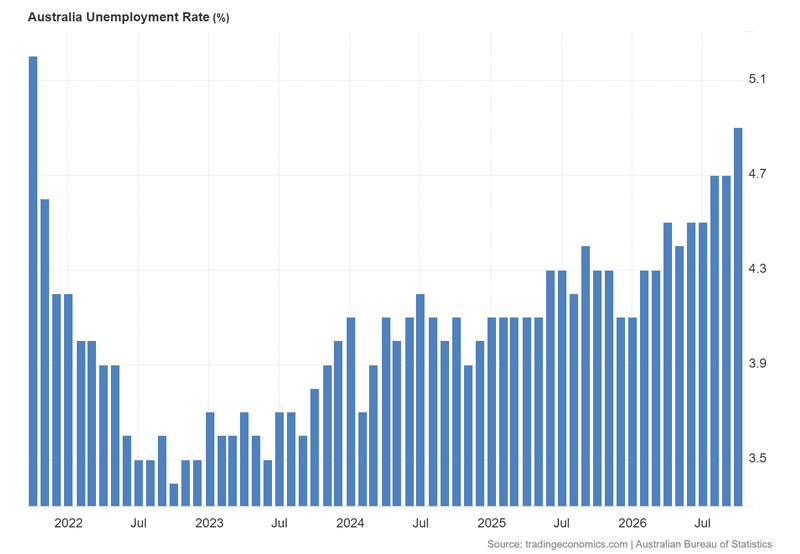
Figure 1. Australia Unemployment Rate (2021–2026). Source: Data from the Australian Bureau of Statistics; chart retrieved via Trading Economics.
