
 Support
 Daily discussion thread for August 10, 2026
Crude oil prices jumped nearly 5% as Middle East conflicts threatened the Strait of Hormuz, pushing bond yields higher ahead of crucial US inflation data and key corporate earnings reports.

Brent and WTI crude rose by nearly 5% following threats from Iran to keep the Strait of Hormuz closed.
Escalating energy costs elevated 10-year US Treasury yields to a multi-month high of 4.7%.
Markets are closely monitoring upcoming US inflation figures, with the consensus forecasting a moderation to 3.4%.
Cisco Systems and Applied Materials are scheduled to publish their quarterly financial results this week.
Oil advances amid geopolitical uncertainty in the Middle East
Crude oil benchmarks advanced in tandem amid heightened geopolitical uncertainty across the Middle East. The Brent futures contract (BRNV6) rose by 4.99% to settle at $87.72, while the West Texas Intermediate (WTI) futures contract (CLU6) gained 4.98% to reach $82.16 per barrel.
Although US officials previously indicated that a peace agreement with Iran was nearing completion, Iranian officials denied the existence of such diplomatic talks. Instead, Tehran appears focused on asserting full control over the Strait of Hormuz while separate diplomatic discussions with Oman proceed. Furthermore, Iranian authorities reaffirmed that the strategic waterway will remain closed until all of Tehran’s conditions are satisfied by the US.
Should this vital maritime corridor remain obstructed, the prolonged disruption to global energy supplies could aggravate inflationary pressures, placing additional pressure on central banks to adopt a more restrictive monetary policy stance. Reflecting this heightened economic risk, the 10-year US Treasury yield climbed 5.6 basis points to hit 4.7%—a peak zone not seen since January 2025.
Consequently, despite early assurances from the US administration that the US–Iran conflict would last only a matter of weeks, the confrontation approaches its fifth month. An extended disruption to energy supplies poses severe downside risks to the global economy. Beyond the immediate inflationary impact of elevated crude prices, secondary inflationary pressures threaten the agricultural sector via increased fertiliser costs, as well as the real estate market, where long-term interest rates are threatening to break above critical historical resistance levels.
Market participants have now turned their attention to the upcoming US Consumer Price Index (CPI) report, scheduled for release this Wednesday by the Bureau of Labor Statistics. While the consensus forecast anticipates a slight deceleration to 3.4%, underlying oil prices jumped approximately 20% in July following the breakdown of the ceasefire agreement between the US and Iran.
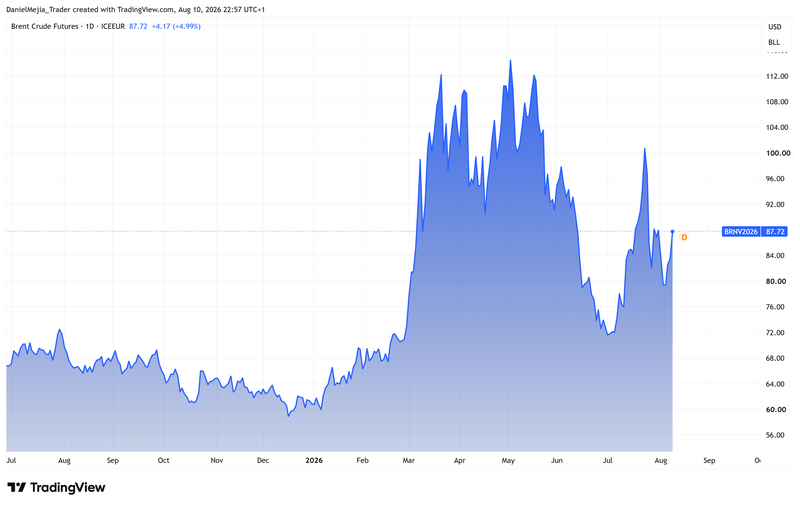
Figure 1. Brent Futures Contract (2025–2026). Source: Data from the ICE-EUR Exchange; Figure obtained from TradingView.
Quarterly US financial results
The second-quarter 2026 earnings season continues this week. The following key institutions are scheduled to report, which may contribute to further volatility in US equity markets:
Wednesday
- Cisco Systems (CSCO)
Thursday
- Applied Materials (AMAT)
Key economic events this week
Several critical economic indicators are scheduled for release this week, with the following being of particular importance to market participants.
Tuesday
- Australia: RBA Interest Rate Decision
- US: Existing Home Sales
Wednesday
- US: Inflation Rate
- US: EIA Crude Oil Stocks Change
Thursday
- United Kingdom: GDP Growth Rate
Friday
- US: Retail Sales
- US: Michigan Consumer Sentiment
