
 Support
 Daily discussion thread for August 25, 2026
Iran and Oman are collaborating in a plan to restore safe navigation through the Strait of Hormuz, exerting downward pressure on global oil prices. Meanwhile, weak US home sales continue to digest the impact of elevated mortgage rates.

Iran and Oman plan to establish a joint shipping corridor to reopen the Strait of Hormuz, aiming to facilitate commercial navigation.
Oil prices declined: Brent crude dropped by 3.61% to $87.27 per barrel, while WTI fell by 4.09% to $81.53 per barrel.
July US new home sales plummeted by 10.5% month-on-month (MoM) as long-term mortgage rates remained elevated around 6.65%.
Intuit surpassed quarterly revenue and EPS expectations; however, its stock fell by approximately 7% in post-market trading.
Iran and Oman announce plan to restore safe navigation through the Strait of Hormuz; oil prices fall
According to a report by CNBC, Iran and Oman are conducting bilateral talks to establish a temporary joint shipping route through the Strait of Hormuz, alongside a mission to clear naval mines in the area. The report indicates that Oman's Foreign Minister, Sayyid Badr bin Hamad Albusaidi, stated that both nations will attempt to implement practical arrangements to restore safe navigation through the waterway. Concurrently, the Omani official described his discussions with Iranian diplomat Abbas Araghchi as constructive.
In this context, a potential reopening of the Strait of Hormuz could alleviate pressure on global energy supply chains. Currently, this strategic maritime passage acts as a severe chokepoint for oil supplies, impacting not only Middle Eastern nations but also global economies as inflationary pressures sustain restrictive monetary policy stances worldwide.
Meanwhile, the diplomatic efforts suggest that Iran and Oman are advancing towards a potential agreement granting them joint management of this crucial corridor. Prior to the escalation of the US–Israel–Iran conflict on 28 February, approximately 20% of the global oil supply transited through the strait. From a geopolitical perspective, full administrative control over the waterway would grant both nations enhanced strategic influence in the Middle East.
Following these diplomatic developments, crude oil benchmarks fell in tandem: the Brent Crude futures contract (BRNX6) decreased by 3.61% to trade at $87.27 per barrel, whilst the West Texas Intermediate (WTI) futures contract (CLV6) declined by around 4.09% to $81.53 per barrel.
US new home sales drop sharply, exceeding contraction expected by analysts
According to data released by the US Census Bureau, new home sales declined by 10.5% month-on-month in July, marking the lowest level of activity since January 2026. Consequently, the seasonally adjusted annualised rate fell from 0.678 million in June to 0.607 million in July, missing the market consensus estimate of 0.62 million. This downturn can be largely attributed to long-term mortgage interest rates, which have risen amid persistent inflationary pressures.
Data from the Federal Reserve Bank of St Louis indicates that the average 30-year fixed-rate mortgage in the United States reached 6.65% on 20 August, placing it near a 12-month high. An environment of elevated interest rates typically dampens domestic demand for real estate, as property acquisitions predominantly rely on long-term credit financing.
Following the economic release, major US stock benchmarks advanced in unison. Market participants appeared more focused on geopolitical developments surrounding the US–Iran conflict and how energy supply disruptions might influence upcoming Federal Reserve monetary policy decisions. At the market close, the S&P 500 index gained 0.32% to reach 7,677 points, the Dow Jones Industrial Average advanced by 0.30% to 53,582, and the Nasdaq 100 rose by 0.64% to 29,209 points. Investors appear to be interpreting the potential reopening of the Strait of Hormuz as a positive catalyst for equity markets.
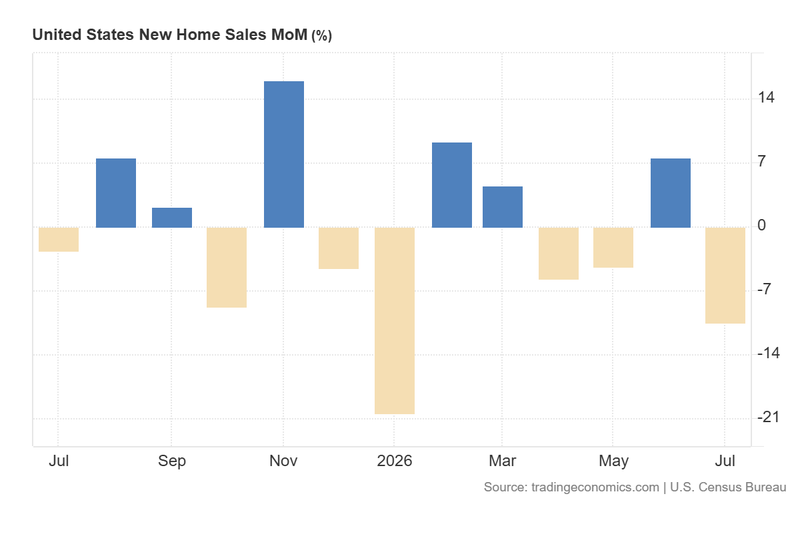
Figure 1. US New Home Sales MoM (2025–2026). Source: Data from the US Census Bureau; figure retrieved from Trading Economics.
Intuit Inc. beats revenue and EPS expectations in quarterly earnings report, yet shares decline post-market
Intuit Inc. managed to surpass analysts' estimates for both total revenue and earnings per share (EPS) in its quarterly earnings report. The company reported revenue of $4.4 billion, topping forecasts of $4.28 billion. Concurrently, the firm reported an EPS of $4.03, outperforming the market consensus estimate of $3.54. These figures represent a year-on-year (YoY) revenue growth rate of 14.8% and a 46.5% YoY surge in EPS. Nevertheless, despite delivering solid financial results, Intuit’s shares dropped by approximately 7% in the post-market trading session amid high scrutiny from market participants.
