
 Support
 Daily discussion thread for August 6, 2026
Oil prices surged following renewed transit conflicts in the Strait of Hormuz between Iran and Washington. Meanwhile, Australia reported an unexpected trade surplus, and Airbnb shares jumped in post-market trading following strong second-quarter earnings.

Oil prices rose after Iran proposed banning US and Israeli vessels from transiting the Strait of Hormuz.
Brent crude climbed 3.83% and WTI gained 2.76% amidst ongoing energy supply uncertainty.
Australia posted an AUD 1.93 billion trade surplus, beating market forecasts due to a surge in gold exports.
Airbnb beat Q2 revenue and EPS estimates with a 16.4% year-on-year revenue growth rate, pushing its shares up 9% post-market.
Oil prices rise amid geopolitical instability over Strait of Hormuz transit
Oil prices rose sharply following renewed instability affecting transit through the Strait of Hormuz. According to the Iranian state news outlet Fars, as reported by CNBC, Iran and Oman have announced a proposed transit framework for the Strait under which US and Israeli vessels would be banned, alongside nations and individuals that have caused damage to Tehran. Additionally, Iran is considering implementing financial penalties amounting to approximately 20% of cargo value for those violating the terms. Nevertheless, this proposal remains under revision and subject to formal approval.
Conversely, Washington rejected the proposed terms following statements earlier in the week by US officials—including President Donald Trump and Treasury Secretary Scott Bessent—who affirmed that the Strait of Hormuz would be reopened by Wednesday or Thursday. In this context, conflicting statements underscore acute uncertainty across this vital maritime corridor, while energy markets remain heavily dependent on geopolitical developments to establish a clearer price trajectory.
At market close, Brent crude futures jumped by 3.83% to $82.49 per barrel, whilst West Texas Intermediate (WTI) futures advanced by 2.76% to $77.34 per barrel. Despite a brief pullback in crude prices following statements by US officials assuring that a Strait opening was imminent, both benchmark contracts maintain an appreciation of approximately 14% over the past month.
Australia’s trade balance exhibits surplus driven by solid exports
According to data released by the Australian Bureau of Statistics, Australia's trade balance achieved a surplus of AUD 1.93 billion, comfortably surpassing the market consensus forecast of an expected AUD 1.1 billion deficit. This outcome was driven by robust export growth, which expanded by 9.6% month-on-month in June, in contrast to imports, which contracted by 0.02% over the same period. An analysis by Trading Economics indicates that the surplus was primarily explained by non-monetary gold exports, which surged by 60.2% following a contraction in the preceding month. However, although the current surplus represents a positive surprise relative to forecasts, the structural downward trend observed over the last three years remains intact, as illustrated in Figure 1.
Following the economic release, the Australian dollar depreciated by 0.36% against the US dollar to $0.7028.
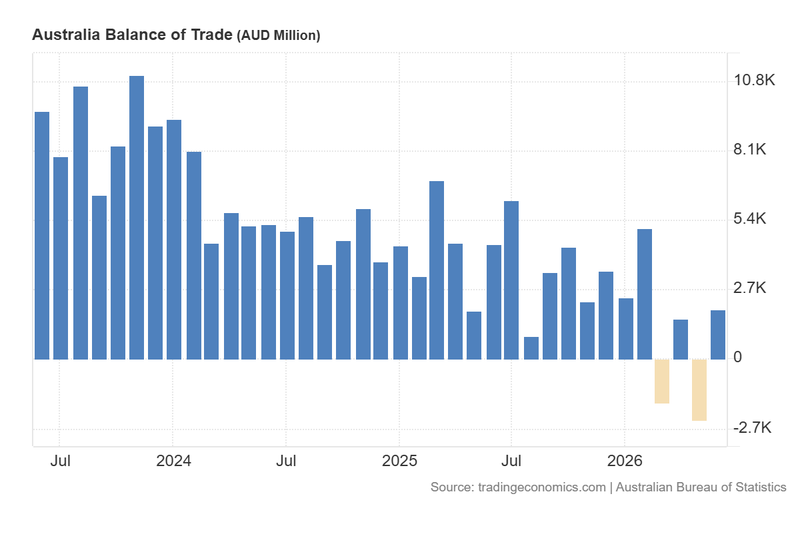
Figure 1. Australia Balance of Trade (2023–2026). Source: Data from the Australian Bureau of Statistics; Figure obtained from Trading Economics.
Airbnb releases earnings exceeding analysts’ expectations
Airbnb Inc. released second-quarter financial results with both total revenue and earnings per share (EPS) topping market estimates. The company reported quarterly revenue of $3.61 billion, beating the consensus forecast of $3.58 billion. Furthermore, it posted an EPS of $1.37, outperforming analyst expectations of $1.26. These results represent a year-on-year (YoY) revenue increase of 16.4% and a 33% YoY rise in earnings per share. Driven by these solid quarterly metrics, Airbnb’s shares advanced around 9% in post-market trading.
