
 Support
 Daily discussion thread for July 16, 2026
Escalating Middle East tensions have heightened the risk of energy supply disruptions, particularly within the Red Sea maritime corridor. Conversely, robust US bank earnings have underscored underlying domestic economic resilience, whereas Netflix shares retreated post-market despite surpassing quarterly earnings per share expectations.

Iran has reportedly asked its Houthi allies to prepare for the disruption of Red Sea shipping routes should US military actions escalate.
Prominent risks include severe supply-chain bottlenecks at the Bab el-Mandeb strait and potential direct military involvement by Saudi Arabia and Pakistan.
Netflix exceeded quarterly EPS forecasts but fell short of revenue consensus estimates, causing its share price to slide 8.38% in post-market trading.
Major US financial institutions beat revenue and EPS projections, demonstrating operational strength, though broader geopolitical friction and valuation anxieties continue to weigh on market sentiment.
Geopolitical tensions could escalate to the Red Sea region
Persistent geopolitical friction in the Middle East continues to pose a high risk to the global energy supply architecture. According to Reuters, Tehran has asked to Houthi forces in Yemen to prepare for the closure of vital Red Sea shipping lanes in the event that Washington targets Iranian energy and power infrastructure. Such an action threatens to trigger severe crude oil supply disruptions, given that the region serves as a critical choke point for global oil and commodity transit. This diplomatic back-and-forth follows recent threats from the US President Donald Trump regarding potential retaliatory strikes against Iranian infrastructure.
Concurrently, Houthi forces launched missile strikes targeting Saudi Arabia, following allegations that the Kingdom was involved in a recent bombardment of a Houthi-controlled airport. This development materially elevates regional contagion risks, threatening to transform the localised friction into a broader dispute. In response, Saudi Arabia may engage in military retaliation for self-defence, while Pakistani forces could become actively involved to safeguard the Kingdom under the terms of their bilateral mutual defence pact. Amidst these tensions, Pakistani military personnel alongside a fighter jet squadron have been deployed to Saudi Arabian territory, as reported by Reuters. Consequently, Pakistan's capacity to act as a regional mediator could be compromised should it become a direct militant in the conflict.
Ultimately, two primary systemic risks are intensifying: a severe energy supply disruption if the Bab el-Mandeb strait faces targeted attacks by Houthi forces, and an expansive regional escalation should Saudi Arabia and Pakistan enter the hostilities directly.
Despite these developments, energy markets reacted with relative moderation. The Brent crude futures contract (BRNU6) depreciated by 0.85% to settle at $84.23 per barrel, while the West Texas Intermediate (WTI) futures contract (CLU6) declined by 0.82% to close at $78.95 per barrel. Market participants remain highly focused on forthcoming official declarations to gain greater clarity regarding these structural risks.
Netflix’s EPS surpasses forecasts, but revenue misses estimates
The streaming giant Netflix Inc. delivered mixed results in its latest quarterly earnings report, exceeding market consensus on earnings per share (EPS) but failing to match top-line revenue expectations. Netflix reported total revenue of $12.56 billion, slightly below the $12.58 billion projected by Wall Street analysts. Conversely, the firm's EPS reached $0.80, marginally outperforming the consensus estimate of $0.79. These financial results represent a year-on-year (YoY) revenue expansion of 13.3% and an 11.11% increase in EPS.
A report from CNBC noted that the corporation maintained healthy underlying consumer engagement metrics, highlighted by live broadcasting events that contributed to a total of over 97 billion hours of content consumed during the first half of 2026. Furthermore, the sustained revenue growth was driven by robust subscriber additions, strategic pricing adjustments, and an expansion in advertising-based revenue. However, despite these stable operational metrics, investors expressed dissatisfaction, causing the share price to drop 8.38% during the post-market trading session to $68.12.
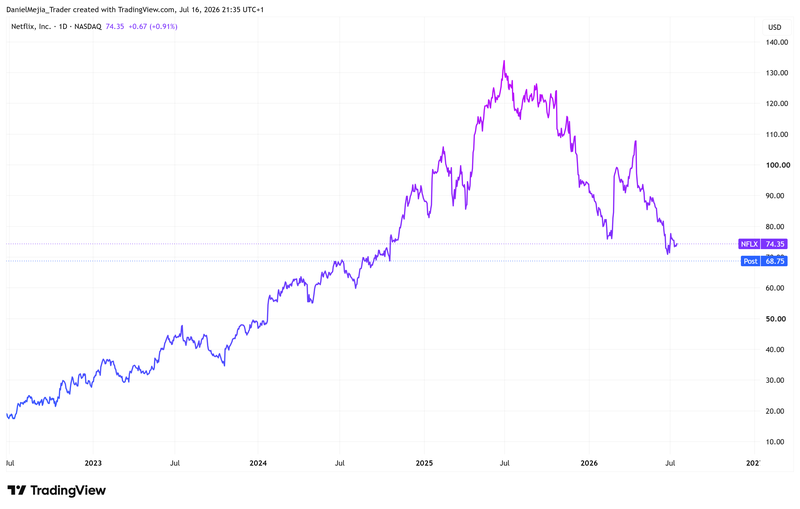
Figure 1. Netflix Share Price (2023-2026). Source: Data from the Nasdaq Exchange. Figure obtained from TradingView.
US banks release solid results in the Q2 earnings season
Major US banking institutions have delivered robust financial performance for the second quarter of the fiscal year. Throughout the week, financial giants have reported total revenue and earnings per share that exceeded market consensus forecasts. On Tuesday, JPMorgan Chase & Co. reached $57.35 billion in revenue and an EPS of $7.70. Concurrently, Bank of America Corp. achieved revenue of $31.60 billion alongside an EPS of $1.21, while Goldman Sachs Group Inc. posted $20.34 billion in revenue and an EPS of $20.98. Wells Fargo & Co. reported $22.62 billion in revenue and an EPS of $2.00, and Citigroup Inc. registered $24.77 billion and $3.15, respectively. Following these releases on Wednesday, Morgan Stanley announced total revenue of $21.30 billion and an EPS of $3.46, while BlackRock Inc. achieved $7.08 billion in revenue and an EPS of $13.91.
These aggregated figures demonstrate that the financial sector continues to generate solid returns, thereby reinforcing the resilience of major equity benchmarks. Nevertheless, US stock indices face persistent headwinds from escalating Middle East geopolitics, growing expectations of a more restrictive monetary policy stance from the Federal Reserve, and mounting anxieties regarding elevated market valuations—the latter factor exerting notable pressure on artificial intelligence (AI) related firms.
