
 Support
 Daily discussion thread for July 22, 2026
Rising US-Iran conflict in the Middle East has pushed oil prices up by over 25% in July. Meanwhile, Alphabet and Tesla second-quarter earnings delivered mixed performance, and Japan’s trade deficit expanded significantly due to a surge in energy imports.

Escalating US-Iran threats and a potential Houthi blockade sent Brent crude to $94.07 and WTI to $86.89 per barrel.
Alphabet beat Q2 revenue and EPS expectations, yet its stock slipped 3.15% in post-market trading.
Tesla beat revenue targets at $28.24bn but missed EPS forecasts, triggering a 4% post-market decline.
Japan’s trade deficit widened to ¥406.9bn as oil imports surged 59.3% amid Middle East turmoil.
Threats from Washington and Iran elevate tensions in the Middle East; Oil prices rise
Geopolitical tensions in the Middle East continue to escalate, raising concerns over renewed global inflationary pressures. According to Reuters reports, US President Donald Trump stated that "the US will destroy an Iranian bridge or power plant every time that Iran attacks a ship in the Strait of Hormuz". Conversely, Iran’s joint military command warned that if Washington acted on its threats against Iranian infrastructure, Tehran would target regional oil, gas, electricity, and economic infrastructure to block crude flows.
Concurrently, Houthi forces declared their intention to enforce a naval blockade in the Bab el-Mandeb Strait in Yemen. This could further deteriorate global energy supply chains and force commercial vessels to take alternative routes around Southern Africa, thereby increasing logistics and transit costs for shipping companies.
In this context, the main oil benchmarks rose in tandem at the market close: the Brent futures contract (BRNU6) advanced by 3.36% to $94.07 per barrel, while the West Texas Intermediate (WTI) futures contract increased by 2.98% to $86.89 per barrel. Both crude benchmarks have now accumulated an appreciation of over 25% in July alone.
Alphabet beats analysts' estimates on revenue and EPS, while Tesla delivers mixed results
Two technology giants belonging to the "Magnificent Seven" group reported their second-quarter earnings results: Alphabet Inc. and Tesla Inc.
Alphabet Inc. exceeded analysts' estimates in both total revenue and earnings per share (EPS). The technology giant reached $119.8 billion in revenue, comfortably above the forecast of $116.51 billion. In turn, the firm achieved an EPS of $9.11, significantly surpassing the market consensus estimate of $2.88. These results represent a year-on-year (YoY) revenue growth rate of 24% and a solid YoY increase of 294% in EPS. Nevertheless, the stock dropped by 3.15% in post-market trading.
Meanwhile, Tesla Inc. delivered mixed results, beating revenue expectations but missing EPS forecasts. The automotive giant reported total revenue of $28.24 billion, exceeding analyst forecasts of $25.55 billion. However, the firm achieved an EPS of $0.33, falling short of the estimated $0.49. These results represent a YoY revenue growth rate of 25.5%, but an annual decline of 17.5% in EPS. Consequently, Tesla’s shares fell by 4% in the post-market session.
Japanese imports jump above forecasts
The Ministry of Finance of Japan reported that the trade balance decreased by ¥406.9 billion in June, falling significantly below analysts' forecasts of a ¥120 billion deficit and expanding beyond the previous contraction of ¥391.8 billion. This widening trade deficit was primarily driven by a sharp increase in imports, which surged by 25.4% YoY, surpassing the estimated 21% growth. Concurrently, Japanese exports advanced by 19.3% YoY, slightly exceeding the forecast of 18.6%. In both cases, the current readings represent the highest levels since November 2022.
An analysis from Trading Economics suggests that Japanese imports rose due to increased domestic demand for crude oil (+59.3%) amidst the ongoing conflict in the Middle East. Meanwhile, Japanese exports advanced on the back of a weaker yen and robust global demand for AI-related semiconductors.
Following the economic release, the Japanese yen fell marginally by 0.06% to ¥163.07 against the US dollar. In turn, the Nikkei 225 index decreased slightly by 0.18% to close at 66,115 points.
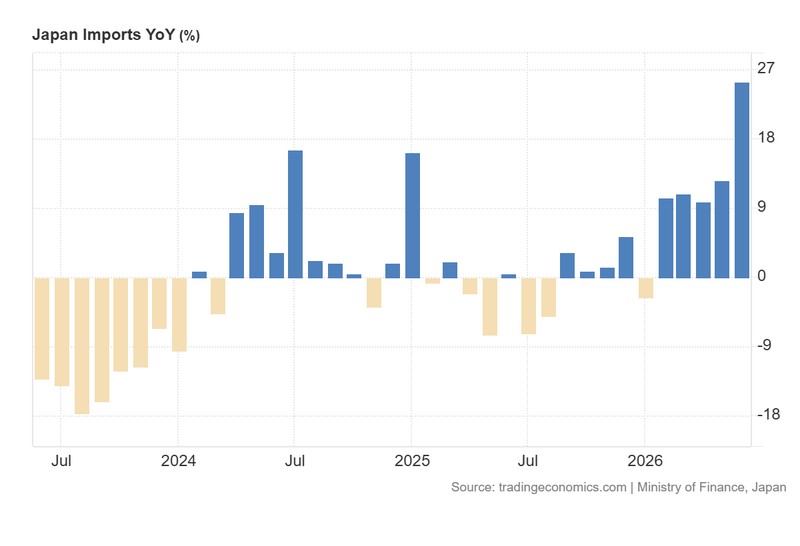
Figure 1. Japan Imports YoY (2023–2026). Source: Data from the Ministry of Finance; Figure obtained from Trading Economics.

