
 Support
 Daily discussion thread for October 6, 2026
The S&P 500 reached a record high despite elevated US inflation, national debt concerns, and a persistent trade deficit. Meanwhile, Canadian business activity decelerated sharply, and Australian consumer confidence fell amidst mounting economic pressures.

The S&P 500 reached a record 7,818 points, driven by resilient economic growth ahead of the third-quarter earnings season, where market participants could be anticipating solid corporate performance.
Persistent US PCE inflation at 3.4% and Middle East geopolitical tensions continue to exert upward pressure on Treasury yields.
Canada's Ivey PMI decelerated to 58.2 points as US tariffs and rising prices weighed on inventory levels.
Australian consumer sentiment fell 4.7% to 80.4, dragged down by elevated borrowing costs and fuel prices.
S&P 500 index reaches a new record high despite US macroeconomic uncertainty
The S&P 500 index reached a fresh record high following a daily gain of 0.58% to 7,818 points, accumulating a year-to-date (YTD) appreciation of 13.34%. This robust performance was achieved despite the United States navigating a complex macroeconomic backdrop and political uncertainty ahead of the mid-term elections in November.
On the one hand, US inflation, as measured by the Personal Consumption Expenditures (PCE) Price Index, remains well above the Federal Reserve's 2.0% target, standing at 3.4% for the August reading. In this context, inflationary pressures persist amidst ongoing US-Iran tensions in the Middle East, maintaining uncertainty surrounding global energy supply chains.
Consequently, the US central bank has adopted a more restrictive monetary policy stance in an effort to contain prices. This stance has triggered severe selling pressure on government bonds as investors anticipate further interest rate hikes, driving Treasury yields to multi-year highs. This dynamic has heightened concerns regarding US sovereign debt, which remains at historically elevated levels, thereby increasing pressure on the federal budget through mounting net interest payments.
Additionally, data published today by the US Bureau of Economic Analysis revealed that the trade deficit contracted to $105.57 billion in August, marking its narrowest level since March 2025. This outcome underscores that, despite tariff implementation by the US administration, imports continue to outpace exports, indicating a persistent reliance on foreign goods and services.
Conversely, economic productivity—evidenced by robust Gross Domestic Product (GDP) growth and positive Purchasing Managers' Index (PMI) readings, particularly within the services sector—remains resilient, contrasting sharply with the broader backdrop of high inflation and rising borrowing costs. In this environment, investors appear to be placing greater weight on strong macroeconomic data, while anticipating a solid third-quarter earnings season in the coming days, supported by healthy corporate financial reports in previous quarters.
Canadian PMI decelerates sharply amid trade uncertainty with the US
Canada's Ivey Business School released its latest PMI evaluation, showing a sharp deceleration in business activity from 64.3 points in August to 58.2 points in September, missing the consensus market forecast of 65.2 points. The detailed report indicated that the employment sub-index accelerated from 55.0 to 56.5, whilst the price index rose from 80.4 to 82.8. Conversely, inventories decelerated from 61.4 to 58.3 points, and supplier deliveries contracted further from 41.5 to 39.2 points.
This configuration reflects how rising price pressures and persistent tariffs from the US—Canada's primary trade partner, accounting for approximately 70% of Canadian exports and 50% of imports according to Observatory of Economic Complexity (OEC) data for the end of 2024—are impinging on inventories and supplier delivery schedules, even as employment exhibits resilience. Nevertheless, the headline PMI remains comfortably above the 50.0 expansion threshold, maintaining a positive three-year trend line.
Following the release, the Canadian dollar appreciated by 0.31% against the US dollar, with the USD/CAD exchange rate easing to 1.4206 by market close.
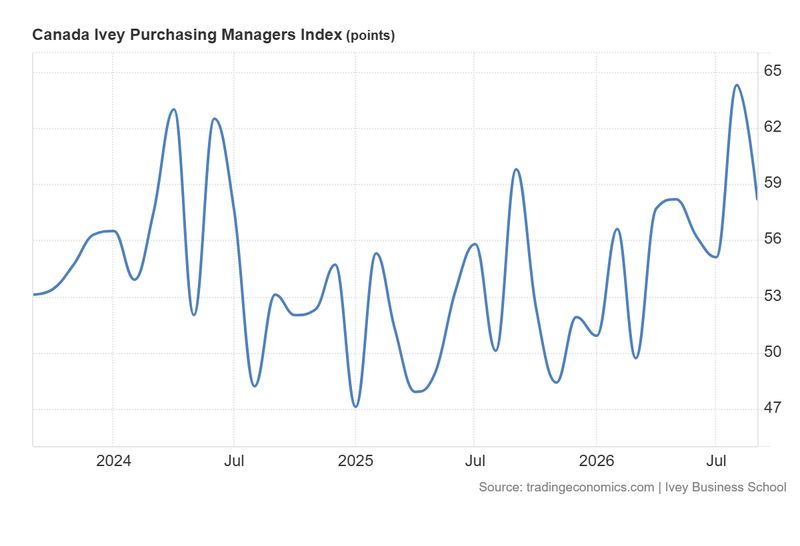
Figure 1. Canada Ivey Purchasing Managers Index (2023–2026). Source: Data from the Ivey Business School; chart obtained via Trading Economics.
Australian consumer confidence declines for second consecutive month
According to data published by Westpac Banking Corporation and the Melbourne Institute, Australia's Consumer Sentiment Index fell from 84.4 points in September to 80.4 points in October, representing a month-on-month decline of 4.7%. Consequently, the index has now contracted for two consecutive months. The report noted that consumer confidence remained constrained by elevated fuel prices and rising interest rates, a combination fostering widespread concern over the potential deterioration of household finances. Furthermore, broader economic sentiment waned amidst persistent, uncontained inflationary pressures.
Following the economic release, the Australian dollar appreciated by 0.17% against the greenback, with the AUD/USD pair advancing to 0.6980 at the market close.
