
 Support
 Daily discussion thread for September 15, 2026
China's industrial output exceeded expectations, though weak domestic retail sales weighed on Asian equities. Meanwhile, steady UK unemployment and subdued German economic sentiment influenced broader European market trends.

China's industrial output expanded to 5.2% year-on-year in August, whereas retail sales growth decelerated to 0.4%.
Chinese stock markets fell sharply as sluggish consumer demand continued to weigh on domestic sentiment.
UK unemployment held firm at 4.9%, reinforcing market expectations that the Bank of England will maintain benchmark interest rates at 3.75%.
The German ZEW Economic Sentiment Index edged up slightly to 34.7 points, falling short of consensus forecasts of 37.0 points.
China's industrial production accelerates above expectations, yet retail sales slow
According to data released by the National Bureau of Statistics (NBS) of China, annual industrial production accelerated firmly from 4.5% in July to 5.2% in August, surpassing the market consensus forecast of 4.8%. The report indicated that expansion was driven by manufacturing output, which rose from 5.5% to 6.1%, alongside electricity, gas, heat, and water production, which accelerated from 4.9% to 5.9% over the period, as highlighted by Trading Economics.
In this context, while manufacturing and essential utilities exhibit resilience, current momentum remains insufficient to restore the long-term trend in Chinese production, which stays below its three-year average (see Figure 1).
Concurrently, the NBS reported that year-on-year retail sales growth slowed from 0.6% in July to 0.4% in August, missing consensus estimates of 0.8%. Contraction was concentrated in automobile sales, furniture, building materials, and gold and silver jewellery. This trend underscores persistent underlying weakness in domestic consumer spending, particularly for big-ticket items that entail long-term commitments and rely heavily on credit availability.
Against this backdrop, export performance remains the primary growth engine for the Chinese economy, generating a robust trade surplus amidst sustained overseas demand.
Following the NBS release, the FTSE China A50 index dropped sharply by 1.26% to 14,312 points, while the Hang Seng Index declined by 0.79% to 24,761 points, reflecting investor concerns over persistent domestic demand fragility.
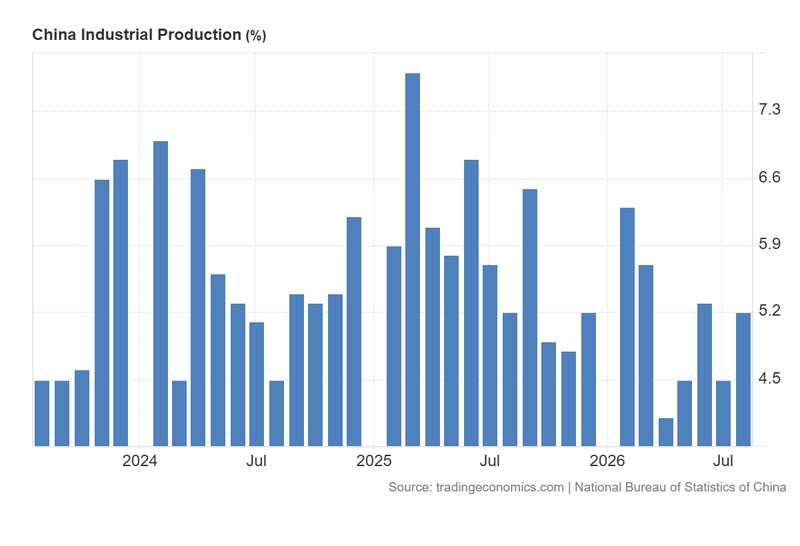
Figure 1. China Industrial Production (2023–2026). Source: Data from the National Bureau of Statistics of China; chart obtained via Trading Economics.
UK unemployment rate holds steady, defying forecasts of an increase
Data published by the UK Office for National Statistics (ONS) revealed that the unemployment rate held firm at 4.9% in the three months to July, remaining below the consensus forecast of 5.0%. This marks the fourth consecutive month that the metric has remained unchanged, pointing to relative labour market stability. Meanwhile, net employment growth decelerated, with job gains easing from 83,000 in the previous period to 67,000.
Notably, although headline unemployment has stabilised in recent months, overall jobless levels remain above their ten-year average and continue on a multi-year upward trajectory. This structural slack could encourage the Bank of England (BoE) to adopt a more neutral posture, even as lingering inflationary pressures exert countervailing force, fostering expectations of a tighter monetary policy stance.
The prevailing market consensus anticipates that the Bank of England will leave its benchmark interest rate unchanged at 3.75% at its policy meeting this week.
Following the ONS labour market report, the British pound depreciated by 0.14% against the US dollar amidst steady domestic employment figures and growing expectations of a Federal Reserve rate hike later this week. The GBP/USD pair traded around $1.3477 during the session, while the benchmark FTSE 100 index slipped by 0.37% to 10,658 points.
German economic sentiment improves, but falls short of analysts' forecasts
The ZEW Centre for European Economic Research reported that its German Economic Sentiment Index edged up from 34.2 in August to 34.7 points in September. However, despite this modest gain, the reading fell short of analysts' projections of 37.0 points. The ZEW survey highlighted that persistent anxieties over energy costs, geopolitical volatility, and broader economic uncertainty continue to weigh on investor confidence.
From a sectoral perspective, whilst financial institutions continue to benefit from higher interest rates, key industrial sectors—notably automotive, steel, and metal manufacturing—remain under pressure due to trade friction with the German's principal export partner, the United States.
Concurrently, the ZEW Current Conditions Index staged a modest recovery, though it remains in negative territory.
Following the publication of the data, the German DAX 40 index fell by 0.15% to 25,402 points, influenced by mounting inflationary pressures that recently prompted the European Central Bank (ECB) to tighten monetary policy. Last week, the ECB raised its benchmark interest rate by 25 basis points to 2.65%. Meanwhile, the EUR/USD pair dipped by a marginal 0.04%, indicating that the ZEW release had a limited immediate impact on foreign exchange trading.

