
 Support
 Daily discussion thread for September 18, 2026
The Bank of Japan raised interest rates to 1.25% despite steady inflation, resilient UK retail sales supported the pound, while surging US diesel prices heightened broader inflationary risks.

The Bank of Japan raised its benchmark interest rate to 1.25%—a 31-year high—in an effort to curb inflation risks.
USD/JPY rose to ¥156.81 as markets prioritised the Federal Reserve's restrictive policy outlook.
UK retail sales grew 2.4% year-on-year in August, signalling underlying domestic economic resilience.
US diesel prices reached a record $6.29 per gallon, raising transportation and food cost concerns.
Japanese inflation holds steady, but BoJ decides to increase benchmark interest rate
According to data released by Japan's Ministry of Internal Affairs and Communications, the Japanese headline inflation rate held steady at 1.9% year-on-year in August, accompanied by a marginal monthly increase of 0.1%. Simultaneously, the report indicated that core inflation—which excludes the volatile components of fresh food and energy—decelerated slightly from 1.8% to 1.7%.
Nevertheless, despite Japanese inflation remaining below target, the Bank of Japan (BoJ) decided by a 7–2 majority vote to raise its benchmark interest rate by 25 basis points to 1.25%—its highest level since April 1995. According to Reuters, BoJ Governor Kazuo Ueda stated that the central bank has entered a new phase focussed on preventing inflation from overshooting its 2% target. This statement suggests that the BoJ remains open to the possibility of further rate hikes.
Following the economic releases, the Japanese yen depreciated by 0.57% against the US dollar in a highly volatile session, with the USD/JPY pair trading around ¥156.81. This market reaction suggests that market participants are prioritising the Federal Reserve's restrictive policy stance over the BoJ's hawkish posture. Investors appear to view inflationary pressures in the US as higher than those in Japan, expecting a more aggressive tightening posture from the US central bank to contain price growth.
UK retail sales accelerate above analysts' expectations
Data released by the UK's Office for National Statistics (ONS) revealed that retail sales volumes advanced by 0.5% month-on-month in August, defying consensus analyst forecasts of a 0.2% contraction. Consequently, year-on-year retail sales growth accelerated sharply from 1.2% in July to 2.4% in August, exceeding market estimates of 1.9%. The ONS report highlighted that growth was driven by non-store retailers, non-food stores, and food store sales. Conversely, fuel sales declined as elevated pump prices altered consumer spending habits.
Against this backdrop, the UK economy continues to demonstrate resilience in consumer demand. Notably, the three-year trend in retail sales indicates an upward trajectory (see Figure 1). However, headline inflation—currently standing at 3.1%—remains considerably above the Bank of England's (BoE) 2% target. This economic resilience has enabled the BoE to hold its benchmark interest rate steady throughout 2026, although the central bank warned at its latest monetary policy meeting that further rate hikes may be necessary should inflationary pressures persist.
Following the ONS release, the British pound appreciated 0.12% against the US dollar, with the GBP/USD currency pair trading around $1.3369 during the session. This modest recovery followed four consecutive days of depreciation driven by the Federal Reserve's restrictive monetary stance, which has continued to bolster the greenback.
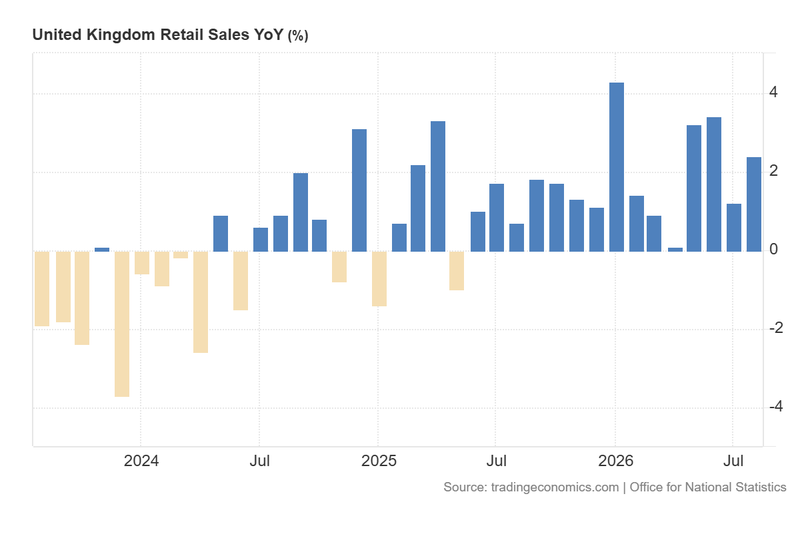
Figure 1. United Kingdom Retail Sales (2023–2026). Source: Data from the Office for National Statistics; chart obtained via Trading Economics.
US diesel prices reach historic highs, pressuring food prices
Earlier this week, the US Energy Information Administration (EIA) reported that retail diesel sales prices had reached a historic high of $6.29 per gallon, representing an approximate year-on-year (YoY) surge of 68%. Consequently, this is placing upward pressure on freight and food distribution costs, given that agricultural supply chains rely heavily on diesel-powered trucking networks. Furthermore, should Middle East supply disruptions persist, fertiliser prices could also escalate, driving up farm input costs and further aggravating inflationary pressures if farmers are not able to absorb costs.
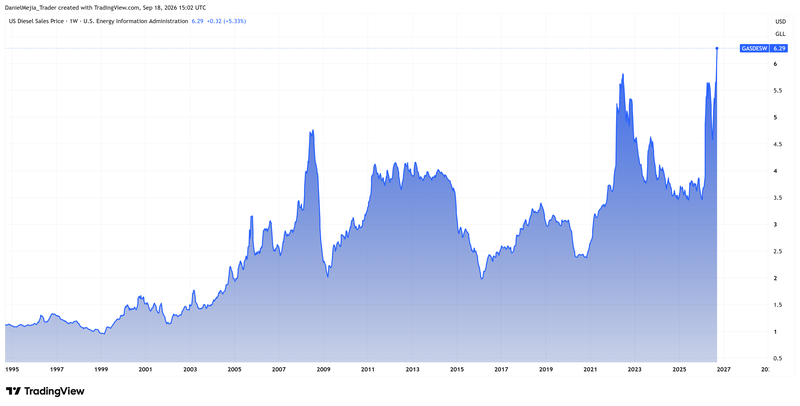
Figure 2. US Diesel Sales Price (1995–2026). Source: Data from the US Energy Information Administration; chart obtained via TradingView.

