
 Support
 Daily discussion thread for September 2, 2026
Escalating tensions in the US–Iran conflict pushed crude oil prices higher, while weaker-than-expected US ADP payroll data lifted equity markets. Simultaneously, the Bank of Canada maintained its benchmark interest rate, and Broadcom reported robust quarterly financial results.

Escalating US–Iran military strikes pushed Brent crude to $95.63 per barrel amid heightened concerns of potential energy supply disruptions.
US ADP payroll growth slowed to 38,000, missing market expectations but bolstering equity markets on hopes of a Federal Reserve rate pause.
The Bank of Canada held its benchmark rate at 2.25%, citing inflation risks linked to Middle Eastern hostilities and potential US tariffs.
Broadcom surpassed quarterly revenue and EPS expectations, though softer forward guidance weighed on shares in after-hours trading.
US continues military operations against Iranian territory as Tehran strikes regional US bases
The conflict between the United States and Iran in the Middle East continues to escalate. According to reports from Reuters, US forces conducted strikes along Iran’s southern coast, while Tehran retaliated by targeting US military facilities across the region, including sites in Bahrain, Jordan, and Kuwait. Media reports characterized this exchange of fire as the most severe escalation since July. Furthermore, US Treasury Secretary Scott Bessent stated that Washington is considering additional economic measures targeting the aviation sector, maritime shipping, and digital assets to intensify economic pressure on Tehran.
In this environment, a return to active, high-intensity engagements remains a distinct risk, even though both economies have sustained considerable impacts over the six months since hostilities commenced.
At the market close, global oil benchmarks advanced moderately: the Brent crude futures contract (BRNX6) gained 1.04% to settle at $95.63 per barrel, while the West Texas Intermediate (WTI) futures contract (CLV6) rose 0.83% to $90.99 per barrel.
ADP employment change index decelerates, missing market expectations
Automatic Data Processing (ADP) Inc. released its monthly private payrolls assessment, revealing that employment growth slowed from a revised 46,000 in July to 38,000 in August, falling short of the market consensus forecast of 47,000. The report indicated that the primary sector driving job creation was education and health services (+45,000 positions), whereas manufacturing recorded the sharpest contraction (-17,000 positions).
Consequently, the latest ADP report highlighted underlying vulnerabilities in private-sector hiring. On a broader horizon, the index continues to trace a downward trajectory, signalling sustained moderation across the US labour market.
Although restricted to private-sector employment, the ADP report is closely scrutinised by investors seeking preliminary signals ahead of the official Non-Farm Payrolls (NFP) report published by the Bureau of Labor Statistics (BLS). Historically, the ADP index has served as a key reference point for broad employment trends. Market attention now shifts to the upcoming BLS employment release scheduled for this Friday.
At the closing bell, major US equity indices advanced in unison, driven by growing expectations that the Federal Reserve could hold its benchmark interest rate steady at its upcoming monetary policy meeting. The S&P 500 gained 0.46% to close at 7,667, the Dow Jones Industrial Average rose 0.56% to 53,067, and the Nasdaq 100 appreciated 0.23% to 29,143 points.
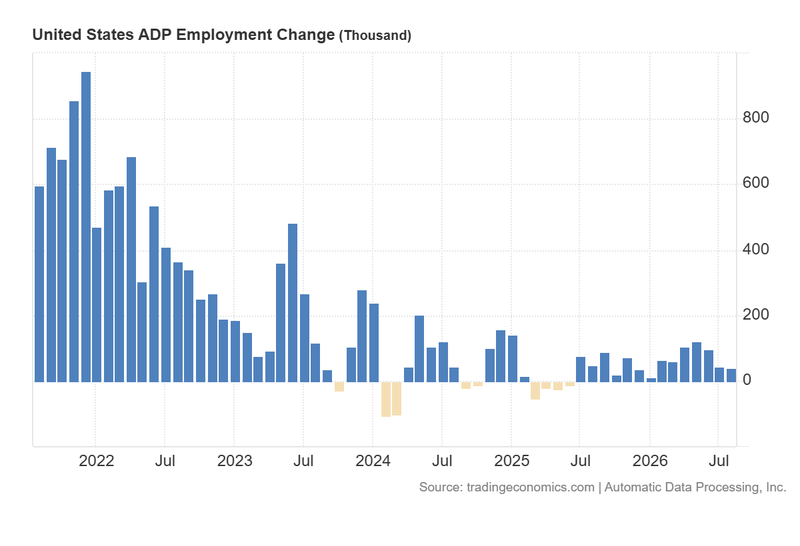
Figure 1. US ADP Employment Change (2021–2026). Source: Data from Automatic Data Processing Inc.; chart retrieved from Trading Economics.
Bank of Canada maintains benchmark interest rate unchanged
The Bank of Canada (BoC) held its key policy rate at 2.25%, aligning with market consensus. However, the central bank cautioned against upside risks to inflation stemming from two primary economic factors: escalating Middle Eastern hostilities, which threaten global energy supply chains and elevate oil prices, and potential new US tariffs, which could disrupt Canadian supply chains given the deep integration between the two economies.
Conversely, the BoC noted that the domestic economy continues to display resilience despite a complex international environment. With headline inflation remaining within the central bank's 1%–3% target control range (standing at 3.0% for the July reading), policymakers emphasised a cautious, data-dependent approach to future monetary policy adjustments.
Following the BoC’s announcement, the Canadian dollar strengthened by 0.39%, bringing the USD/CAD exchange rate to approximately 1.3843. Underlying macroeconomic stability appears to be providing support for the domestic currency.
Broadcom shares slip after-hours despite strong quarterly earnings
Broadcom Inc. delivered robust quarterly financial results, outperforming market expectations on both top- and bottom-line metrics. The semiconductor manufacturer reported revenue of $29.59 billion, surpassing the consensus forecast of $29.25 billion, while earnings per share (EPS) reached $3.32 against an expected $3.21. These figures represent year-on-year (YoY) revenue growth of 85.5% and EPS growth of 96.0%, reflecting sustained demand for custom semiconductor solutions.
However, the company’s forward-looking revenue guidance of $34.8 billion for the upcoming quarter fell slightly short of analysts' projections of $35.03 billion. This modest variance dampened investor sentiment, causing Broadcom shares to trade slightly lower in extended post-market trading.
