
 Support
 Daily discussion thread for September 9, 2026
Oil prices surpassed $100 per barrel as US–Iran hostilities escalated, pushing US Treasury yields to multi-year highs and heightening global inflationary risks, whilst China’s consumer inflation accelerated modestly to 0.8%.

Brent crude breached the $100 mark following sharp military escalations between the US and Iran near the Strait of Hormuz.
US Treasury yields reached multi-year highs driven by sovereign debt concerns and persistent inflationary risks.
Escalating energy market disruptions increase pressure on the Federal Reserve, the European Central Bank (ECB), and the Bank of Japan (BOJ) to consider further interest rate hikes.
China’s year-on-year inflation accelerated to 0.8%, underscoring export-led growth amid sluggish domestic demand.
Brent crude reaches $100 threshold amid escalating US–Iran tensions
Global oil benchmarks rallied in tandem amid escalating US–Iran tensions in the Middle East. The Brent crude futures contract (BRNX6) surged by 3.36% to $101.21 per barrel, surpassing the $100 threshold. Similarly, the West Texas Intermediate (WTI) futures contract (CLV6) rose by 3.25% to $96.09 per barrel.
According to reports by Reuters, Iran declared that it had attacked ten vessels near the Strait of Hormuz after the US sank five Iranian oil tankers. Furthermore, Tehran stated that it had launched ballistic missiles at a US base in Jordanian territory. This marks a sharp escalation in conflict following several weeks of relative moderation.
Meanwhile, US President Donald Trump stated that energy prices 'will not come down until after the midterm elections', as quoted by CNBC. Additionally, US Secretary of State Marco Rubio warned that 'for every time that Iran tries to hit US naval ships, they are going to lose tankers'. Conversely, the Iranian Islamic Revolutionary Guard Corps (IRGC) affirmed that Tehran would sharply escalate its response to any further aggression, claiming it would hit 20 targets if the adversary struck two or three, according to Reuters.
Consequently, the current trajectory suggests that the US–Iran conflict may intensify and persist for at least another two months, leading up to the US midterm elections scheduled for November. This dynamic poses significant upward pressure on global inflation rates, complicates monetary policy decisions for major central banks, and heightens sovereign debt risks—particularly in the US and Japan, both of which maintain elevated debt commitments.
Furthermore, parallel maritime risks persist in the Bab-el-Mandeb Strait near Yemen, where active engagements between Houthi forces and Saudi Arabian troops continue. Should traffic through both the Strait of Hormuz and the Bab-el-Mandeb Strait remain severely restricted or halted simultaneously, ongoing energy supply disruptions could deepen, applying further upward pressure to global price levels.
US long-term Treasury yields reach multi-year highs amid intensifying inflation pressures
Long-term US Treasury bond yields have surged to multi-year highs, driven by compounding inflation fears and sovereign debt concerns that have triggered substantial selling pressure amongst bondholders. At market close, the 10-year Treasury yield rose by 5.3 basis points to 4.84%—its highest level since November 2023. Concurrently, the 30-year government bond yield increased by 4.4 basis points to 5.29%, reaching levels not seen since May 2007.
Against this backdrop, market participants are increasingly alarmed by historic national debt levels—which have crossed the $40 trillion mark—in a high-interest-rate environment. Elevated debt volumes coupled with high borrowing costs drive net interest payments upwards, escalating concerns among bondholders regarding the trajectory of the US fiscal deficit, which has deteriorated markedly over the past six years.
Simultaneously, investors remain apprehensive about burgeoning inflationary pressures fuelled by the ongoing US–Iran conflict in the Middle East, causing severe energy supply disruptions that have persisted for over six months.
Consequently, major central banks—particularly in Western economies—are facing heightened pressure to maintain or enforce restrictive monetary policy measures to anchor price expectations. Notably, market participants anticipate potential rate hikes from the European Central Bank (ECB), the Bank of Japan (BOJ), and the Federal Reserve at their upcoming monetary policy meetings. According to the CME FedWatch Tool, market-implied probabilities signal a 60% chance of a Federal Reserve benchmark rate increase, alongside a 40% probability of holding rates unchanged.
Chinese consumer inflation accelerates beyond analyst expectations
According to figures released by China's National Bureau of Statistics, headline consumer inflation rose by 0.4% month-on-month in August, surpassing analyst expectations of 0.3%. Consequently, the year-on-year (YoY) rate accelerated from 0.5% in July to 0.8% in August. The official release indicated that the uptick in headline inflation was predominantly driven by price increases in transport, clothing, healthcare, and education. Conversely, housing costs and food prices declined, reflecting persistent weakness in domestic consumption. Meanwhile, core inflation—which excludes volatile energy and unprocessed food prices—rose from 0.9% to 1.0% YoY over the same period.
In this context, while Chinese inflation metrics suggest a marginal stabilization in underlying consumption, overall demand remains weak and below the People's Bank of China's (PBOC) 2% target. This disparity indicates that economic expansion continues to be driven primarily by external demand via exports, whilst domestic consumption and industrial production remain subdued. Recent macroeconomic indicators show that year-on-year growth in retail sales and industrial production decelerated in unison. By contrast, China’s trade surplus maintained its upward momentum, underpinned by robust export volumes driven by global demand for artificial intelligence (AI) products.
Following the release of the economic data, the FTSE China A50 index rose by 0.69% to 14,665 points, whereas the Hang Seng Index slipped marginally by 0.07% to 25,143 points. Chinese equity markets continue to exhibit a consolidated year-to-date performance, as broader macroeconomic indicators have yet to demonstrate a robust recovery despite ongoing fiscal and monetary stimulus initiatives.
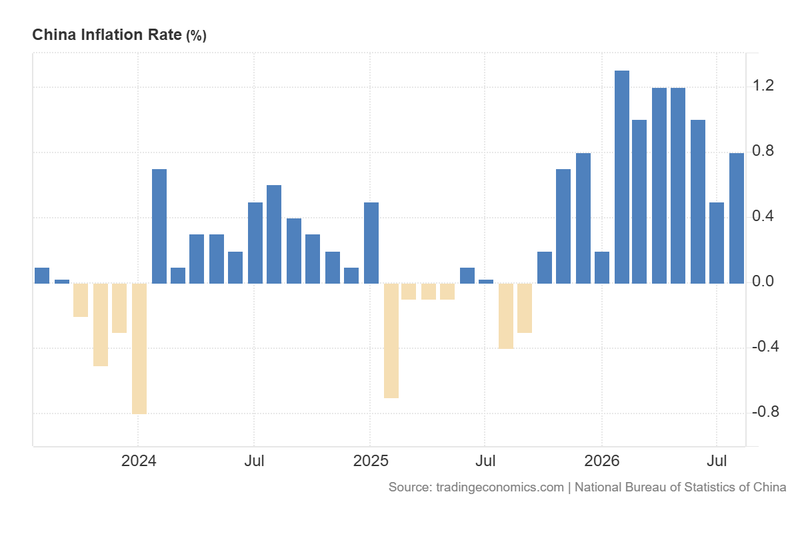
Figure 1. China Inflation Rate (2023–2026). Source: Data from the National Bureau of Statistics of China; chart via Trading Economics.

