
 Support
Democratic midterm victory lifts US equities as services activity softens
The US stock market rallied following the Democratic victory in the midterm elections, which reduced political uncertainty and drove crude oil prices lower, while economic data indicated ongoing expansion in US services and accelerating European inflation.

US stock benchmarks jumped as Democratic midterm wins and plunging crude oil prices mitigated political uncertainty.
Semiconductor shares slumped sharply across the board over growing fears of stricter AI regulation.
The US services PMI eased amid rising concerns regarding tariffs and fuel costs within supply chains.
EU inflation rose to 4.0% due to surging energy costs, spurring gains in the EUR/USD exchange rate.
Date: 5 November 2026 (GMT+3)
US stock markets jump following democratic victory in both Senate and House of Representatives as oil prices plunge
US equity benchmarks surged in tandem following the US midterm elections, in which Democrats secured majorities in both the Senate and the House of Representatives. The S&P 500 Index advanced by 1.58% to 7,688 points, the Nasdaq 100 rose by 0.91% to 28,437, and the Dow Jones Industrial Average jumped by 3.03% to 53,361 points.
This market rally was primarily driven by a significant reduction in political uncertainty, alongside expectations that inflationary pressures could abate on hopes of a diplomatic resolution between Washington and Tehran in the Middle East. Against this backdrop, oil prices plunged, with the Brent crude futures contract (BRN) dropping by 8.67% to $94.62 per barrel, while West Texas Intermediate (WTI) futures contract (CL) fell by 8.29% to $88.12 per barrel.
Notably, US Vice-President JD Vance distanced himself from President Donald Trump regarding the war with Iran, questioning the political cost incurred by Republicans in the midterm elections, as reported by Reuters. The Vice-President stated that "the reason we lost is the war", as quoted by CNBC. In this context, it is anticipated that congressional Democrats may seek to restrict funding for military operations, complicating the continuation of the conflict.
However, despite the sharp decline in oil prices, market expectations of a Federal Reserve interest rate hike remained firm. According to the CME FedWatch Tool, the market-implied probability of a rate increase at the Fed's December meeting stands at 81.5%, indicating that investors continue to price in a restrictive monetary policy stance from the central bank.
Meanwhile, the semiconductor sector did not benefit from the Democratic victory, as shares fell across the board on fears of tighter regulatory oversight of artificial intelligence. Nvidia dropped by 3.17%, Intel declined by 3.77%, Micron fell sharply by 7.00%, and Broadcom depreciated by 2.00%.
US services PMI moderates, missing analysts' expectations
According to data published by the Institute for Supply Management (ISM), the US Services Purchasing Managers' Index (PMI) decelerated from 54.9 in September to 54.5 in October, falling short of analysts' consensus estimates of 54.8. Nevertheless, despite the slight deceleration, the index remains above the critical 50.0 threshold, marking 28 consecutive months of expansion. Consequently, the PMI maintains a resilient upward trajectory over the past year, reflecting sustained momentum within the services sector.
The underlying moderation in October was primarily driven by slower growth in New Orders (which declined from 59.8 in September to 55.9 in October), Business Activity (down from 56.5 to 53.8), Inventories (down from 57.8 to 55.4), and Prices (easing from 74.0 to 73.0). Conversely, the New Export Orders index rebounded sharply, expanding from 46.9 to 55.2.
Meanwhile, the compounding impacts of tariffs and elevated fuel costs were the most frequently cited factors exerting pressure on domestic supply chains, according to data cited by Trading Economics.
At the market close, broader economic resilience helped underpin equity valuations, with the Dow Jones Industrial Average recording the strongest relative performance across US stock indices.
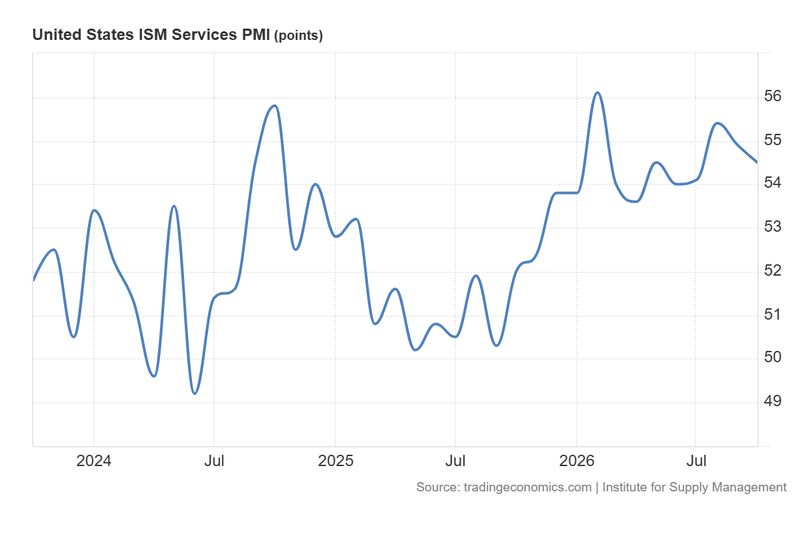
Figure 1. US Services PMI (2023–2026). Source: Data from the Institute for Supply Management (ISM); chart retrieved via Trading Economics.
European Union inflation rate accelerates to 4.0%, matching market estimates
Data released by Eurostat indicates that the annual inflation rate in the European Union accelerated from 3.8% in September to 4.0% in October (year-on-year), matching market expectations. Eurostat's report highlighted that the increase was predominantly driven by higher energy prices stemming from the ongoing conflict in the Middle East, with energy inflation surging by 20.8%, as cited by Trading Economics.
Conversely, the core inflation rate—which excludes volatile components such as energy and unprocessed food—remained stable at 2.5%. This stability suggests that underlying price pressures in the euro area remain primarily linked to energy market volatility rather than broad-based domestic inflation.
Following the Eurostat release, the euro appreciated by 0.35% against the US dollar, with the EUR/USD currency pair settling at 1.1227. This market movement suggests that investors are anticipating a potential hawkish monetary policy response from the European Central Bank (ECB) as inflation continues to run above its 2.0% medium-term target.
