
 Support
 Fed rate-hike expectations rise on strong US inflation; China trade advances
Surging US inflation driven by energy price spikes has heightened Federal Reserve rate-hike expectations, weighing on equity valuations and bolstering the US dollar, whilst China's trade surplus expanded significantly despite subdued domestic demand.

US headline inflation accelerated to 3.7%, reinforcing market expectations of tighter Federal Reserve monetary policy.
Equity markets declined while the US dollar strengthened alongside mounting inflationary pressures.
China's trade surplus reached $133.53 billion, propelled by robust artificial intelligence exports despite sluggish domestic consumption.
Quarterly earnings reports from major US banks delivered mixed results, failing to improve overall equity market sentiment.
Date: 14 October 2026
US inflation rate accelerates beyond analysts' estimates, raising restrictive Fed expectations; equities decline as greenback gains
According to data released by the US Bureau of Labour Statistics (BLS), headline inflation accelerated from 3.4% in August to 3.7% in September, surpassing analysts' consensus estimates of 3.6%. Concurrently, the BLS report revealed that core inflation—which excludes volatile components such as energy and unprocessed food prices—nudged upward from 2.4% to 2.6%, indicating that energy price pressures may be spilling over into the core index.
In detail, the report demonstrated that gasoline prices jumped by 34.2% year-on-year (YoY), while fuel oil surged by 74.2% YoY—as cited by CNBC. These two items constituted the heaviest drivers of headline inflation—a dynamic that could worsen should energy prices filter further into the core basket as elevated transportation and logistical costs are passed on to processed food and the service sector.
Consequently, the CME FedWatch Tool reflected notable recalibrations relative to preceding trading sessions. The market-implied probability of a Federal Reserve rate hike at its October meeting rose to 33%, though the baseline scenario remains an unchanged policy stance with a 67% probability. Nevertheless, expectations of subsequent policy tightening gained traction: the FedWatch Tool signalled a 62% probability of a 25-basis-point rate hike and a 29% likelihood of a 50-basis-point increase on Fed's December meeting.
Following the inflation release, US equity benchmarks declined in tandem. A higher-for-longer interest rate environment typically dampens corporate capital expenditure on growth projects while depressing equity valuations through higher discount rates. The S&P 500 index fell 1.11% to 7,718 points, the Nasdaq 100 dropped 2.02% to 29,950 points, and the Dow Jones Industrial Average slipped marginally by 0.09% to 51,626 points.
Concurrently, the US dollar index appreciated by 0.31% to close at 102.53 points, having touched an intraday high of 102.94 points. Demand for the greenback typically strengthens in elevated interest rate environments as rising US Treasury yields attract foreign capital flows. Consequently, investors could be increasing allocation to US currency holdings, leading to dollar gains against major peers including the euro, Japanese yen, and British pound.
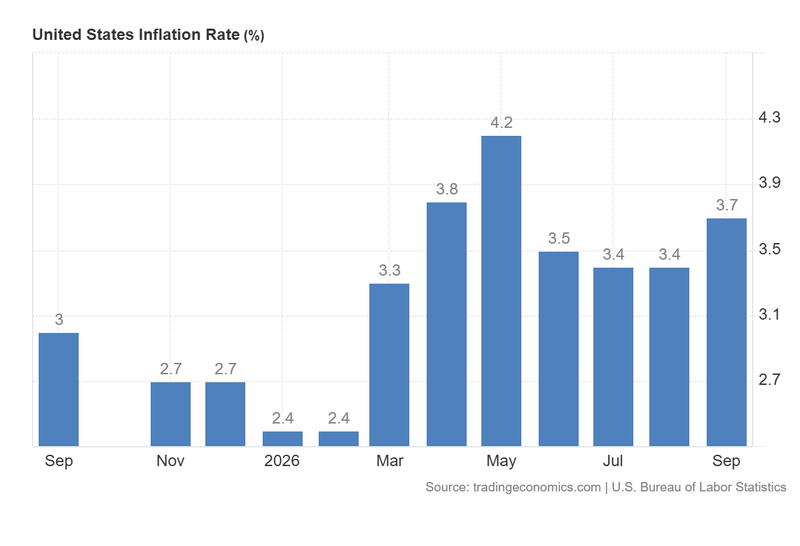
Figure 1. US Inflation Rate (2025–2026). Source: Data from the US Bureau of Labour Statistics; chart retrieved via Trading Economics.
Chinese trade balance expands, strengthening its long-term upward trend
Data from China's General Administration of Customs revealed that the Chinese trade surplus expanded robustly from $119.09 billion in August to $133.53 billion in September, substantially beating analysts' consensus forecasts of $118.1 billion. This marks the highest monthly trade surplus recorded since January 2025, reinforcing the long-term upward trajectory of the country's trade performance.
The strong trade balance was primarily driven by a surge in exports to $447.18 billion, representing a 36.3% YoY increase, while imports grew by 31.0% YoY to $313.66 billion (as cited by Trading Economics). Export strength was underpinned by robust global demand for Chinese artificial intelligence (AI) and high-technology goods, whereas imports were buoyed by elevated domestic appetite for AI-related hardware, crude oil, and industrial commodities.
However, despite resilient external trade performance, domestic consumption remained subdued. According to data from the National Bureau of Statistics of China, annual consumer price inflation picked up slightly from 0.8% in August to 0.9% in September, falling short of market expectations of 1.0%. This divergence underscores an economy reliant on strong external demand to sustain growth, while internal consumption continues to struggle for momentum.
Following the economic releases, the FTSE China A50 equity index fell 1.49% to 13,512 points, while the Hang Seng Index experienced a minor decline of 0.11% to close at 24,330 points.
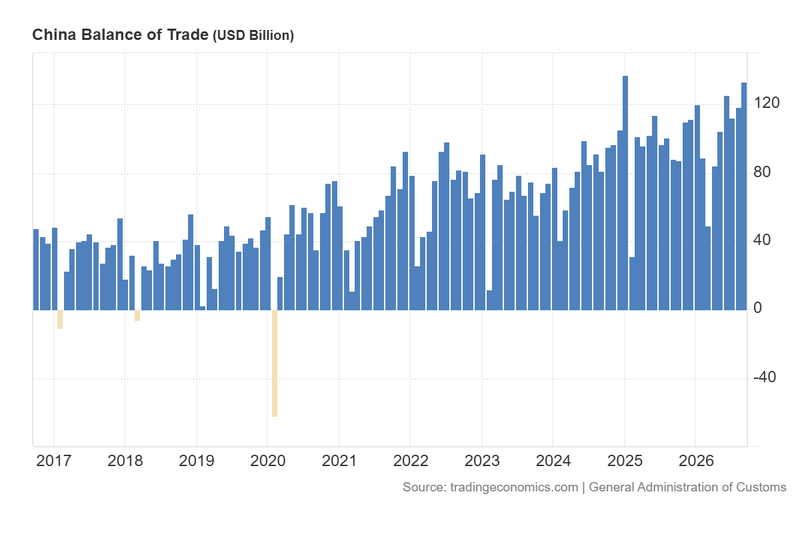
Figure 1. China Balance of Trade (2016–2026). Source: Data from China's General Administration of Customs; chart retrieved via Trading Economics.
Major US banks deliver mixed quarterly earnings results
Although major US financial institutions delivered mixed quarterly results, earnings announcements failed to catalyse positive sentiment across equity markets, with investors remaining primarily focused on inflation dynamics and artificial intelligence developments.
In the previous session, both Goldman Sachs and Citigroup beat analyst estimates for revenue and earnings per share (EPS); nonetheless, their shares posted two-day cumulative declines of 1.75% and 7.22%, respectively. Conversely, JPMorgan Chase missed expectations on both top and bottom lines yet managed a modest share price gain of 0.27% (two-day performance). Meanwhile, Wells Fargo topped EPS estimates but missed revenue forecasts, leading to a two-day share price contraction of 2.85%.
During today's trading session, Morgan Stanley and BlackRock both delivered better-than-expected top- and bottom-line results, though share price reactions were mixed: Morgan Stanley fell 2.75%, whereas BlackRock advanced 0.72%. Furthermore, Bank of America missed revenue and EPS forecasts, prompting a sharp share price drop of 4.76%.
