
 Support
Iran tensions lift oil, US housing weakens and Huang's exit weighs on Nvidia
US stock markets retreated amid surging energy prices. US existing home sales declined to a multi-year low amid elevated mortgage rates. Additionally, Jensen Huang's resignation from Nvidia dampened investor sentiment.

Oil and gas prices jumped after US–Iran diplomatic talks stalled, while the US President stated that the Washington does not need a deal with Tehran.
Elevated mortgage rates have pushed October existing home sales to their lowest level since 2010.
Nvidia's shares dropped 4.34% after CEO Jensen Huang resigned amid an extramarital affair scandal.
Major US indices declined in tandem as energy prices advance and technology sector uncertainty weighed on markets.
Date: 13 November 2026 (GMT+3)
Oil prices jump after US President Donald Trump states that the US does not need a deal with Iran
Oil prices surged amid renewed concerns that the US–Iran conflict could be prolonged. The Brent crude futures contract (BRN) rose by 3.30% to $95.82 per barrel, while the West Texas Intermediate (WTI) futures contract (CL) advanced by 2.76% to $88.92 per barrel. Furthermore, the Dutch TTF Natural Gas futures contract (TFM)—the primary natural gas benchmark for European countries—jumped by 10% amid concerns over further energy supply disruptions should the conflict persist.
This surge in oil prices followed a Truth Social post in which US President Donald Trump stated that Washington does not need a deal with Tehran—as cited by CNBC. Additionally, the US President wrote that the United States holds hundreds of billions of dollars in Iranian funds, as well as their Strait—referring to the Strait of Hormuz.
This shift in rhetoric is influencing the oil market, driving prices higher as energy traders anticipate that supply disruptions across the region could be prolonged. Following the US midterms, the US President stated that fresh attacks on Iran were highly unlikely as talks to end the conflict were progressing. However, Trump's latest comments signal that Washington remains resistant to negotiating, whilst Iran has not altered its demands.
Notably, both sides have clearly defined objectives, yet neither appears willing to make significant concessions. Washington is seeking the complete dismantlement of Iran's nuclear stockpile, whilst Tehran is demanding the lifting of sanctions and full compensation for war-related damage. These competing demands highlight the substantial gap between the two sides' negotiating positions, leaving little clarity on where, or how, a diplomatic agreement might emerge.
US existing home sales decline to their lowest level in more than ten years
According to data released by the National Association of Realtors (NAR) of the United States, existing home sales declined by 5.5% month-on-month in October, marking the steepest contraction since January 2026. Consequently, the seasonally adjusted annual rate of existing home sales fell from 3.97 million in September to 3.75 million in October, missing analysts' estimates of 3.85 million. Crucially, this represents the lowest level registered since August 2010—as reported by Reuters.
Against this backdrop, existing home sales have declined as mortgage interest rates have increased, exhibiting an inverse correlation over the last years. According to data published by the Federal Reserve Bank of St. Louis (FRED), the average 30-year fixed-rate mortgage in the US reached 7.11% (as of 12 November 2026). This reading stands well above the indicator's five-year average. When mortgage interest rates are higher, housing demand tends to decrease as financing becomes more expensive.
Additionally, mortgage rates are linked to long-term Treasury yields, which have been rising as concerns over higher inflation intensify. This has weighed on housing demand amid growing expectations of further interest rate hikes by the Federal Reserve to contain price pressures.
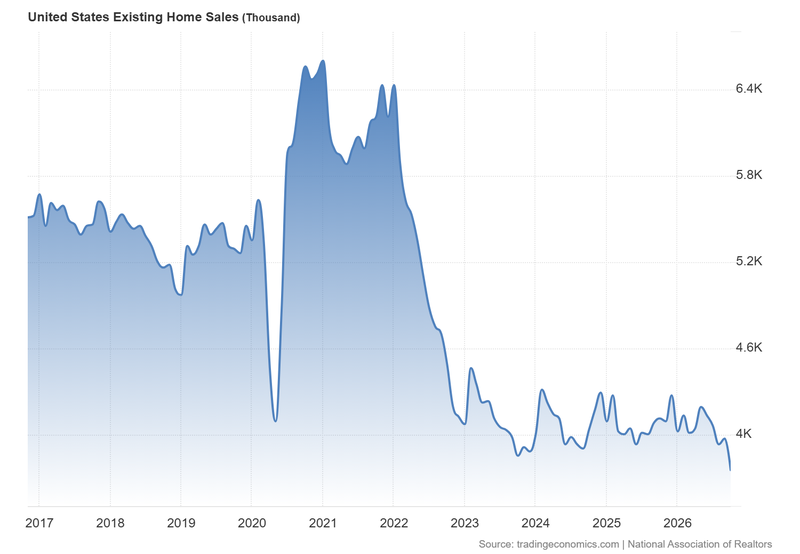
Figure 1. US Existing Home Sales (2016–2026). Source: Data from the National Association of Realtors; chart retrieved via Trading Economics.
Nvidia's shares fall after Jensen Huang resigns as CEO
Nvidia's shares exhibited a sharp contraction during the market session following Jensen Huang's resignation as President and CEO of the semiconductor company. The decision followed a controversy involving two alleged extramarital affairs, including allegations of a relationship between an Nvidia woman executive, as well as a woman reportedly suspected of having links to Chinese intelligence. Consequently, Chief Financial Officer (CFO) Colette Kress was appointed interim CEO, while Harvey Jones was named the firm's first-ever board chairman—as reported by Reuters.
At market open, Nvidia's shares plunged by 13% following Jensen Huang's resignation, although the price recovered during the trading session, closing with a net decline of 4.34% at $166.19.
While this development directly raises concerns regarding Nvidia's future, market participants have also signalled fears over broader implications for the performance of the artificial intelligence (AI) sector in the United States, given Jensen Huang's substantial influence across the industry.
In this context, major US equity benchmarks declined in tandem amid two primary factors weighing on market sentiment: Nvidia's pullback and the surge in oil prices. The S&P 500 Index declined by 0.35% to 7,592, the Dow Jones Industrial Average dropped by 0.36% to 52,302, and the Nasdaq 100 Index fell by 0.30% to 28,289 points.
