
 Support
Semiconductor selloff weighs on markets; BoE hikes rates
US markets plummeted over AI regulatory fears following midterm election results, while the Bank of England raised interest rates to 4.0% and Eurozone producer prices surged due to Middle Eastern energy shocks.

Democrats securing Congress sparked fears of stricter AI regulation regarding data centre energy.
Major chipmakers led a sharp sell-off that erased nearly $3 trillion in S&P 500 market value.
The Bank of England raised interest rates by 25 bps to 4.00% to combat rising 3.5% headline inflation.
European producer inflation accelerated to 11.1% in September, driven by severe energy price hikes.
Date: 6 November 2026 (GMT+3)
US stock markets plunge as semiconductor firms lead a significant sell-off
US equity benchmarks plunged, led by semiconductor firms, as market participants expressed growing concern over potential further regulation of artificial intelligence (AI) by Democrats. The S&P 500 index dropped by 4.36% to 7,353 points, the Dow Jones Industrial Average declined by 3.44% to 51,528, and the Nasdaq 100 fell by 6.36% to 26,629 points. Notably, the Volatility Index (VIX) surged by 69.70% to 28.17 points, reflecting significant uncertainty among investors.
After the Democrats secured control of both chambers of Congress in the midterm elections, market participants are concerned that lawmakers could introduce further regulation targeting AI development, particularly sectors linked to the semiconductor industry and data centres. This issue has come under increasing scrutiny, as the expanding water and energy demands of AI data centres place additional pressure on local resources, potentially intensifying competition between technological infrastructure and the fundamental needs of surrounding communities.
Among the most significant decliners were Nvidia, which fell by 9.26%; Broadcom, down 10.43%; Tesla, dropping 10.77%; Micron, depreciating 17.46%; and Advanced Micro Devices, plunging 17.26%. Remarkably, Nvidia lost its rank as the largest company in the S&P 500 index, slipping to second place behind Apple. Against this backdrop, the sell-off erased around $3 trillion in stock market value within the S&P 500 index alone.
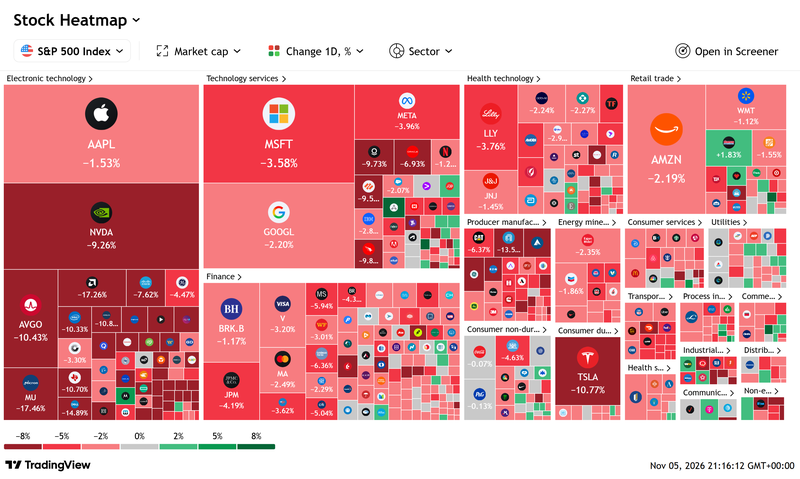
Figure 1. S&P 500 Index Heatmap (5 November 2026). Source: Figure retrieved from TradingView.
Bank of England decides to increase benchmark interest rate to 4%, in line with analysts' expectations
The Bank of England (BoE) decided to increase its benchmark interest rate by 25 basis points to 4.0%, matching analysts' expectations. This marks the central bank's first rate hike since August 2023, as UK policymakers focus on price containment amid headline inflation reaching 3.5%—a level substantially above the BoE's 2.0% target. The decision was backed by a majority, with eight policymakers voting in favour of a 25-basis-point increase and one member advocating a 50-basis-point hike.
The Bank of England expects headline inflation to rise to 5.0% by mid-2027, as surging energy prices produce second-round effects across the broader economy, such as the pass-through of costs from producers to consumers. Consequently, the central bank is seeking to act pre-emptively against the risk of persistent price pressures. Furthermore, the BoE highlighted that rising fuel costs resulting from ongoing geopolitical tensions in the Middle East—particularly for petrol, diesel, and natural gas—have exerted considerable strain on UK supply chains, an inflationary factor that requires decisive monetary action.
Finally, the UK central bank emphasised that it will continue to evaluate incoming economic data, making policy decisions on a meeting-by-meeting basis.
Despite the BoE's hawkish stance, the British pound depreciated by 0.13% against the US dollar, with the GBP/USD exchange rate settling near $1.3447. This market reaction suggests that the rate hike had largely been priced in by investors.
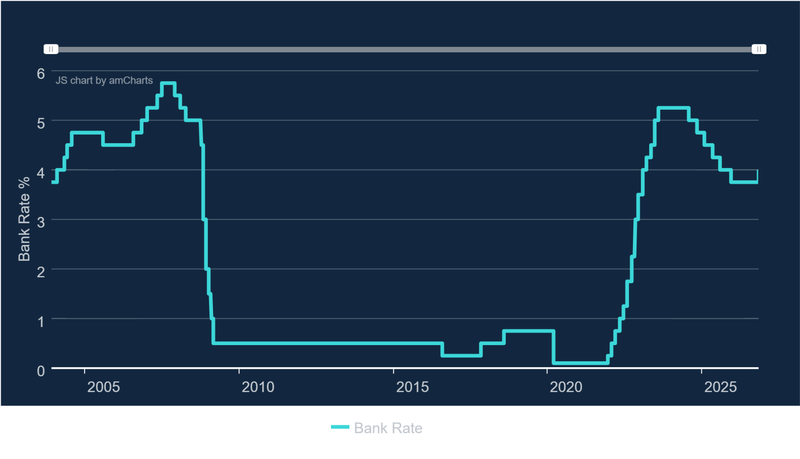
Figure 2. UK Bank Rate (2005–2026). Source: Figure retrieved from the Bank of England's official portal.
European Union producer inflation accelerates above market forecasts
According to data released by Eurostat, producer price inflation accelerated from 8.3% in August to 11.1% in September, exceeding analysts' expectations of 10.9%. This surge was primarily driven by rising energy costs, which have placed severe pressure on broader supply chains across the Eurozone.
On a year-on-year (YoY) basis, the price of Brent crude—the primary oil benchmark for European economies—has increased by approximately 52%. Concurrently, the Dutch TTF natural gas futures contract—the key benchmark for the Eurozone—has surged by 186%. These substantial increases are directly tied to ongoing geopolitical tensions in the Middle East, which have triggered severe energy supply disruptions for Europe, a region heavily reliant on imported energy commodities.
Nevertheless, by the market close, the EUR/USD currency pair recorded a slight depreciation of 0.10%, suggesting that investors viewed the producer price release as relatively less impactful.
