
 Support
 US stocks fall on renewed geopolitical tensions; Canadian inflation exceeds forecasts
US benchmarks fell on renewed geopolitical tensions, halting progress on peace talks. Market anxiety intensified ahead of crucial PCE inflation data, while a 16% drop in SpaceX shares added significant selling pressure. Concurrently, Canadian inflation surged to 3.2%, breaching the central bank's target due to soaring gasoline costs.

The S&P 500 and Nasdaq 100 dropped amid renewed geopolitical tensions, heightening fears of a widening Middle Eastern conflict.
Investors are focused on upcoming US PCE data to gauge future interest rate paths under the Federal Reserve's new Chairman, Kevin Warsh.
SpaceX shares tumbled 16% to $154.60 after the company announced its first public bond emission to fund long-term capital projects.
Canadian inflation unexpectedly surged to 3.2% in May, driven by a 33.2% spike in gasoline prices and exceeding the BoC's target range.
US stocks decline on renewed geopolitical tensions
The benchmark US stock indices, the S&P 500 and the tech-heavy Nasdaq 100, fell in parallel as optimism regarding a sustainable US-Iran conflict resolution deteriorated. At the closing bell, the S&P 500 index retreated by 0.37% to settle at 7,472 points, while the Nasdaq 100 index decreased by 0.19% to finish at 30,347 points. According to reports from Reuters, although US and Iranian officials noted that significant diplomatic progress had been achieved, deep-seated tensions persist over military operations in Lebanon and security within the Strait of Hormuz. Geopolitical risks remain highly elevated as cross-border engagements between Israel and Hezbollah continue. In response to these hostilities, Iran announced its intention to restrict transit through the Strait of Hormuz—a vital global maritime choke point—until military actions on Lebanese territory cease.
Market participants have consequently shifted their focus to the upcoming PCE Price Index data, scheduled for release later this week. At the latest Federal Reserve monetary policy meeting, the newly installed Chairman, Kevin Warsh, was emphatic that the central bank’s overriding priority remains the containment of inflationary pressures in the coming periods. Consequently, this updated PCE inflation reading is expected to provide critical clues to market participants regarding upcoming interest rate decisions and the broader policy framework.
Additionally, equity market selling pressure was reinforced by a sharp 16% depreciation in SpaceX shares, which heavily weighed on investor sentiment. The aerospace firm announced its first bonds offering since becoming a public company, a strategic move aimed at expanding its cash reserves to finance long-term capital infrastructure projects. However, equity investors did not interpret the debt issuance as a positive near-term catalyst, triggering a sell-off that returned the SpaceX share price to $154.60.
Canadian inflation rate accelerates above analysts’ expectations
Data published by Statistics Canada reveals that the country's headline consumer price inflation accelerated from 2.8% in April to 3.2% in May on a year-on-year basis. This reading significantly overshot the market consensus forecast of 3.0%. The primary driver behind this acceleration was a substantial increase in retail gasoline inflation, which surged from an annual rate of 22.8% in April to 33.2% in May, reflecting the broader impact of the Middle East conflict on global energy supply lines. On a month-on-month basis, headline inflation increased by 1.0%, outpacing the market estimate of a 0.8% expansion and following a 0.4% increase in the prior month.
Consequently, headline consumer price growth has moved past the upper ceiling of the Bank of Canada’s (BoC) official 1% to 3% target range. This breach introduces renewed policy challenges and intensifies pressure on the Canadian central bank ahead of its upcoming monetary policy meetings. Meanwhile, core inflation—which strips out the highly volatile components of energy and unprocessed food—advanced marginally from 2.1% to 2.2% over the same year-on-year period.
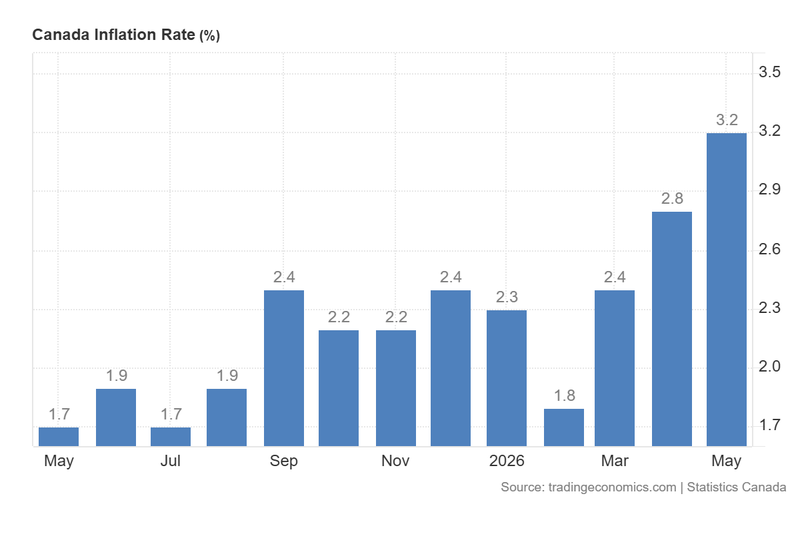
Figure 1. Canada Inflation Rate (2025–2026). Source: Data from Statistics Canada; Figure obtained from Trading Economics.
Key economic events this week
Several critical economic indicators are scheduled for release this week, with the following being of particular importance to market participants:
Monday
- Canada: Inflation Rate
Tuesday
- Germany: Manufacturing PMI
- United Kingdom: Manufacturing PMI
Wednesday
- Germany: Ifo Business Climate
- US: EIA Crude Oil Stocks Change
Thursday
- Germany: GfK Consumer Confidence
- US: PCE Price Index
- US: Personal Income
- US: Personal Spending
