
 Support
US stocks slide on chip selloff; UK and Canadian retail sales strengthen
US equity indices plunged amid a sharp semiconductor sell-off driven by artificial intelligence scrutiny and hawkish Federal Reserve expectations. Conversely, retail sales in Canada and the United Kingdom surpassed analysts' expectations.

Major US indices plunged as semiconductor stocks fell sharply amid scrutiny of AI returns.
Elevated probabilities of December and January interest rate hikes by the Federal Reserve weighed on US equities.
Canadian retail sales accelerated by 7.5% year-on-year in September, reaching a multi-year high.
British retail sales rose by 2.3% year-on-year in October, surpassing analysts' expectations.
Date: 21 November 2026 (GMT+3)
US stock markets plunge amid significant sell-off in semiconductor firms
US equity markets recorded significant losses amid a sharp sell-off in semiconductor firms. The Dow Jones Industrial Average declined by 1.93% to 48,151 points, the S&P 500 index dropped by 3.70% to 6,910, and the Nasdaq 100 index plunged by 5.61% to 25,028 points. This downturn occurred amid heightened scrutiny of artificial intelligence (AI)-related firms regarding the sustainability of their capital expenditures (Capex), as well as their capacity to capitalise on returns from these elevated investments.
Notably, the volatility index jumped by 26.28%, reaching 35.90 points. This signals a marked increase in put contracts, suggesting that market participants are seeking to hedge via derivatives.
Against this backdrop, the steepest declines occurred among semiconductor firms. Advanced Micro Devices dropped by 13.25%, Micron decreased by 13.89%, Broadcom fell by 12.19%, while Nvidia plunged by 14.01%. In particular, Nvidia faced acute downward pressure following a Reuters report signalling a potential investigation by the US Securities and Exchange Commission (SEC) into possible accounting issues at the firm.
Additionally, expectations of a more hawkish monetary policy stance from the Federal Reserve weighed on US equity markets. According to the CME FedWatch Tool, market-implied probabilities signal a 91% likelihood that the US central bank will raise its benchmark interest rate by 25 basis points at its December meeting, followed by a secondary interest rate hike at its January 2027 meeting (signalling a 57% probability).
Crucially, AI-related companies Anthropic and SpaceX declined by 8.50% and 7.69%, respectively, amid the broader scrutiny surrounding AI.
Canadian retail sales (YoY) surge to highest level since July 2022
According to data released by Statistics Canada, Canadian retail sales accelerated from 5.6% in August to 7.5% year-on-year (YoY) in September, reaching their highest level since July 2022. On a monthly basis, retail sales increased by 0.8%, exceeding analysts' estimates of 0.7%. This expansion was primarily driven by a solid performance at gasoline stations and fuel vendors, where sales rose by 6.9%—as cited by Trading Economics. Additionally, sales advanced marginally across new car dealers, as well as motor vehicle and parts dealers.
Although the implementation of US tariffs on Canadian goods has weighed on the broader economy, key indicators of productivity and consumption have remained resilient. Against this backdrop, the gross domestic product (GDP) growth rate rose by 0.8% in Q2 2026 (the latest available reading), year-on-year industrial production increased by 2.2% in August (its highest level since March 2025), and year-on-year retail sales recorded their strongest pace since 2022 in the September release.
However, following the economic report, the Canadian dollar depreciated marginally by 0.01% against the US dollar, with the USD/CAD pair closing at 1.4339.
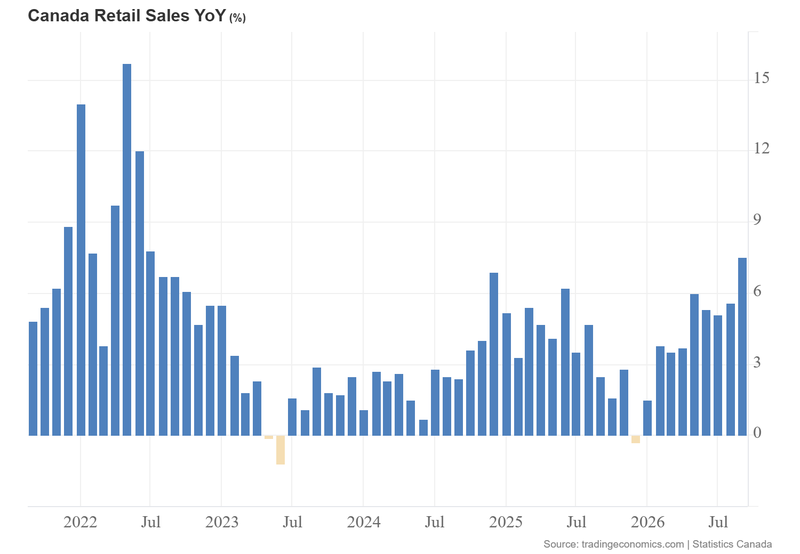
Figure 1. Canada Retail Sales YoY (2021–2026). Source: Data from Statistics Canada; chart retrieved via Trading Economics.
UK retail sales accelerate beyond analysts' expectations
The United Kingdom's Office for National Statistics (ONS) reported that retail sales recovered from 0.4% in September to 2.3% in October (YoY change), exceeding analysts' estimates of 1.7%. On a monthly basis, UK retail sales rose by 0.7%, comfortably surpassing the market consensus estimate of 0%. This underlying strength reflected higher sales across both food and non-food retailers. Notably, supermarkets, non-food stores, and online clothing retailers registered a robust performance during the analysed month.
Nevertheless, the British pound registered a marginal depreciation against the US dollar at market close, with the GBP/USD pair settling at $1.3082. Market participants remained primarily focused on expectations that the Federal Reserve could adopt a more restrictive monetary policy stance at upcoming meetings, which has supported the greenback against major currencies such as the pound.
