
 Support
 US stocks weaken on economic and AI concerns; Gold falls amid dollar strength
US equities fell as doubts over debt-fuelled artificial intelligence (AI) spending and rising expectations of a hawkish Federal Reserve weighed on risk appetite, with semiconductor shares leading losses. The Nasdaq 100 slumped, the VIX jumped, and gold declined as a stronger dollar reduced demand for non-yielding assets.

US stocks fell, led by chipmakers, as concerns over debt-backed AI investment and tighter Federal Reserve policy weakened sentiment.
Semiconductor losses were steep: Micron fell 13.18%, Qualcomm 8.01%, Intel 6.14%, AMD 5.76%, and Nvidia 4.13%.
The Nasdaq 100 slid 3.29%, the S&P 500 lost 1.44%, and the Dow fell 0.09%, while the VIX jumped 12.67% amid higher volatility.
Gold fell 1.19% to $4,149 as the DXY rose 0.39% to 101.37, with higher Federal Reserve rate expectations weighing on bullion.
Economic risks and AI doubts weigh on US equities
US stock benchmarks fell sharply, led by semiconductor companies, amid growing doubts about debt-financed artificial intelligence (AI) spending and rising expectations that the Federal Reserve could adopt a more hawkish stance in order to contain inflationary pressures.
According to a Reuters report, several technology firms have sought financing through bond markets in order to raise capital for growth projects linked to artificial intelligence. Notably, SpaceX announced its first bond issuance at the beginning of the week in order to raise capital, a development that contributed to a depreciation of around 16% in the company’s market capitalisation. By the market close, semiconductor firms had fallen sharply, with the most notable declines recorded by Micron (-13.18%), Qualcomm (-8.01%), Intel (-6.14%), Advanced Micro Devices (-5.76%), and Nvidia (-4.13%).
In addition, market participants remain concerned about the possibility of a more hawkish Federal Reserve at forthcoming monetary policy meetings, a scenario that could place pressure on the broader economy and on cyclical sectors such as technology, industrials, and financials. According to CME’s FedWatch Tool, implied probabilities indicate a 50% likelihood of a 25-basis-point increase at the September meeting, the highest probability in the assessment. In turn, the implied probability that the target rate reaches 4.25% at the December meeting stands at 34%, slightly below the 36% probability that it rises to 4.0%.
Consequently, the main stock benchmarks fell sharply in tandem. The Nasdaq 100 index plunged by 3.29% to 29,347 points, the S&P 500 declined by 1.44% to 7,365, while the Dow Jones Industrial Average fell by 0.09% to 51,672. By contrast, the volatility index (VIX) rose by 12.67% to 19.48 points, reflecting a sharp increase in implied volatility.
Market participants are now focused on Micron Technology, which is due to release its quarterly earnings report on Wednesday, 24 June, as well as the PCE Price Index update, which will be published by the US Bureau of Economic Analysis (BEA) on Thursday, 25 June. In both cases, investors are likely to obtain further information on the implications of AI for the semiconductor industry and on possible future movements in Federal Reserve monetary policy.
Gold falls amid dollar strength
Gold prices fell amid rising expectations of a more hawkish Federal Reserve stance and a stronger US dollar, which makes bullion more expensive for international buyers. As noted above, CME’s FedWatch Tool points to at least one interest rate hike by the December meeting, with implied probabilities cumulatively reaching 70%. The precious metal tends to weaken in a high interest rate environment, as the opportunity cost of holding non-yielding assets increases.
Consequently, the gold futures contract (GCQ6) declined by 1.19% to $4,149 per ounce. By contrast, the US dollar index (DXY)—which measures the dollar against major currencies such as the euro, pound, and yen—appreciated by 0.39% to 101.37 points, a level not seen since May 2025. Gold prices tend to fall when the US dollar strengthens, given that bullion—which is denominated in dollars—becomes more expensive for global buyers.
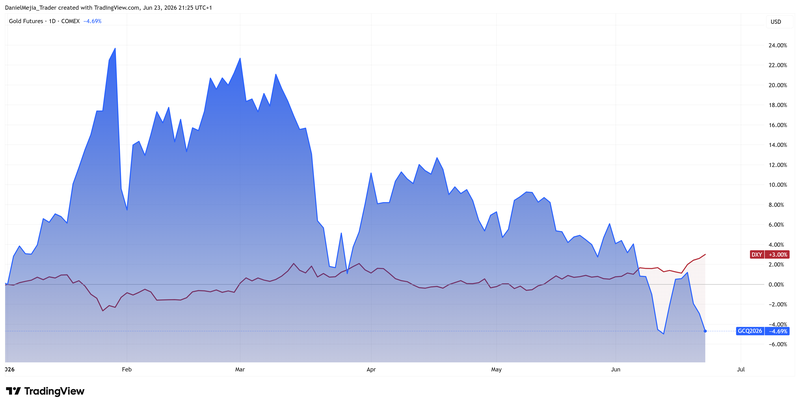
Figure 1. Gold Futures Contract vs Dollar Index (year to date). Source: Own analysis conducted via TradingView.
