
 Support
Are we already in an AI bubble? why the boom could still have further to run
Artificial intelligence increasingly looks like a textbook financial bubble: asset prices have surged, capital spending is accelerating at historic speed and investors are assigning extraordinary valuations to companies across the AI ecosystem. Yet this cycle is being supported by something many previous bubbles lacked - powerful earnings growth.

AI beneficiaries have delivered price gains that increasingly fit traditional definitions of a market bubble
The four largest hyperscalers could lift combined capital spending by more than 80% to about $750 billion this year.
With roughly 88% of S&P 500 companies having reported, second-quarter EPS growth is running close to 50% year over year.
AI-related debt issuance is projected to rise around 25% to $2.25 trillion, making higher interest rates one of the biggest threats to the boom.
The strongest economics remain concentrated in semiconductors and equipment, although software is beginning to re-emerge as an important part of the AI trade
The AI bubble debate has become impossible to ignore
Calling artificial intelligence a bubble immediately divides investors into two camps. One side sees another version of the late-1990s technology boom, where extraordinary expectations eventually became detached from financial reality. The other argues that AI represents one of the largest productivity shifts since the internet and that traditional valuation comparisons fail to capture the scale of what is coming.
The question investors should be asking is much harder: what will finally remove the earnings and liquidity support that is allowing the bubble to keep expanding?
Both views can contain some truth.
By conventional definitions, parts of the AI market already exhibit bubble characteristics. Prices of several companies associated with semiconductors, memory, data centers and artificial intelligence have risen far faster than their historical earnings or long-term price trends. Some of the most dramatic beneficiaries have multiplied several times over within only a few years, while late entrants to the rally have occasionally generated returns that rival or exceed those of companies such as Nvidia and Micron.
The mistake is assuming that identifying a bubble automatically tells investors when it will burst.
History suggests exactly the opposite. Bubbles can become increasingly obvious while asset prices continue rising for months or even years. The difficult part is rarely recognizing excess. It is identifying the catalyst that finally forces markets to reassess the assumptions embedded in prices.
That is where the current AI debate becomes much more interesting.
Why AI valuations increasingly look like a bubble
One classic definition of an asset bubble is a sustained rise in prices far beyond historical norms or underlying intrinsic value. Another focuses on the divergence of asset prices from their long-term real trend.
The current AI cycle increasingly satisfies both descriptions.
Semiconductor stocks have experienced extraordinary appreciation. Data-center suppliers, networking companies and memory manufacturers have been revalued around expectations of an enormous buildout in computing capacity. Software businesses with credible AI exposure have also seen sharp repricing whenever earnings demonstrate that artificial intelligence is accelerating revenue rather than threatening existing business models.
The concern has grown large enough to attract warnings from some of the most prominent investors on Wall Street. Ray Dalio has compared the current enthusiasm with conditions seen around 1929 and 2000, while Goldman Sachs has highlighted evidence of what it describes as valuation-bubble characteristics.
But price appreciation alone does not explain why the debate has intensified again.
The much bigger issue is spending.
$750 billion is becoming the number that defines the AI boom
The largest technology companies are building AI infrastructure at a scale corporate markets have rarely seen.
The four biggest hyperscalers are expected to increase capital expenditure by more than 80% this year, taking combined spending toward approximately $750 billion.
That money is flowing into advanced semiconductors, data centers, networking equipment, electricity generation, cooling systems, cloud infrastructure and the enormous computing clusters needed to train and operate increasingly sophisticated AI models.
The investment cycle is creating extraordinary revenue for suppliers. Nvidia, memory producers, semiconductor-equipment manufacturers and data-center businesses have benefited from demand that often exceeds available capacity.
But the same spending boom creates a difficult question for investors: how much future revenue must be generated to justify three-quarters of a trillion dollars of annual capital expenditure?
This is where the AI narrative is beginning to mature. During the early phase of the boom, higher capex itself was viewed as bullish because it demonstrated confidence in future AI demand. Markets are becoming more selective. Investors increasingly want to see evidence that those investments are generating attractive returns.
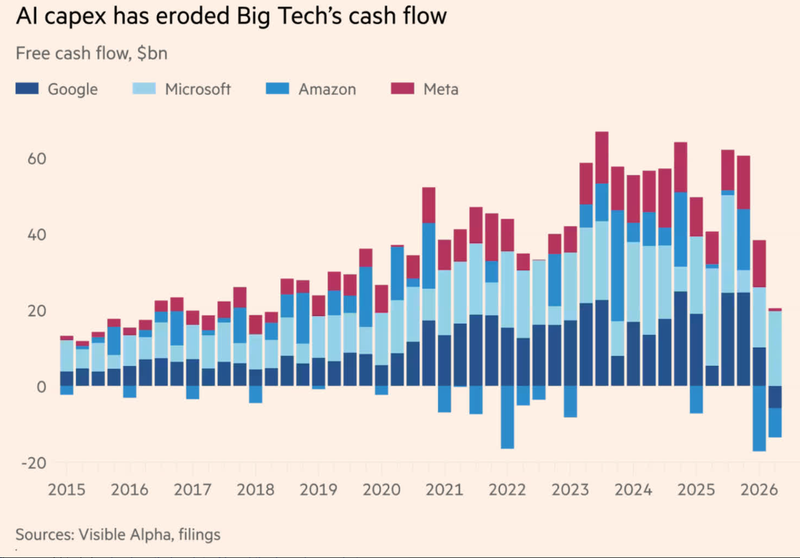
Free cash flow is becoming the pressure point
The hyperscalers entered the AI cycle with some of the strongest cash-generating businesses in the world. That provided enormous freedom to finance data centers and semiconductor purchases internally.
Yet capital spending has become so large that free cash flow is being squeezed toward some of its lowest levels in years across parts of the group.
That does not mean companies such as Microsoft, Amazon, Alphabet or Meta are facing financial distress. Their balance sheets remain exceptionally strong. The concern is about returns on capital.
Every dollar spent on an AI data center represents capital that could otherwise be returned to shareholders, used for acquisitions or retained on the balance sheet. The larger the investment becomes, the higher the future revenue and margins must be to justify it.
Markets currently expect free cash generation to improve materially from late 2027 as early AI infrastructure begins producing stronger cash returns.
That expectation has become one of the central assumptions supporting valuations.
If it proves correct, today's aggressive capex could eventually look entirely rational.
If it does not, investors may begin asking much harder questions about how much of the AI infrastructure buildout was economically necessary.
Earnings are the strongest argument against an imminent collapse
This is where the current AI cycle differs significantly from the most speculative moments of the dot-com bubble.
Corporate profits are booming.
With approximately 88% of the S&P 500 having reported second-quarter results, blended year-over-year earnings-per-share growth is running close to 50%.
That compares with approximately 15.2% average EPS growth over the past five years and around 11.2% over the past decade.
The comparison with expectations is even more striking. At the midpoint of consensus estimates, second-quarter earnings were initially expected to rise only about 23.1%.
Actual results have therefore been more than twice as strong as analysts initially anticipated.
The current quarter also marks the second consecutive period of more than 25% earnings growth and the seventh straight quarter of double-digit expansion.
Those numbers matter because market bubbles become particularly vulnerable when prices rise while earnings fail to follow.
That is not what is happening today.
A 20-times market multiple needs context
The S&P 500 trades at roughly 20 times forward earnings, a valuation that is elevated compared with many historical periods.
But companies in the index are also on track to produce earnings growth approaching 30% this year if the current trajectory continues.
That dramatically changes the valuation discussion.
A market trading at 20 times earnings while profits grow 5% would look expensive.
A market trading at the same multiple while earnings grow 30% presents a much more defensible case.
This does not mean the index is cheap. It means valuation cannot be analyzed independently from the extraordinary earnings environment.
The strongest argument for staying exposed to the AI trade is therefore not that valuations are reasonable. It is that corporate profits continue growing fast enough to support them.
For the bubble to become dangerous, that relationship may need to change.
Follow where the AI profits are actually accumulating
Another mistake is treating artificial intelligence as a single investment category.
The economics across the AI value chain are very different.
The most profitable areas have generally been closer to the physical infrastructure: advanced semiconductors, semiconductor equipment, memory, networking and other scarce components required to build computing capacity.
This is why semiconductor-focused vehicles such as SMH and SOXX have attracted so much attention throughout the boom.
When demand for AI computing significantly exceeds available supply, companies controlling the scarce infrastructure capture much of the economic value. Their margins can expand even while companies further up the chain spend aggressively.
The model and application layers can face a different problem. Competition is intense, pricing is less established and the cost of computing can consume a large portion of revenue.
That means investors should distinguish between companies financing the AI boom and companies earning the highest margins from it.
Software may be entering the next stage of the AI trade
Earlier this year, software stocks faced one of their sharpest sentiment shocks of the AI era.
The selloff became known as the “SaaSpocalypse,” reflecting fears that generative AI could reduce the value of traditional software subscriptions, automate coding and make established applications easier to replace.
Some of those concerns were reasonable. Others became excessive.
Since May, parts of the software sector have recovered strongly as companies demonstrated that AI could accelerate their businesses rather than destroy them.
Palantir, Atlassian, Twilio and Cloudflare are among the names that surprised investors with stronger operating performance and improved growth expectations.
This could mark an important evolution in the AI investment cycle.
The first phase was dominated by the companies supplying the hardware.
The next phase may increasingly reward businesses that prove they can turn AI infrastructure into recurring software revenue.
If that transition occurs, the trade does not necessarily disappear. Leadership simply moves from one part of the value chain to another.
The real warning signal is deceleration
Investors often wait for earnings to decline before becoming concerned.
That may be too late.
High-growth stocks can suffer severe corrections even while profits are still expanding if the rate of growth begins slowing materially.
Imagine a company growing earnings by 60%, then 45%, then 30%, then 20%.
The business remains profitable. It remains successful. It may still be gaining market share.
But a valuation assigned when profits were expanding at 60% may no longer make sense at 20%.
That is why earnings deceleration may ultimately matter more for the AI bubble than outright contraction.
The key numbers to watch are not simply revenue and earnings growth. Investors should monitor whether growth continues to exceed expectations and whether the return generated from each additional dollar of AI capex is improving or deteriorating.
Debt is quietly changing the AI risk profile
One of the most important developments in the AI boom is receiving less attention than semiconductor prices or data-center spending.
Debt financing is becoming much larger.
AI-related debt issuance is projected to increase approximately 25% to $2.25 trillion this year.
That matters because the investment cycle initially benefited from companies financing much of their expansion with enormous internal cash flows. As debt becomes more important, interest rates become much more relevant.
Higher borrowing costs can pressure the AI ecosystem from several directions simultaneously. Companies pay more to finance data centers and infrastructure, while investors apply higher discount rates to future earnings. Bonds become more competitive with expensive growth equities, and highly leveraged projects face greater pressure to demonstrate attractive returns.
The combination makes monetary policy one of the clearest potential catalysts capable of puncturing the bubble.
Interest rates may be the pin investors should fear most
Many financial bubbles end after monetary conditions tighten.
The mechanism is relatively simple.
Easy money encourages investors to pay higher prices for future growth. Abundant liquidity supports leverage, venture funding and large capital projects. When interest rates rise, those assumptions are suddenly tested against a higher cost of capital.
The late-1990s technology bubble ultimately collided with tighter financial conditions. Similar dynamics played an important role during earlier speculative episodes.
Artificial intelligence may be vulnerable to the same mechanism because the boom has become increasingly capital intensive.
A meaningful rise in rates would make the $750 billion hyperscaler spending cycle more expensive while potentially reducing the valuation multiples investors are willing to pay for the companies benefiting from it.
The AI technology itself could continue improving rapidly while AI stocks fall sharply.
Those two outcomes are perfectly compatible.
A technology can change the world and still become overpriced
This is perhaps the most important lesson from the dot-com period.
The internet bulls were fundamentally correct.
The internet did transform commerce, media, communication, advertising and virtually every major industry.
The problem was that investors paid prices assuming the transformation would produce enormous profits much faster than reality allowed.
Many companies disappeared. Some survived and became dominant businesses. Others eventually justified their valuations, but shareholders who bought at the peak spent years waiting for fundamentals to catch up.
AI could follow a similar path.
Artificial intelligence may prove to be as transformative as its strongest advocates believe. Nvidia, Microsoft and other leaders may remain extraordinary businesses.
That does not mean every price investors are willing to pay for them will ultimately produce attractive returns.
A great company and a great stock are not always the same thing.
Why leaving the market entirely carries its own risk
There is another side to the bubble debate that is often overlooked: opportunity cost.
Warnings about an AI bubble have circulated repeatedly since at least 2024. Investors who exited the market entirely after the earliest warnings would have missed enormous gains across semiconductors, infrastructure, software and the wider S&P 500.
That demonstrates the danger of treating investing as a binary decision between “bubble” and “not a bubble.”
A market can be overvalued and continue producing strong returns.
A bubble can expand significantly before the catalyst arrives that eventually breaks it.
The more useful approach is to identify where profits are accumulating, avoid assuming that every AI beneficiary deserves the same valuation and remain sensitive to changes in earnings, margins and capital spending.
What could actually burst the AI bubble?
Several developments deserve close attention.
The first is interest rates. A meaningful Fed tightening cycle or sustained increase in Treasury yields would raise financing costs and pressure valuations.
The second is hyperscaler capex guidance. If Microsoft, Amazon, Alphabet or Meta begin reducing AI infrastructure spending because demand fails to justify additional capacity, semiconductor and equipment suppliers could feel the effect quickly.
The third is declining AI margins. The extraordinary profitability currently enjoyed by some infrastructure providers depends partly on scarcity. Increasing competition and supply could compress those margins.
The fourth is slowing software monetization. If businesses struggle to convince customers to pay meaningful premiums for AI products, the revenue assumptions supporting the infrastructure buildout would need to be reconsidered.
And the fifth is earnings deceleration across the broader market. The S&P 500 can support elevated valuations while profits grow close to 30%. That equation becomes significantly less attractive if growth falls back toward historical averages.
The AI bubble may still become much larger
None of these warning signs currently amounts to definitive evidence that the boom is ending.
Corporate earnings remain exceptionally strong. AI computing demand continues to support semiconductor and infrastructure suppliers. Hyperscalers remain committed to enormous investment programs, and parts of the software industry are demonstrating improved monetization.
That environment can support elevated asset prices for longer than valuation-focused investors may expect.
This is what makes bubbles so difficult.
Prices can become detached from traditional historical norms long before the underlying momentum disappears. Investors who identify excess too early may be fundamentally correct and financially unsuccessful at the same time.
The end usually comes when one of the assumptions supporting the cycle changes.
For AI, the most important assumptions are strong earnings growth, plentiful financing, rising infrastructure demand and confidence that hundreds of billions of dollars in capex will eventually generate attractive returns.
Market takeaway
Artificial intelligence increasingly meets the textbook definition of a financial bubble, but that conclusion tells investors surprisingly little about what happens next.
Asset prices have surged. Hyperscaler capital expenditure could approach $750 billion this year. AI-related debt issuance may reach $2.25 trillion. Valuations across parts of the ecosystem have moved well above historical norms.
At the same time, the fundamental backdrop is extraordinarily powerful. S&P 500 second-quarter earnings are growing close to 50%, the index remains on track for roughly 30% annual EPS growth, and the most profitable parts of the AI value chain continue generating exceptional returns.
That combination explains why the bubble has not burst.
The real danger will emerge when the economics stop confirming the expectations embedded in prices. That could come through higher interest rates, slowing hyperscaler investment, weaker AI monetization, falling semiconductor margins or a broader deceleration in corporate earnings.
Until one of those conditions changes materially, the AI boom may remain expensive, speculative and remarkably resilient at the same time.
The question is no longer whether there are signs of a bubble. There clearly are.
The question investors should be asking is much harder: what will finally remove the earnings and liquidity support that is allowing the bubble to keep expanding?


