
 Support
 AI stocks face a revenue test as higher bond yields pressure valuation
The AI investment cycle is approaching a more demanding stage. OpenAI’s reported annualized revenue of nearly $50 billion, below the previously discussed figure of $70 billion, triggering a widespread tech sell-off.

Investors need to know how much of the industry's growth comes from independent customer spending.
Oracle illustrates how this expansion can create substantial financing requirements.
Salesforce, Adobe and Palantir have established customer relationships and products that can incorporate AI into existing business processes.
Revenue growth is no longer enough
OpenAI and Anthropic operate through complex cloud partnerships, and differences in how transactions are recognized can make headline revenue figures difficult to compare. Annualized revenue is also a run rate, not audited full-year revenue, the reported difference should therefore not be interpreted as a $20 billion loss of business or proof that customers are abandoning AI.
Microsoft’s financial disclosures provide another perspective on the scale of these relationships, illustrating how AI revenue is increasingly linked to commercial arrangements between model developers and their technology partners.
The concern is more fundamental
Investors need to know how much of the industry's growth comes from independent customer spending, how much is supported by cloud credits or financing arrangements, and how much economic value ultimately remains with the AI developer after computing costs and payments to infrastructure partners.
These distinctions matter
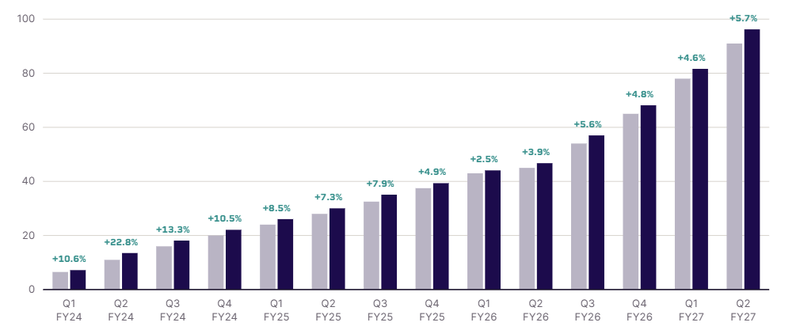
Nvidia illustrates the scale of the infrastructure opportunity, its data-centre business has become a central beneficiary of spending on AI computing, while Broadcom supplies custom chips and networking technology that help connect increasingly complex systems. Their growth demonstrates the strength of current investment, but it does not by itself establish whether the wider industry will generate enough recurring revenue to justify the full cost of building that capacity.
Source: rexshares
The capital cycle is becoming harder to sustain
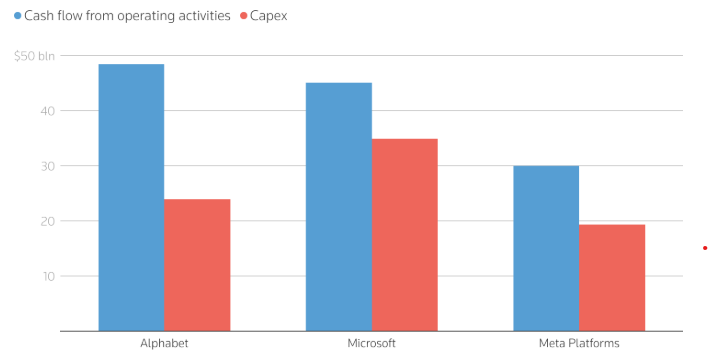
The infrastructure behind AI requires substantial spending before its full commercial return becomes visible. Semiconductor purchases, data centers, power supply and networking equipment must be financed upfront, while demand and utilization develop over time.
The economics work if customers continue paying more for AI services and the resulting revenue grows faster than the cost of delivering them.
Oracle illustrates how this expansion can create substantial financing requirements. Its cloud infrastructure ambitions require significant investment in additional capacity, making the relationship between future cloud revenue, customer commitments and the cash generated from that investment increasingly important.
Cloud partnerships can complicate that equation
A technology provider may finance or extend credits to an AI developer, which then purchases computing services from the same provider. These arrangements can accelerate adoption and make commercial sense, but the resulting spending needs to be assessed alongside its source of funding and the cash ultimately collected from end customers.
Microsoft and OpenAI provide a prominent example of this relationship, while Amazon and Alphabet have also developed significant cloud businesses around AI demand. These arrangements can give model developers access to computing capacity without requiring them to build everything themselves.
The risk emerges if infrastructure capacity grows faster than customers' willingness to pay. Lower utilization, pricing pressure or slower enterprise adoption would delay the recovery of capital expenditure, while operating expenses, depreciation and financing obligations remain. In that scenario, revenue could continue increasing without delivering the returns investors had anticipated.
Debt adds to the pressure on infrastructure spending
Companies financing data centres and computing capacity through bond markets become more sensitive to borrowing costs, refinancing conditions and investor appetite for risk. Corporate issuance does not automatically push government bond yields higher, but elevated market rates raise the hurdle for new projects. Capital expenditure that looked attractive under cheaper financing may no longer offer the same return.
This is the vulnerability in the AI investment cycle
Spending supports suppliers' revenues and reinforces expectations of further expansion, but the cycle depends on customers eventually generating enough cash to pay for the infrastructure. If monetization disappoints, the capital already committed cannot be recovered simply by maintaining the pace of spending.
Source: Company statements
The market will start separating builders from earners
That distinction could change where investors look for returns, semiconductor and infrastructure companies benefit directly from the construction phase of AI, but their growth ultimately depends on continued demand for additional computing capacity. If customers become more cautious or utilization fails to keep pace with new supply, even strong order books may offer less protection than investors expect.
Software companies offer a different route into the theme
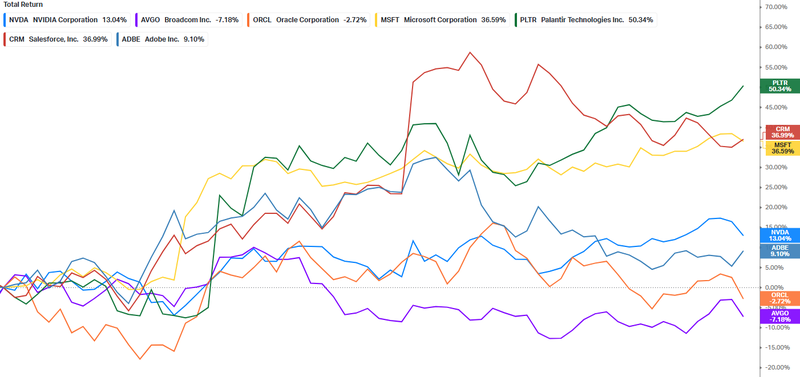
Salesforce, Adobe and Palantir have established customer relationships and products that can incorporate AI into existing business processes. Their opportunity lies in demonstrating that AI can increase revenue per customer, improve productivity or support higher margins without allowing computing costs to absorb the gains.
They are not automatic beneficiaries
Competition, disruption to existing products and elevated valuations remain risks. The market will need evidence that AI is creating incremental earnings rather than simply helping established companies defend their positions.
Source: Koyfin
What would change the outlook?
The base case is a more selective AI market, not an immediate collapse in investment. The decisive evidence will come from customer-funded revenue, cash conversion, operating margins, infrastructure utilization and returns on incremental capital expenditure. These measures will show whether spending is creating durable economic value or whether expected returns depend on another round of investment.
If monetization catches up with infrastructure costs, the AI investment cycle can continue even if valuations become more disciplined. If borrowing and capital expenditure keeps rising while cash generation disappoints, the risk of further repricing increases, particularly while bond yields remain elevated.
The AI opportunity has not disappeared
What is changing is the standard of proof. Investors have already financed much of the industry's expansion on the expectation of future demand, now they need to see that demand translate into earnings and cash flow capable of paying for it. The next phase of the trade will depend less on how much the industry spends than on what that spending ultimately earns.


