Support
AI infrastructure delays expose the financing risks behind the AI trade
AI trade now depends on more than demand for chips and computing power. Investors began pricing a slower path for data-centre approvals just as debt-funded expansion has made timing central to the sector's returns.

Democratic gains and local ballot measures increased the risk of tougher rules for power, water and data-centre approvals.
UBS estimates that about 30% of expected US data-centre capacity additions in 2028 could be exposed to pauses or delays.
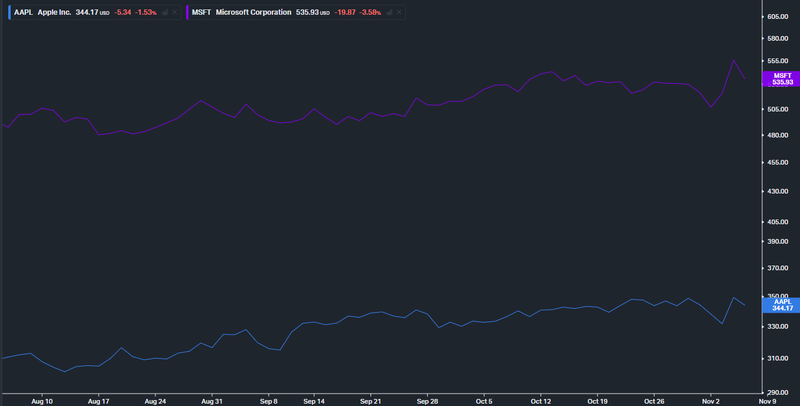
Apple and Microsoft held up better for different reasons: Apple carries far less infrastructure spending, while Microsoft can fund a much larger programme from operating cash flow.
The election changed the timetable behind the AI trade
The Nasdaq fell 5.5% and the Philadelphia Semiconductor Index lost more than 12%, yet the selling was concentrated in the companies most exposed to the physical expansion of AI. Chipmakers, server suppliers, power companies and specialized data-centre operators all depend on the construction schedule that markets had treated as increasingly certain. The election result made that schedule less secure.
Democratic gains in Congress increased the likelihood of closer scrutiny of the industry's power use and financing, while state and local races created a more immediate constraint. Planning permission, grid connections and water access are often decided below the federal level.
Communities that have accepted data centres as a source of investment are now asking who pays for new generation, transmission and cooling capacity, particularly where household electricity bills are already rising.
Texas represents a quarter of planned US data-centre capacity
The incoming Democratic governor’s call for a pause on new data-centre approvals until consumer and environmental protections are established has turned a local policy debate into a national market risk.
Texas accounts for roughly 27% of planned US data-centre capacity, making any prolonged delay in the state significant for the wider AI infrastructure build-out.
Tesla shares came under pressure alongside SpaceX as investors reassessed the outlook for Musk’s businesses. Tesla is exposed through its energy division, which supplies battery storage systems to data-centre operators.
As well as the proposed Terafab chip project in Texas, the sell-off therefore reflects concerns about the wider Musk-linked AI and infrastructure ecosystem.
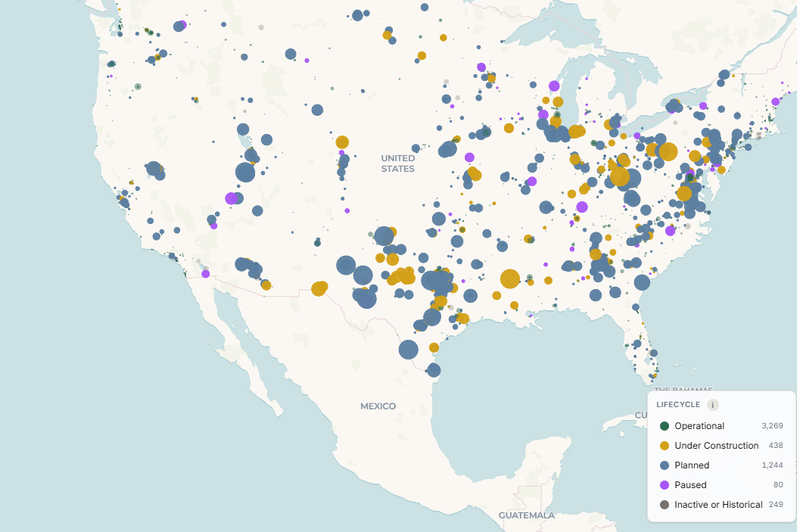
Source: dcmap
A construction delay becomes a revenue delay
Estimations that around 30% of the US capacity additions expected in 2028 could be at risk if pauses and approval delays spread. That figure refers to planned additions for that year, rather than 30% of all operating capacity.
The distinction still leaves a large part of the industry's growth assumptions exposed to decisions that technology companies do not fully control.
A delayed facility pushes several revenue streams into the future at once. Chip orders can be deferred, server deliveries move later, power contracts take longer to start, and data-centre operators wait longer before renting capacity to customers.
End demand may remain strong throughout this process
The valuation problem comes from the timing: revenue expected in 2028 become revenue for 2029 or 2030, reducing its present value and weakening the return on capital already committed.
This helps explain the speed of Thursday's decline
The market had valued the AI buildout as a continuous expansion in which capital expenditure created capacity and capacity quickly generated revenue. Permitting risk inserts a gap between those stages
That gap is manageable for companies funding projects from cash, but it becomes expensive when construction depends on borrowed money.
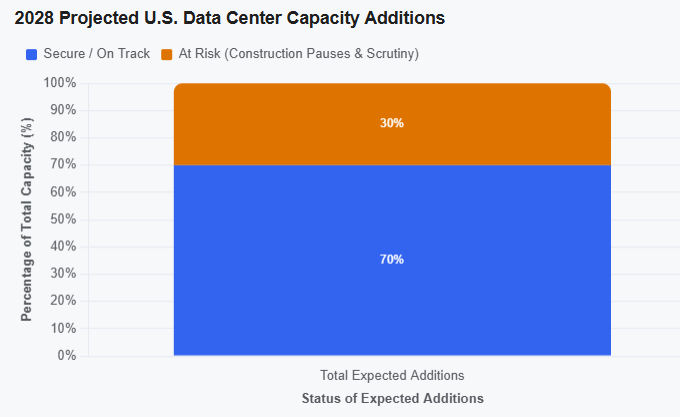
Source: Google
Debt turns time into a cost
Interest does not wait for a delayed data centre to open, a developer can postpone equipment orders or renegotiate a completion date, but the debt raised for land, power reservations and early construction continue to carry a financing cost.
The longer the delay, the more future revenue is required simply to protect the original return.
Core Weave illustrates the imbalance
The company carries close to $50 billion of debt and is expected to spend about $35 billion to $39 billion on capital investment against roughly $13 billion of revenue. Its credit-default-swap spreads widened to record levels as the equity market sold off, showing that investors were reassessing repayment risk alongside earnings growth.
Lower Treasury yields offered limited relief because the company's own credit premium was rising. The same pressure can reach the sector even when projects are financed by investment-grade issuers.
Large technology companies have increasingly used bond markets to support AI investment.
Their balance sheets remain much stronger than those of specialized operators, but heavier issuance links the construction cycle more closely to long-term yields and credit conditions.
A project delayed by regulation can therefore face a second setback if refinancing becomes more expensive before the facility begins earning revenue.
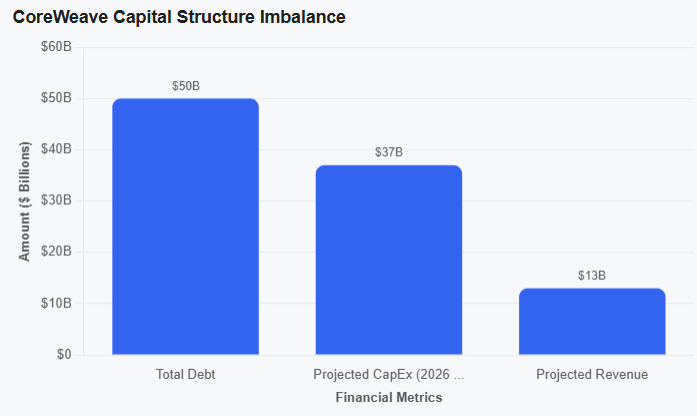
Source: Google
Why Apple and Microsoft held up better
Apple fell about 1.4%, far less than the broader technology market. Its resilience reflects a business model that requires much less physical AI infrastructure.
The company generated around $145 billion of operating cash flow over the previous four quarters while spending roughly $9 billion on capital expenditure.
A slowdown in data-centre construction therefore has a smaller direct effect on its near-term cash flow, giving investors less reason to question the financing behind its valuation.
Microsoft's case is different
It is one of the industry's largest spenders, with quarterly capital expenditure reaching $41 billion and management expecting more than $50 billion in the following quarter.
Its shares still declined by only 3.6%, partly because it generated $55.4 billion in operating cash flow and remained free-cash-flow positive.
Its existing cloud infrastructure also provides an operating asset base that generates revenue, rather than leaving the investment case dependent entirely on projects still under construction.
Existing capacity could become more valuable if new projects are delayed, as customers seeking computing power would have fewer new facilities to choose from.
Apple offers protection through lower infrastructure spending, while Microsoft benefits from scale, cash generation and capacity already in operation.
Source: Koyfin
The selloff reached the entire construction chain
The decline in semiconductor shares did not require investors to expect lower AI usage. Nvidia and AMD are exposed to the timing of accelerator orders, Dell to server deployment, GE Vernova and Constellation Energy to new power demand, and specialised cloud operators to the availability of completed facilities.
A delayed project can therefore affect several companies' earnings forecasts before a single customer cancels an AI workload.
This helps explain why the SOX index fell much more sharply than Apple and Microsoft: semiconductor valuations had priced in a rapid conversion of planned data centres into equipment demand, leaving companies further down the construction chain more exposed when political and permitting risks threatened that timetable.
The AI trade has entered a phase in which time carries a visible price
The pressure could ease if developers relocate projects, states introduce clearer approval standards and hyperscalers maintain their capital-expenditure guidance.
However, the outlook also depends on whether the fiscal environment continues to support the infrastructure investment cycle.
A less expansionary fiscal outlook could weaken expectations for government-backed infrastructure spending and related investment, particularly if a Democratic-led Congress constrains further deficit-financed spending. That could affect the AI buildout through reduced support for power infrastructure, grid upgrades and other projects needed to bring new data centres online.
The actual impact would depend on which programmes face limits and whether private-sector investment fills the gap.
There could also be a competitive consequence beyond the US
If regulatory delays and tighter financing slow the expansion of American data-centre capacity, China could gain an opportunity to strengthen its position as an alternative AI infrastructure hub.
Chinese developers and suppliers may accelerate investment in data centres, power systems and related equipment to attract companies seeking faster access to computing capacity.
That would not guarantee a shift away from the US, particularly given restrictions on advanced chips and the geopolitical limits facing foreign technology firms.
But a slower US build-out could give Chinese companies more room to expand their role in the global AI supply chain.
Data-centre capacity would arrive later or in different locations
In that scenario, data-centre capacity would arrive later or in different locations, while demand for computing power could remain strong enough to support parts of the supply chain.
A recovery led by companies with established operations and strong cash generation would be consistent with that outcome. A broader move towards moratoriums, combined with tighter fiscal conditions, would create a more difficult adjustment
Project backlogs would take longer to translate into revenue, debt-funded operators would face higher interest costs relative to cash generation, and suppliers would have to revise delivery assumptions.
Credit spreads would become as important as equity prices, offering a clearer indication of whether lenders still believe delayed projects can generate enough cash to service their debt.
The AI investment case is therefore becoming more sensitive
The sensitivity between time, spending and revenue. Demand can remain strong while expected returns weaken if approvals slow, financing costs stay elevated and debt accumulates before projects become productive.
Companies with operating cash flow and existing capacity have more room to absorb delays. Those that borrowed against rapid construction schedules have less flexibility. Thursday’s selloff reflected a growing distinction between the two.