Support
Alphabet stock falls as AI spending overshadows record Google Cloud growth
Alphabet’s third-quarter results showed that demand for its AI products is real. Revenue rose 25% to $127.6 billion, while Google Cloud revenue more than doubled to $30.7 billion. Yet the shares fell because the cost of meeting that demand is rising faster than investors expected, leaving Alphabet with negative free cash flow for a second consecutive quarter.
Google Cloud revenue increased 103%, helped by enterprise AI demand and TPU system sales.
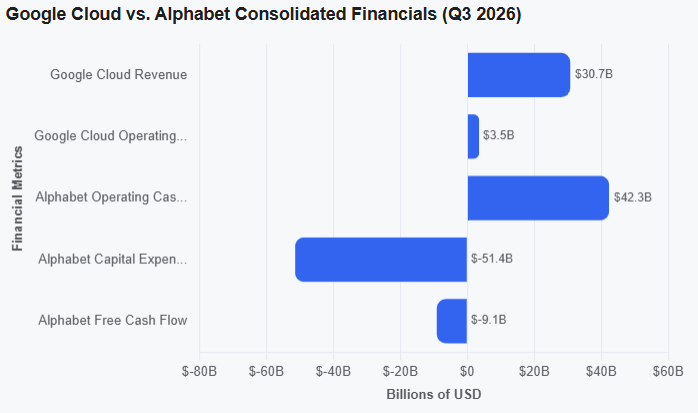
Quarterly capital expenditure reached $51.4 billion, pushing free cash flow to negative $9.1 billion.
Democratic control of Congress and warnings about data-centre-driven inflation added another risk to the investment case.
A close above $288.53 would be the first sign that the rebound is gaining strength and could bring $300 into focus.
Cloud growth came with a different cash-flow model
Google Cloud was the strongest part of the quarter. Revenue reached $30.7 billion, while operating income more than tripled to $11.1 billion and the segment’s margin rose to 36.2%. Cloud backlog also reached $561 billion, with more than half expected to become revenue over the next two years.
However, part of that growth came from sales of Alphabet’s TPU systems. Selling complete AI systems requires the company to purchase chips, networking equipment and other components before customers pay.
This ties up cash in inventory and makes the business more capital-intensive than Google’s traditional advertising model. Alphabet generated $42.3 billion in operating cash flow during the quarter but spent $51.4 billion on capital expenditure.
The company therefore reported negative free cash flow of $9.1 billion. Inventory built for future TPU sales, and a $5.2 billion payment related to an EU fine added further pressure.
The spending is producing revenue, but the cash arrives after Alphabet has already paid for much of the infrastructure.
Source: Google
Search still funds the AI expansion
Google Search revenue increased 12% to $63.4 billion, its fastest query growth in five years. However, advertising revenue missed market expectations, while management warned that Search growth would face a tougher comparison in the fourth quarter.
That leaves Alphabet relying on its established advertising business to finance an AI expansion that has not yet reached a steady cash-generating stage.
Full-year capital expenditure is expected to reach $195–$205 billion, followed by another significant increase in 2027. Higher spending will also continue appearing in future results through depreciation, energy costs and data-centre operating expenses.
Investors are therefore looking beyond Cloud’s revenue growth; they want to know how long Alphabet must spend at this pace before free cash flow begins to recover.
Democratic victory adds political risk to data-center spending
The initial post-earnings decline was driven by cash burn, the advertising miss and plans to increase spending again next year. The Democratic sweep in the midterm elections then placed more pressure on Alphabet and other AI companies.
Markets began pricing a greater risk of tighter scrutiny over data-centre construction, including energy use, local electricity costs, environmental approvals and the effect on surrounding communities. Alphabet fell another 2.2% during the broader technology selloff, while the Nasdaq lost 5.5%.
This creates a difficult situation for Alphabet. It needs more infrastructure to meet Cloud demand, but political restrictions or slower approvals could delay when those investments begin producing revenue.
Data-centre spending could also keep interest rates higher
Chicago Fed President Austan Goolsbee added another concern by describing the AI data-centre buildout as “old-fashioned demand overheating.” Companies are competing for the same land, electricity, chips, construction capacity and skilled workers, pushing costs higher before the expected productivity gains arrive.
If that investment keeps inflation elevated, the Fed may need to maintain higher interest rates. Alphabet would then face pressure from both sides: rising construction and energy costs would make its AI expansion more expensive, while higher bond yields would reduce the valuation investors are willing to place on its future earnings.
Alphabet’s results did not show weak AI demand. They showed that winning the AI race may require far more cash, infrastructure and time than the market had priced in.
Technical outlook
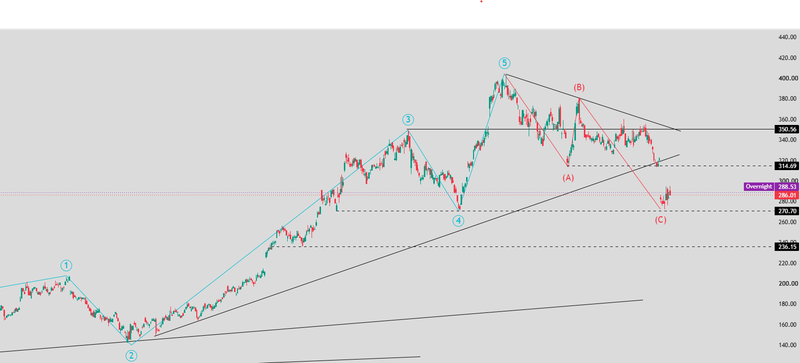
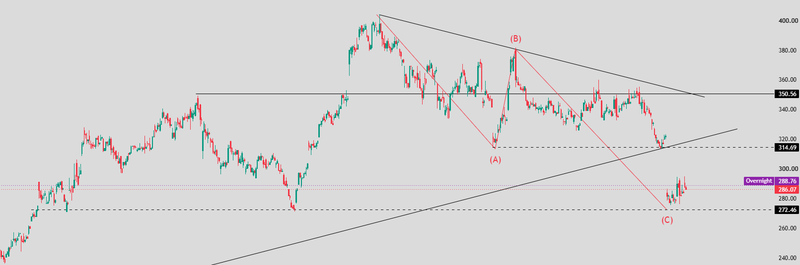
Alphabet’s rejection from $400 appears to have completed a five-wave advance and started an ABC correction. Wave A reached $314.69, while Wave B recovered toward $380 but failed below the previous high.
Wave C then broke the ascending trendline and moved below the Wave A low, extending the decline to $270.70. This area is important because it also sits close to Wave 4 of the previous rally, making it a possible completion zone for the correction.
The recovery toward $286 shows that buyers have returned, but Alphabet remains below the broken trendline and its previous support levels. The current move should therefore be treated as a rebound until the price begins rebuilding the bullish structure.
Source: TradingView
Scenario ahead
A close above $288.53 would be the first sign that the rebound is gaining strength and could bring $300 into focus. The stronger confirmation sits at $314.69, where former support may now act as resistance. Reclaiming this level could extend the recovery toward $350.56.
If Alphabet fails below $288.53, selling pressure could return and push the stock back toward $270.70. A decisive break below this support would indicate that Wave C is still developing and expose the next major level at $236.15.
For now, $270.70 is holding the correction together, while $314.69 is the level Alphabet needs to recover before the broader technical picture begins to improve.
Source: Trading view