Support

Is Anthropic profitable? revenue, losses and what the S-1 shows
Anthropic’s revenue is surging, but profitability depends on the measure used. Its IPO filings reveal improving operating economics, substantial accounting losses and enormous computing commitments.

Anthropic generated $33.24 billion in revenue in the first nine months of 2026, including $16.96 billion in Q3.
Its $81 billion revenue run rate annualises recent activity. It is separate from revenue already earned.
The company recorded its first quarterly GAAP operating profit in Q2 2026, then returned to an operating loss in Q3.
Most of its $104.04 billion nine-month net loss came from non-cash financing revaluations.
Computing and infrastructure commitments total approximately $900.9 billion, making future cash generation critical.
Anthropic has seen revenue increase to $4.59bn in 2025 and $33.24bn in the first nine months of 2026. As of October 31st, the company had an annualised run rate of approximately $81bn. However, the company is still operating at a net loss. Although it saw its first GAAP operating profit in Q2 2026, it returned to an operating loss in Q3. This is important to understand when evaluating the business.
Is Anthropic profitable?
Yes, it has seen operating profits in Q3. However, it has not yet seen sustained GAAP profitability. The company is still seeing significant net losses.
Four measures explain the distinction:
- GAAP operating income: The company saw losses of $567 million in Q3 2026 and $1.26bn in the first nine months.
- GAAP net income: The company saw losses of $23.29bn in Q3 and $104.04bn in the first nine months.
- Adjusted operating income: The company made profits of approximately $2.46bn in Q3, using its non-GAAP adjustments.
- Cash flow: Separate from accounting profit and heavily influenced by payment timing, infrastructure investment and financing arrangements.
In Q2, Anthropic saw its first brief period of GAAP operating profits. It made $974 million of pre-tax pre-operational profits. This shows that during the period the company was able to cover operating expenses from its revenues. However, this does not indicate that the company is now profitable.
The headline net loss is misleading, as much of it comes from the change in the fair value of financing instruments. It shows that the company has seen significant improvements in its underlying operations. However, it has not yet proven to be sustainable.
Anthropic revenue by year and quarter
Anthropic has seen its revenues increase from $41 million in 2023 to $4.59bn in 2025 and $33.24bn in the first nine months of 2026.
The annual and quarterly figures indicate the amount of revenue that has been recognised in the period. These should be kept separate to the run rate.
Annual revenue: 2023 to 2025
In 2023, Anthropic had an annual revenue of $41 million. In 2024 it increased to $386 million and $4.585bn in 2025.
This indicates that the company has seen significant growth in its revenue. From 2024, it increased by approximately 841% and in 2025 by 1,088%. These are audited figures and show how quickly Claude has grown from an emerging product to a significant software business.
In 2026 the company increased again. It saw $33.242bn in revenues in the first nine months, up from $2.545bn the previous year (approximately 1,206%). These are unaudited figures.
Quarterly revenue: Q4 2024 to Q3 2026
Anthropic’s quarterly revenue was roughly $200 million in the final quarter of 2024. During 2025, it increased to $376 million in Q1, $787 million in Q2, $1.382 billion in Q3 and $2.040 billion in Q4.
Growth accelerated in 2026. Revenue reached $4.731 billion in Q1, $11.555 billion in Q2 and $16.956 billion in Q3.
That means Anthropic generated more revenue in Q1 2026 than during the whole of 2025. By Q3, quarterly revenue was approximately 12.3 times its year-earlier level.
The pace is beginning to moderate as the business becomes larger. Sequential revenue growth slowed from approximately 144% in Q2 2026 to 47% in Q3. Both are exceptionally strong rates, although maintaining the same percentage growth requires progressively larger additions to revenue.
Run-rate revenue: $81 billion and how it is calculated
As of October 31st 2026, Anthropic had a run rate of approximately $81bn. This was an increase of $10bn from the end of September.
This is calculated by:
Run Rate Revenue = (Last 28 days consumption fees x 13) + (Monthly subscription fees x 12).
This indicates the annualised value of the last period of revenue generating activity. It does not indicate that Anthropic made $81bn in revenue in 2026 or that it will continue to make the same amount of revenue from customers in the next year.
It is particularly important to understand during periods of rapid growth. The recognised revenue indicates the revenue from the last period. Whereas the run rate indicates a more up to date view. This can be impacted by seasonality, how much customers are budgeting, pricing and usage.
How does Anthropic make money?
Anthropic earns most of its revenue from customers paying to use Claude, supplemented by subscriptions for individuals, teams and enterprises.
Its commercial model connects revenue to how extensively customers use its AI systems. That creates substantial expansion potential when Claude becomes part of recurring business processes.
Consumption: API and metered app usage versus subscriptions
Approximately 80% of revenue comes from consumption-based activity, including API access and metered application usage. Customers pay according to the model used and the amount of processing consumed.
The remaining approximately 20% comes from subscriptions, including individual and business plans. Subscriptions provide a recurring commercial relationship, while usage-based charges allow spending to expand as customers deploy more demanding workloads.
The attraction of consumption pricing is straightforward: a customer can start with a limited deployment and increase spending without negotiating an entirely new software contract. The exposure works in both directions. Customers can also reduce activity, select cheaper models or move workloads elsewhere.
Claude Code, Cowork and enterprise expansion
Claude Code and Cowork extend Anthropic’s commercial reach into coding and broader workplace tasks. Their financial significance depends on whether customers move from occasional assistance to repeated use across teams and workflows.
Anthropic reported net revenue retention of approximately 900% as of September 30, 2026. Under its methodology, that indicates substantial spending expansion across the measured existing-customer cohort.
A 900% retention figure does not mean the company retained nine times as many customers. It describes revenue expansion after accounting for contraction and churn within the relevant cohort. It also comes from a young business whose customers may be scaling from small initial deployments.
The next test is whether spending continues to expand as those deployments mature and procurement teams scrutinise the returns.
Cloud marketplaces and international revenue
Customers can purchase Claude directly or through cloud distribution channels, including Amazon Web Services, Google Cloud and Microsoft.
These marketplaces make adoption easier for organisations that already manage technology spending through established cloud providers. They can reduce procurement friction and help Anthropic reach businesses beyond its direct sales operation.
International expansion broadens the potential customer base, although cloud distribution and customer geography are different measures. A purchase through an American cloud provider does not, by itself, establish where the underlying customer operates.
Why Anthropic reports such large net losses
The company made a net loss of $104.04bn in the first nine months of 2026. This was largely due to a $94.32bn fair value charge.
This indicates that much of the difference between their operating performance and bottom line comes from this. This also means the headline loss is not a good indicator of how much cash they are consuming.
The fair-value charge on convertible notes, explained simply
Anthropic raised capital using various instruments. This includes convertible notes, derivative liabilities and SAFEs (simple agreements for future equity).
Some of these need to be valued at their fair value. As the company grows in value, the liability attached to them can increase. This is then shown as an expense.
This can look strange as the company is seeing increased demand from investors and therefore has a higher valuation. This can lead to it showing a larger loss.
The fair value charge was approximately $94.3bn in the first nine months of 2026. This was not paid in cash during the period. However, removing it will not necessarily make the company profitable as there are still other expenses and losses.
Operating loss versus net loss versus adjusted operating income
Operating income indicates the revenue after operating expenses. Net income shows non-operating items such as fair value changes, other income/expenses and taxes.
Adjusted operating profit removes certain expenses using the company’s own non-GAAP adjustments. This can help to show underlying changes but investors should still consider what has been removed.
Anthropic made a GAAP operating loss of $567 million in Q3. However, they made an adjusted operating profit of approximately $2.46bn and a net loss of $23.29bn.
Each figure answers a different question. Anthropic have made progress with their adjusted profits. However, the GAAP figure shows a larger base of expenses. The net loss shows the true accounting result.
Anthropic’s costs: compute, research and sales
Anthropic has significant costs around computing. However, they also have payroll, sales and other operating expenses.
In 2025, the company had compute expenses of approximately $7.33bn. In Q3 2026 alone, they had $9.86bn. The company needs to invest in capacity to service their customers and also invest in research to keep their models competitive.
Gross margin: approximately 85% implied versus total compute spending
Anthropic’s first-half 2026 figures imply a gross margin of approximately 85%, based on revenue of $16.29 billion and cost of revenue of approximately $2.38 billion.
That percentage needs an immediate qualification: cost of revenue excludes substantial model-development and training expenditure classified elsewhere.
Total computing and infrastructure expenses represented approximately 55% of first-half revenue and 58% of Q3 revenue. Those broader figures give a more demanding picture of the resources required to operate and develop the business.
A high implied gross margin therefore does not mean Anthropic retains 85 cents of every revenue dollar after paying for all its computing needs. Customer-serving costs and the total cost of maintaining competitive AI capabilities cover different activities.
Why Q3 2026 swung back to an operating loss
Anthropic moved from a $974 million operating profit in Q2 to a $567 million operating loss in Q3, despite another sharp increase in revenue.
Two factors contributed to the reversal: approximately $5 billion of compute under short-term commitments, which carried higher costs than comparable long-term capacity, and approximately $2 billion of non-cash donation-matching charges.
The quarter exposes a practical constraint on rapid growth. When customer demand expands faster than planned infrastructure becomes available, securing additional capacity can be expensive.
Longer-term arrangements may improve computing economics, but they also commit Anthropic to paying for capacity ahead of future demand. Management must balance the immediate cost of shortages against the longer-term risk of buying too much.
Cash, cash flow and $900.9 billion of compute commitments
Anthropic held approximately $131.9 billion in cash, cash equivalents and short-term investments at September 30, 2026, against computing and infrastructure commitments extending to 2045.
The latest prospectus puts those commitments at approximately $900.9 billion, updating the roughly $895 billion figure in earlier materials. Approximately $70.7 billion falls due within the 12 months following September 30, 2026.
These commitments are future contractual spending, spread across many years. They are different from expenses already recognised and from debt immediately payable.
Anthropic generated approximately $3.93 billion of operating cash flow in the first half of 2026. However, operating cash flow is separate from free cash flow after capital expenditure. Its infrastructure expansion can require substantial payments before the associated capacity generates revenue.
The company’s cash position provides considerable funding flexibility. Whether that flexibility lasts depends on customer receipts, investment timing, access to financing and the economics of the capacity being secured.
Customers and revenue concentration
Anthropic has a large customer base who spend a lot. However, they still have significant exposure to enterprise so individual decisions can be significant.
They had over 11,900 customers who generated $100k+ of trailing twelve month revenue. Approximately 250 customers generated $10m+.
The prospectus also indicates that no one customer made up more than 10% of revenue in the first nine months of 2026. This indicates that they have a more diverse revenue base.
Amazon and Google made up approximately 12% of revenue in 2025. However, they are also investors and infrastructure partners.
This is important across the AI industry. Strategic partners can provide capital to help invest in infrastructure. However, the company needs to ensure that there is demand for the services they are providing to make revenue. Investors should understand both.
Anthropic versus OpenAI revenue
The figures indicated that Anthropic has surpassed OpenAI in some areas in 2026.
Anthropic indicated that they made revenue of approximately $11.56bn in Q2 2026. OpenAI indicated that they made $6.7bn.
This figure comes from Anthropic’s financial disclosures in their IPO. OpenAI’s figure is indicated and therefore less precise.
However, there are still questions around being at the top. Different products, pricing and infrastructure can lead to significant differences in margins and cash requirements.
What to watch next
Anthropic’s next set of results will indicate whether they are seeing sustainable operating profits and cashflow from their revenue growth.
Firstly, look at recognised revenue. Although run rate updates are useful, it is important to see how much they have turned into revenue in the period.
Secondly, look at how efficient they are with their computing. Investors should look at whether their computing and infrastructure costs are coming down as they provision longer term capacity. Also look at whether they are passing savings onto their customers through lower pricing.
Thirdly, look at the quality of their profitability. If they can show sustainable GAAP operating income, this will be a stronger indicator.
Finally, look at how much cash they need. Although there is strong demand, they still need to fund the commitments they have negotiated today.
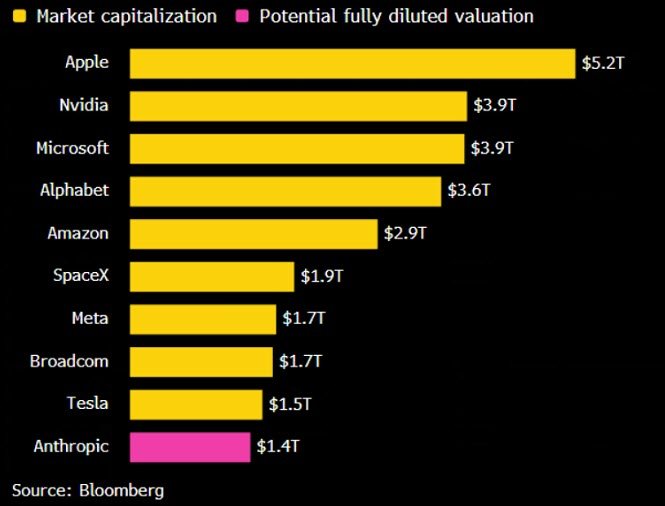
With a targeted fully diluted valuation of approximately $1.4tn, the IPO is heavily weighted on continued execution. The company will also be providing investors with a clearer view of whether they are generating sustainable demand from their AI infrastructure spend.
Source: Bloomberg
How to trade Anthropic
Eligible clients can explore Anthropic pre-IPO CFD trading with Equiti to take a position on price movements ahead of its planned listing, subject to availability and trading conditions.
A CFD provides exposure to price changes without ownership of the underlying shares. Pre-IPO pricing may differ from the eventual IPO price and the price at which shares begin exchange trading.
Before opening a position, ensure you understand how the product is priced, margin requirements, costs and transition to listing. CFDs are leveraged products and can amplify your losses.
Anthropic revenue and profitability FAQs
What is Anthropic’s revenue?
Anthropic generated $4.585 billion in 2025 and $33.242 billion in the first nine months of 2026. Q3 2026 revenue was $16.956 billion.
Is Anthropic profitable?
It remains unprofitable on a GAAP net-income basis. It achieved its first quarterly GAAP operating profit in Q2 2026, then reported an operating loss in Q3.
How does Anthropic make money?
Primarily through usage-based charges for Claude, including API and metered application activity, alongside subscriptions for individuals, teams and enterprises.
Why did Anthropic lose $104 billion?
Approximately $94.3 billion came from non-cash revaluations of financing instruments. Its operating loss was much smaller, at $1.26 billion for the first nine months of 2026.
Who are Anthropic’s biggest customers?
Its largest customers are not comprehensively identified. Amazon and Google each represented approximately 12% of 2025 revenue, while no single customer exceeded 10% in the first nine months of 2026.
Did Nvidia invest in Anthropic?
Yes. The disclosed arrangements include an investment commitment announced in 2025 and participation in the private placement accompanying the IPO. Commitments should be distinguished from capital already received.