Support
Anthropic shares face second-day drop as AI selloff tests record IPO
Anthropic’s record IPO is facing an early test as investors reassess AI valuations, competition and computing costs.

Anthropic shares fell about 5% in post-market trading after closing their debut 17% above the $83 IPO price.
The stock ended its first session at $97.17 after rising as much as 39% intraday.
Anthropic finished the day with a fully diluted valuation of about $1.8 trillion.
Annualized revenue reached $81 billion by October 31, while the company reported a $567 million third-quarter operating loss.
Potential inclusion in the Nasdaq 100 and Russell 1000 could generate billions of dollars in index-fund demand.
Record debut collides with an AI selloff
Anthropic shares are heading toward a weaker second trading session as deteriorating sentiment toward artificial intelligence stocks overshadows the company’s record market debut.
The Claude developer’s shares declined about 5% in post-market trading, with crypto perpetual futures indicating a similar move. That followed a volatile first session in which the stock climbed as much as 39% before closing at $96.97, up 17% from its $83 IPO price.
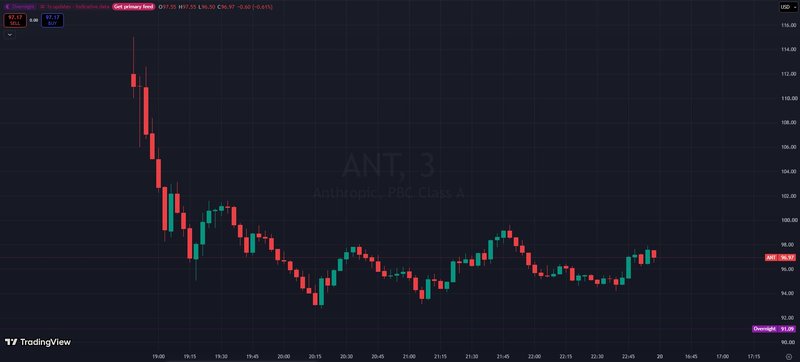
Anthropic ended its first day as the world’s seventh-largest publicly traded company, with a fully diluted valuation of approximately $1.8 trillion.
The timing has complicated its debut. The Nasdaq fell 2.2% on Thursday, while the MSCI Asia Pacific Index dropped 3.3% and extended its decline to seven consecutive sessions. Global equities were also heading toward their longest losing streak since September 2023 as investors reduced exposure to the AI trade.
IPO demand was seven times the available shares
The offering attracted demand for approximately seven times the number of shares available. International investors committed billions of dollars, underlining the scale of demand even as technology stocks weakened.
Japanese investors received about $3 billion of stock after requesting $9.4 billion. Retail investors in the UK and continental Europe purchased another $1.1 billion.
The IPO surpassed the previous fundraising record set by SpaceX, which raised $75 billion in June and eventually increased the total to $86.25 billion through the sale of additional shares. Anthropic’s seven founders saw their combined wealth rise to about $166 billion, while the 22 banks working on the transaction earned a record $550 million in fees.
Heavy demand supported the first-day gain, though the second-day decline shows that scarcity alone cannot protect the shares from concerns about valuation and the broader AI investment cycle.
Revenue is surging, but computing costs remain heavy
Anthropic’s strongest argument is its rapid expansion among corporate customers. Annualized revenue reached $81 billion by October 31, up $10 billion from the end of September.
More than 11,900 customers generated at least $100,000 each in trailing 12-month revenue by the end of September, compared with approximately 1,500 customers in 2025. Claude Code has become an important growth engine and is now widely used by software developers, including engineers at NASA.
The financial challenge remains substantial. Anthropic recorded a third-quarter operating loss of $567 million, driven partly by $5 billion of computing costs under short-term commitments and $2 billion in non-cash charges related to its charitable donation-matching programme.
Current projections suggest the company may not generate positive annual free cash flow until 2030. Annual revenue could reach roughly $685 billion by then, though achieving that scale will require strong customer growth, effective monetisation and control over infrastructure spending.
Competition adds pressure to Anthropic’s valuation
Competitive risks are increasing as Anthropic attempts to expand Claude into software development, law, healthcare and other professional services.
Apple is developing an autonomous AI agent capable of completing tasks for users, entering a market already contested by Anthropic, OpenAI and Meta. Anthropic must also compete with cheaper open-weight models, including systems developed in China, which could place downward pressure on industry pricing.
Investors are increasingly looking beyond evidence of AI demand. The key test is whether rising revenue can produce sustainable profits after the cost of chips, data centres, electricity and cloud capacity.
Index inclusion could provide the next source of demand
Anthropic may receive support from passive investment funds if it qualifies for accelerated index inclusion.
The company could join the Russell 1000 and Nasdaq 100 as early as December after both index providers changed their rules to accelerate the inclusion of exceptionally large new listings. Entry into those benchmarks could generate billions of dollars in automatic purchases from index-tracking funds.
Until then, Anthropic is likely to trade as a real-time measure of confidence in the wider AI sector. Its revenue growth and enterprise customer base are unusually strong, though its $1.8 trillion valuation leaves little room for slower growth, higher computing costs or intensified competition.