Support

Anthropic vs OpenAI: How the two AI leaders compare in 2026
Anthropic and OpenAI are competing for enterprise customers, revenue and investor capital. Here is how their businesses, products and IPO plans compare.
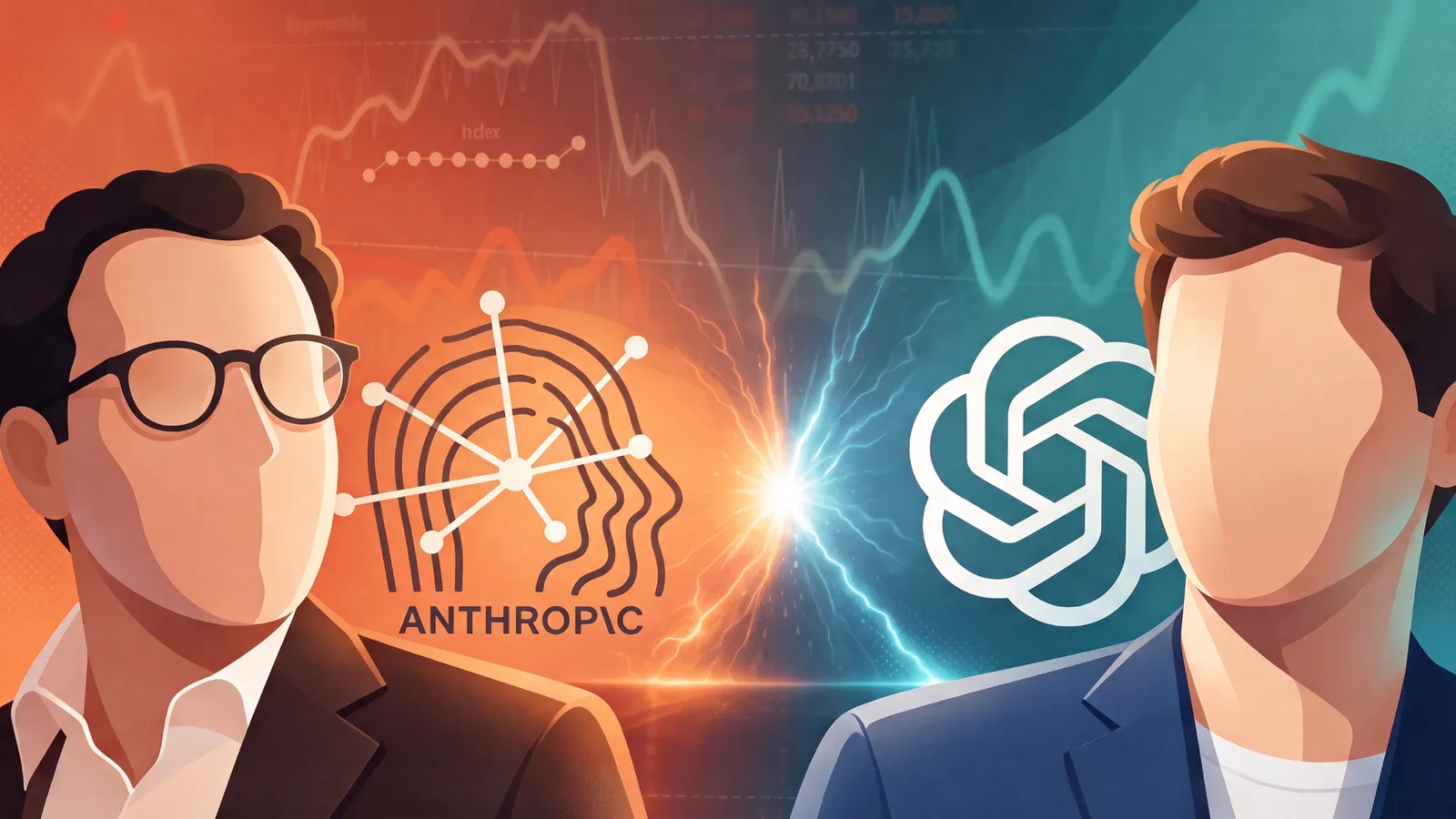
OpenAI has the larger consumer platform; Anthropic has strong momentum in enterprise AI and coding.
Anthropic reported $16.96 billion in Q3 revenue, versus approximately $10 billion reported for OpenAI.
Revenue accounting differs, so the headline figures are not directly comparable.
Anthropic is preparing to list on Nasdaq, while OpenAI remains privately held.
Anthropic vs OpenAI at a glance
Anthropic, founded in 2021 and led by Dario Amodei, develops Claude, Claude Code and enterprise AI services. Its proposed Nasdaq ticker is ANT, with trading expected on November 19.
OpenAI, founded in 2015 and led by Sam Altman, develops ChatGPT, Codex and the GPT model family. It remains private, with management discussing IPO readiness in 2027.
Their strategies overlap increasingly. Anthropic sells consumer subscriptions, while OpenAI is expanding aggressively into business software and developer tools. The useful comparison is therefore their revenue mix, customer spending and economics, rather than a simple enterprise-versus-consumer divide.
Origins: Why Anthropic split from OpenAI
Anthropic was founded by seven former OpenAI employees, including siblings Dario and Daniela Amodei, in 2021. The founding team placed particular emphasis on AI safety, interpretability and the governance of increasingly capable models.
OpenAI began in 2015 as a nonprofit research organisation. Its subsequent commercial expansion created the funding structure supporting ChatGPT, developer services and large-scale computing investment.
Their shared history helps explain the competition. Both pursue advanced general-purpose AI, while taking different approaches to product distribution, governance and deployment.
Products and models compared
Neither company is universally better across every task. Performance depends on the model, tools, price, workflow and evaluation used.
Claude vs ChatGPT
Claude and ChatGPT both support writing, analysis, research and document-based work. Claude’s commercial positioning emphasises professional workflows and enterprise integration. ChatGPT combines broad consumer distribution with business subscriptions and connected tools.
OpenAI reported more than 1.2 billion weekly ChatGPT users in October 2026, illustrating its consumer scale. That figure measures users, rather than paying subscribers or revenue.
Anthropic’s current releases include Opus 5.5, Sonnet 5.5 and Haiku 5.5, alongside the more specialised Fable 5.2 and Mythos 5.2 models. OpenAI’s latest releases include GPT-6.2 Astra and Sol. Availability varies by product, plan and deployment restrictions.
Coding agents: Claude Code vs Codex
Claude Code and Codex compete for software-development workloads, including writing code, investigating bugs and completing tasks across repositories.
For customers, the meaningful comparison is successful work completed after review: implementation quality, reliability, integration and total cost. A model with a lower token price can still cost more if it requires repeated attempts.
Anthropic has strong spending momentum. Ramp’s measured business sample gave it 49.3% of model-attributed AI token spending in the week ending November 1. That is evidence from Ramp-connected businesses, rather than a worldwide coding-market share estimate.
Multimodal, consumer apps and ecosystem
OpenAI offers a broader consumer ecosystem spanning text, images, voice and other media tools. Anthropic’s positioning is more concentrated on reasoning, coding and enterprise work.
Breadth can attract users and create distribution advantages. Enterprise integration can produce recurring, high-value workloads. Both strategies still need to generate sufficient revenue after computing and customer-acquisition costs.
Business model: Enterprise vs consumer
Both companies earn money through subscriptions and usage-based services.
Anthropic’s business is heavily weighted toward consumption: customers pay as Claude processes workloads through APIs and applications. Revenue can expand as a customer moves from limited testing to routine deployment across teams.
OpenAI combines consumer subscriptions with enterprise products, API usage and distribution partnerships. Reporting on its Q3 results indicated that enterprise and consumer sales had become approximately equal.
These models create different sensitivities. Subscriptions depend on conversion and retention; consumption revenue responds more directly to usage, model selection and customer budgets. Neither guarantees stable margins when computing costs remain substantial.
Revenue: Who earns more?
Anthropic has the higher headline quarterly revenue, although differences in accounting limit direct comparisons.
Its filed results show $11.56 billion in Q2 2026 revenue and $16.96 billion in Q3. OpenAI’s reported figures were approximately $6.7 billion and $10 billion, respectively. OpenAI’s numbers come from reporting on private investor disclosures rather than an equivalent public IPO filing.
The accounting distinction matters. Reporting indicates that Anthropic recognises gross revenue from certain cloud-partner sales, while OpenAI records its share of some partner transactions. The headline gap therefore overstates what can safely be concluded about their relative underlying sales.
Run rates require similar care. Anthropic disclosed approximately $81 billion as of October 31. OpenAI’s annualised recurring revenue was reported to be approaching $70 billion in late September. These reflect different dates and potentially different methodologies, and neither represents completed annual revenue.
Valuation: The trillion-dollar race
The Anthropic vs OpenAI valuation comparison changes with funding rounds, share counts and IPO pricing.
The broad sequence in 2026 is:
- March: OpenAI raised funding at a reported $852 billion valuation.
- May: Anthropic’s financing valued it at approximately $965 billion.
- November: Reporting placed OpenAI’s new funding valuation at approximately $1.25 trillion.
- Anthropic’s IPO: Anthropic priced its shares at $83 on November 18, above its initial $70–$78 range, valuing the company at approximately $1.5 trillion on a fully diluted basis. The offering raised a record $107.3 billion, including a $26 billion private placement.
These are different valuation bases. A private post-money valuation and an IPO market capitalisation can incorporate different security rights, proceeds and dilution assumptions.
Revenue multiples also require a consistent denominator. Dividing one company’s valuation by recognised annual revenue and the other’s by an annualised run rate would produce a misleading comparison.
Profitability and compute spending
Neither company has established sustained net profitability.
Anthropic recorded its first quarterly GAAP operating profit of $974 million in Q2 2026, followed by a $567 million operating loss in Q3. Its nine-month net loss reached approximately $104 billion, dominated by non-cash financing revaluations.
OpenAI reportedly generated approximately $10 billion of Q3 revenue while recording an adjusted operating loss of approximately $10.9 billion. That adjusted measure should not be treated as identical to Anthropic’s GAAP operating result.
For both businesses, computing economics are central. Anthropic disclosed approximately $900.9 billion of infrastructure and computing commitments extending to 2045. Those future commitments are different from expenses already recognised or debt immediately payable.
Growing revenue helps fund capacity, but price competition can absorb efficiency gains. Investors need to track how much additional revenue converts into operating cash after the investment required to maintain competitive models.
IPO: Anthropic prepares to list first, OpenAI discusses 2027
Anthropic is expected to price its offering on November 18, with Nasdaq trading expected on November 19 under ANT. Until the final announcement and first trade, these remain expected dates.
OpenAI remains private. President Greg Brockman has discussed the company being IPO-ready in 2027, which is a readiness objective rather than a confirmed listing date.
Public trading will give Anthropic a continuously changing market valuation and regular disclosure obligations. OpenAI’s private status means investors must continue relying on company announcements, funding terms and reported financial information.
Ownership and governance
Both companies have major technology investors, but neither is simply owned by one corporate backer.
Anthropic’s investors and financing partners include Amazon, Google, Microsoft and Nvidia, alongside institutional investors. OpenAI’s major backers include Microsoft, SoftBank, Amazon and Nvidia. Investment relationships should be distinguished from cloud-supply and other commercial agreements.
Anthropic is a public benefit corporation, with a Long-Term Benefit Trust and a proposed founder structure carrying 50.1% of shareholder voting power on matters covered by its special voting shares. The trust has separate director-election rights.
OpenAI’s commercial business is OpenAI Group PBC, controlled by the nonprofit OpenAI Foundation. Economic ownership therefore does not translate directly into control of the organisation.
Safety philosophy and approach
Anthropic’s approach includes Constitutional AI, model evaluations and governance arrangements intended to incorporate its public-benefit objectives.
OpenAI uses model-behaviour policies, safety evaluations and deployment safeguards, with nonprofit oversight embedded in its structure.
Those differences do not establish that one company is more ethical. A meaningful assessment examines disclosed testing, safeguards, deployment decisions and how governance works when commercial incentives conflict with stated commitments.
FAQ
Is Anthropic better than OpenAI?
It depends on the task. Anthropic has strong enterprise and coding adoption, while OpenAI has greater consumer reach and a broader multimodal ecosystem.
Will Anthropic overtake OpenAI?
It already leads on some disclosed revenue measures. Accounting differences and changing product performance prevent a universal ranking.
Who founded Anthropic?
Seven former OpenAI employees founded Anthropic in 2021, including Dario and Daniela Amodei.
Which company has more revenue?
Anthropic reported $16.96 billion in Q3 2026 revenue, versus approximately $10 billion reported for OpenAI. Accounting methods differ.
Is OpenAI public?
No. Management has discussed IPO readiness in 2027, without confirming a listing date.
Can I invest in OpenAI or Anthropic?
Anthropic shares are expected to become publicly tradable after listing; eligible clients can also access CFDs. OpenAI direct investment remains restricted, with some indirect routes available.
Who backs Anthropic and OpenAI?
Anthropic’s backers include Amazon and Google. OpenAI’s include Microsoft and SoftBank. Several major technology investors have relationships with both.
Is either company profitable?
Neither has demonstrated sustained net profitability. Anthropic achieved one GAAP operating-profit quarter; OpenAI continues to report substantial losses through private financial disclosures.