
 Support
AI infrastructure spending is testing big tech's balance sheets
U.S. stocks slipped on Wednesday as higher Treasury yields added pressure to expensive technology stocks. The reaction was clear in Alphabet and Amazon. Alphabet fell after committing another $15.1 billion to AI infrastructure in Finland, while Amazon dropped after raising £4.25 billion in its first sterling bond sale. Meta went the other way, rising more than 6% after launching its new AI agent.

Off-balance-sheet commitments of nine major technology companies have risen above $3.5 trillion.
Amazon's first sterling bond raised 4.25 billion.
The BIS has now warned that AI investment by the five largest global technology companies exceeded $1 trillion across 2025 and 2026.
credit market is starting to ask whether future AI cash flows will arrive quickly enough to keep balance sheets as strong as they were before the spending cycle began.
Big Tech is committing money faster than it is making money from AI
The infrastructure bill is becoming enormous, combined off-balance-sheet commitments of nine major technology companies have risen above $3.5 trillion, including future equipment purchases, leases, strategic investments and financing structures. Around 85% of that exposure comes from procurement and leasing commitments.
That is separate from the hundreds of billions already being spent on data centres, chips, power and networking and other estimates that Microsoft, Alphabet, Amazon, Meta and Oracle could spend more on capital expenditure than they generate in free cash flow by 2027. The five companies are already putting pressure on cash generation as AI investment accelerates.
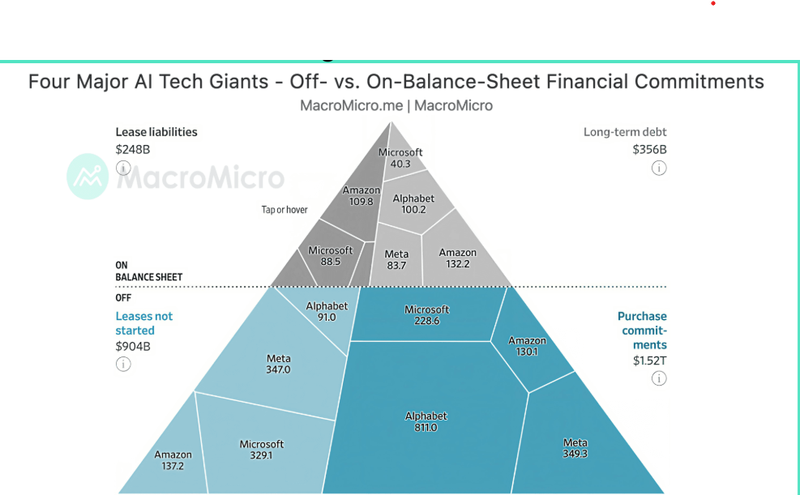
Source: MacroMicro
Amazon is showing where the financing is heading
Amazon's first sterling bond sale is a useful example. The company raised 4.25 billion, taking total hyperscaler debt issuance in 2026 above $200 billion, more than double the full-year figure from 2025.
The demand was strong enough to complete the deal, but borrowing in several currencies tells us something important: the funding requirement is becoming too large to rely on a single bond market.
That does not mean Amazon has a balance-sheet problem. It means AI infrastructure is turning Big Tech into a much bigger borrower at the same time that global bond yields are high.
Higher yields hit the AI story twice
The problem is no longer whether Big Tech can afford to spend billions on AI. Most of the largest companies still can. The issue is the return on that spending when the cost of capital is rising.
The BIS has now warned that AI investment by the five largest global technology companies exceeded $1 trillion across 2025 and 2026, with broader AI investment potentially reaching $4 trillion by 2030.
Investors are separating AI revenue growth from AI infrastructure spending
Meta is trying to close that gap with Muse, its new AI agent. The product can perform tasks across email, payments, shopping and travel, and Meta plans both free and subscription versions. The company is effectively trying to turn its enormous AI investment into a product customers can pay for.
2027–2028 is where the numbers get tested
AI infrastructure has a built-in lag. A data centre can take years to build, fill and optimise. The investment comes first; utilisation and recurring revenue come later. That means weak free cash flow today does not automatically prove that the spending is failing.
There is already evidence that the infrastructure is being built against real demand. Google is putting €13 billion into Finnish data centres and energy infrastructure for AI and other services, while Meta, Amazon and Microsoft continue expanding capacity.
But the financial test comes when those facilities move from construction into commercial operation. Reuters expects the pressure on free cash flow to remain significant through 2027, with investors looking for clearer returns by 2028.
That gives the current AI cycle a simple test
If utilisation rises, AI pricing holds and cash flow starts catching up with capital spending, today's huge investment will look justified.
If spending keeps climbing while monetisation stays behind it, the market will start asking why companies are financing more capacity before fully proving the economics of the capacity they already built.
Credit market is getting nervous from the AI bill
There is a clear change in how the credit market is viewing the AI buildout. Amazon's five-year CDS has risen the most, reaching roughly 170 on the chart’s indexed scale, while Meta has moved above 150 and Microsoft has also climbed well above its starting point. Alphabet has risen too, but by much less.
The broader investment-grade CDS index, meanwhile, has stayed close to its starting level. That divergence is what matters. Investors are not suddenly treating these companies as distressed borrowers; they are charging more for protection against a rise in leverage and financing needs.
After months of aggressive AI spending, data-centre construction and new debt issuance, the credit market is starting to ask whether future AI cash flows will arrive quickly enough to keep balance sheets as strong as they were before the spending cycle began. For equities, that creates a second test: AI may still be a powerful growth story, but the cost of financing that growth is becoming part of the valuation.
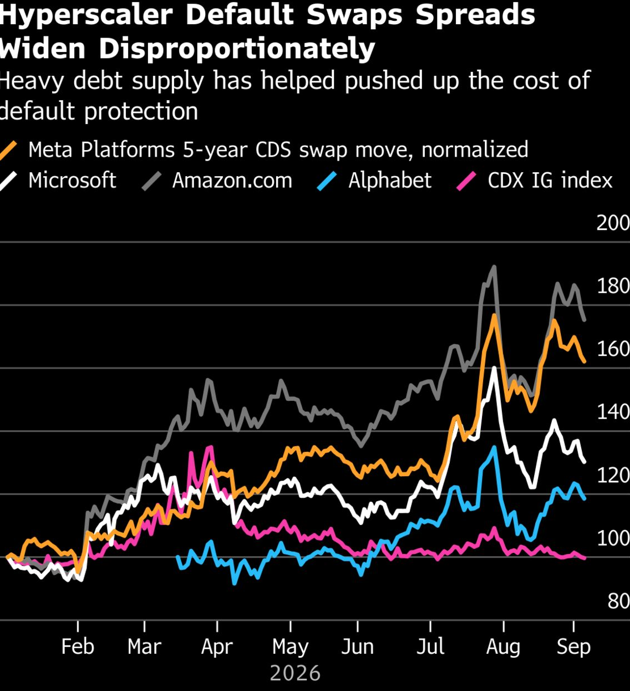
Source: Bloomberg


