Support
AI spending is surging, but where are the returns?
The market is beginning to separate the AI trade into companies that build capacity, companies that sell access to it and companies that turn it into cash. Today’s earnings will show whether that final group is growing quickly enough to justify what the first group is spending.

Alphabet and Amazon reported strong cloud growth but negative free cash flow.
Apple will test whether AI can be monetized through devices and services without matching the hyperscalers’ infrastructure spending.
Palantir must show that spending on computing capacity is becoming profitable software demand.
The selloff was not caused by weak AI demand
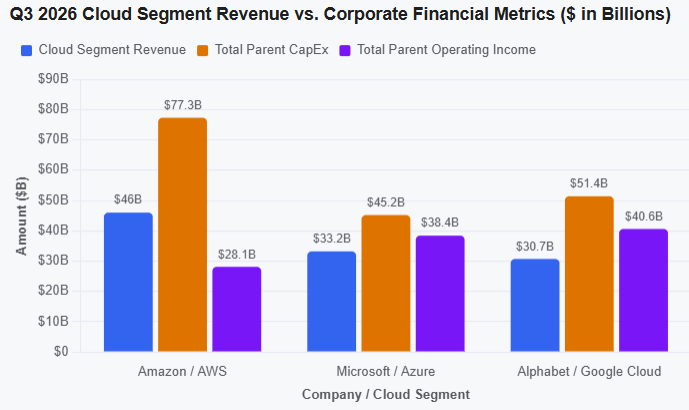
Alphabet’s Google Cloud revenue increased 103% to $30.7 billion, while Amazon Web Services grew 39.3% to $46 billion. Microsoft’s Azure business expanded 48%. These are not the numbers of AI cycles running out of customers.
The problem appeared lower in the financial statements
Alphabet spent $51.4 billion on capital expenditure during the quarter, exceeding its $42.3 billion operating cash flow and leaving free cash flow at negative $9.07 billion. Adjusted earnings of $2.67 also missed the $3.02 consensus, while revenue came in slightly below expectations. Cloud growth was exceptional, but it was not enough to offset concerns about search performance and the rising cost of supplying AI capacity.
Amazon presented a similar tension
AWS accelerated and group operating income reached a record $28.1 billion, yet earnings of $1.89 per share and revenue of $201.94 billion fell slightly below expectations. More significantly, trailing 12-month free cash flow fell to negative $42.4 billion as investment in property and equipment surged. Amazon now expects cash capital expenditure of approximately $220 billion in 2026.
The market was therefore looking at two different clocks. AI demand is growing today, but much of the financial return may arrive years after the data centres, chips and power capacity have been paid for.
Source: Google
AI spending has reached the balance sheet
The investment cycle is now too large to be judged only through revenue growth. US hyperscalers are expected to spend around $800 billion in 2026, although that estimate includes infrastructure that is not exclusively related to AI.
Some companies are already supplementing operating cash flow with outside funding. Alphabet raised $28.7 billion through debt and approximately $12.4 billion through share issuance during the third quarter. Meta said it would use a combination of operating cash flow, debt, partnerships and equity to finance its expansion.
When funding comes from retained cash, the immediate cost appears in weaker free cash flow. When it comes from debt, interest expense becomes part of the equation. When new shares are issued, existing shareholders face dilution.
Apple will test whether lower spending is an advantage
Apple enters today’s results from the opposite direction. Its shares have benefited from the company avoiding the scale of data-centre spending undertaken by its peers. Apple is attempting to monetize AI through devices, software, private computing and the distribution of third-party services across its ecosystem.
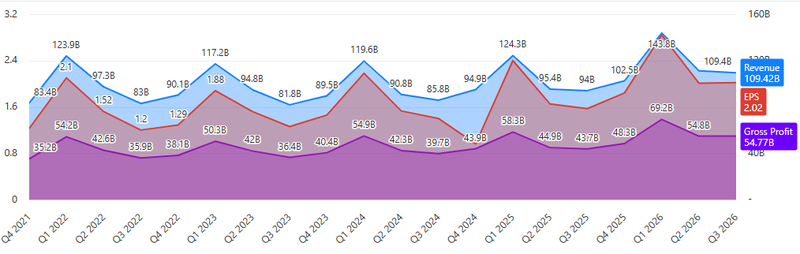
Expectations for fiscal fourth-quarter revenue of approximately $113.4 billion and EPS close to $2. The immediate focus will remain on iPhone demand, services growth and the effect of higher memory costs on margins. The larger question is whether Apple can present a credible AI strategy without joining the same capital-expenditure race.
If Apple can generate AI revenue through Siri, its installed device base or agents distributed through the App Store, its lighter infrastructure model may look increasingly valuable. If management offers few signs of monetization, investors may conclude that lower spending reflects a slower AI position rather than greater capital efficiency.
Source: Stockanalysis
Palantir must prove the spending is reaching software
Palantir provides the next link in the chain. The hyperscalers build the computing capacity; Palantir sells software that helps companies and governments use AI inside their operations.
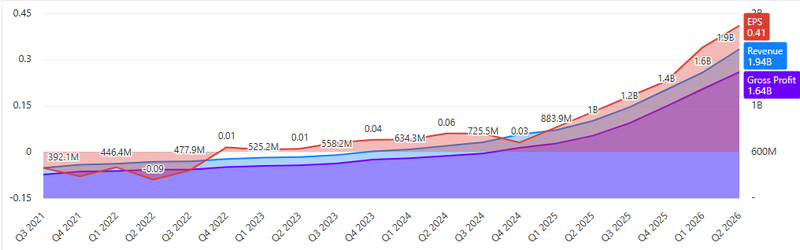
Consensus expects revenue near $2.18 billion and adjusted EPS of approximately $0.41. That revenue estimate already exceeds Palantir’s guidance of roughly $2.16 billion, leaving the company under pressure to beat expectations and raise its outlook again. US commercial revenue will be particularly important because it shows whether private companies are moving from AI experiments into paid deployment.
Palantir does not face the same cash burden as the infrastructure builders, but it carries a different risk. At almost 97 times forward earnings, strong growth is already assumed. A good quarter may not be enough if commercial growth slows down or management fails to lift guidance.
Source: Stockanalysis
What happens next depends on where the returns appear
Strong results from Apple and Palantir would suggest that the AI cycle is progressing from infrastructure into software, devices and services. That could steady technology shares even if hyperscalers spending remains high, because investors would finally see more of the demand converting into profitable applications.
Weak results would create a more difficult conclusion
They would suggest that infrastructure costs are arriving faster than the software and consumer revenue needed to absorb them. The selloff could then spread beyond the companies funding the buildout to those expected to monetize it.
The market is beginning to separate the AI trade into companies that build capacity, companies that sell access to it and companies that turn it into cash. Today’s earnings will show whether that final group is growing quickly enough to justify what the first group is spending.