
 Support
Broadcom Earnings: Can $58 Billion in AI Revenue Justify the semiconductor rise?
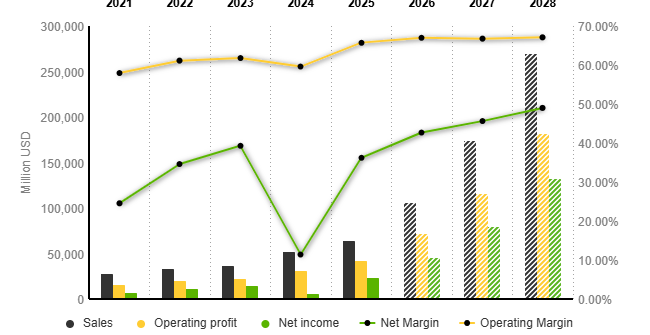
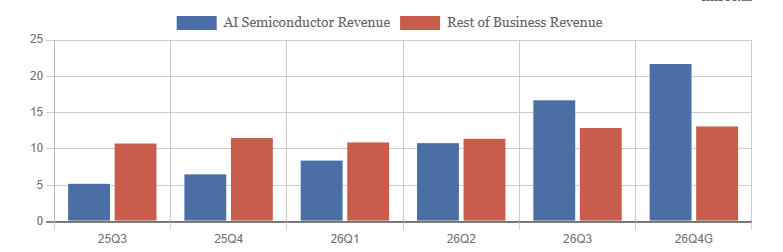
Broadcom reported third-quarter fiscal 2026 revenue of $29.59 billion, up 86% year over year, while adjusted EPS reached $3.32, both ahead of analysts’ expectations. More importantly, AI semiconductor revenue reached $16.7 billion, up 221% from a year earlier and 54% from the previous quarter.
Broadcom now expects fiscal 2026 AI semiconductor revenue of about $58 billion.
Tan said demand exceeds Broadcom’s $115 billion fiscal 2027 supply outlook.
Small Q4 guidance miss matters less for the AI cycle than it does for Broadcom’s share price in the near term.
The AI numbers are getting much bigger
The more important part of the report came from Hock Tan’s longer-term outlook. Broadcom now expects fiscal 2026 AI semiconductor revenue of about $58 billion, up from its previous $56 billion target. For fiscal 2027, the company has secured enough supply to support roughly $115 billion in AI semiconductor revenue. Tan then expects that figure to double again to about $230 billion in fiscal 2028.
The jump from $58 billion to $115 billion is particularly important. Broadcom is effectively saying that the AI buildout is not simply continuing; it is moving into another stage of capacity expansion.
And the company is not relying only on Nvidia-style GPU demand. Broadcom supplies custom AI accelerators and the networking infrastructure needed to connect large AI clusters. That puts it directly in the middle of the shift toward custom silicon at Google, Meta, OpenAI and other large AI customers. Reuters reported that Broadcom has visibility into deployments exceeding 10 gigawatts for Anthropic, more than 5 gigawatts for OpenAI and 3 gigawatts for Meta through 2028.
Source: Market screener
Non-AI semiconductor business remains Stable
The traditional semiconductor business is holding up, but it is no longer where the growth is. Broadcom’s non-AI semiconductor revenue is sitting around $4.1 billion, broadly stable as enterprise customers continue to prioritise AI infrastructure over other areas of technology spending.
Companies are directing more of their capital budgets toward AI accelerators, networking and data-centre capacity, leaving less room for a broad recovery in conventional semiconductor demand. For Broadcom, that creates a clear split in the business: AI is driving the upside, while the legacy semiconductor segment is mainly providing stability.
Source: MacroMicro
The real signal may be coming from the customers
Broadcom’s fourth-quarter AI semiconductor revenue is expected to reach $21.7 billion, up 236% year over year. Both XPU and AI networking revenue are expected to roughly triple year over year.
There is another detail investors should not overlook: Tan said demand exceeds Broadcom’s $115 billion fiscal 2027 supply outlook. In other words, the constraint may not be customer demand; it may be how quickly Broadcom, and its partners can produce enough components.
That changes the AI-bubble debate slightly
The market has spent months asking whether Big Tech is spending too much on AI infrastructure. Broadcom is providing evidence that at least some of that spending is translating into firm semiconductor orders and long-term deployment commitments.
Source: Finsee
Why the stock can still struggle after strong earnings
Broadcom now faces a different problem: investors are moving from asking whether AI demand is real to asking how much of that demand is already priced into semiconductor valuations.
The same reaction has appeared across the sector. Marvell recently fell despite strong results because investors wanted clearer evidence of when its large Google custom-chip opportunity would become meaningful revenue. Meanwhile, Dell has raised its AI-server forecast again after receiving more than $130 billion in AI-server orders over the past year.
The standard for beating expectations keeps rising
For Broadcom, the $115 billion target is now the number to watch. The company has the demand visibility, customers and supply commitments to make the case. What the market needs next is evidence that those commitments are turning into revenue and cash flow fast enough to justify the valuation.
That is why the small Q4 guidance miss matters less for the AI cycle than it does for Broadcom’s share price in the near term. The AI story is getting bigger. The question for investors is whether Broadcom’s earnings can grow faster than the expectations already embedded in stock.


