
 Support
Can Azure's $100 billion milestone push MSFT toward $550?
Azure has passed $100 billion in annual revenue.
Azure grew 43% year over year, its fastest pace in years.
Hyperscalers now face a much more expensive next phase of AI expansion.
Azure has become more than a cloud business
Microsoft spent years convincing investors that AI would become a commercial business rather than an expensive experiment. The latest numbers suggest that transition has happened.
Azure's 43% growth is the fastest it has delivered in years, pushing the business beyond the $100 billion mark for the first time. That matters because Microsoft rarely discloses Azure's standalone revenue, making this one of the clearest signals yet about how quickly enterprise AI spending has accelerated.
The interesting part is not simply the size of the business
It is where the growth is coming from. Companies are no longer buying cloud capacity only to store data. They rent computing power to train models, run AI agents and process workloads that barely existed a few years ago. That changes what investors expect from Microsoft's next chapter.
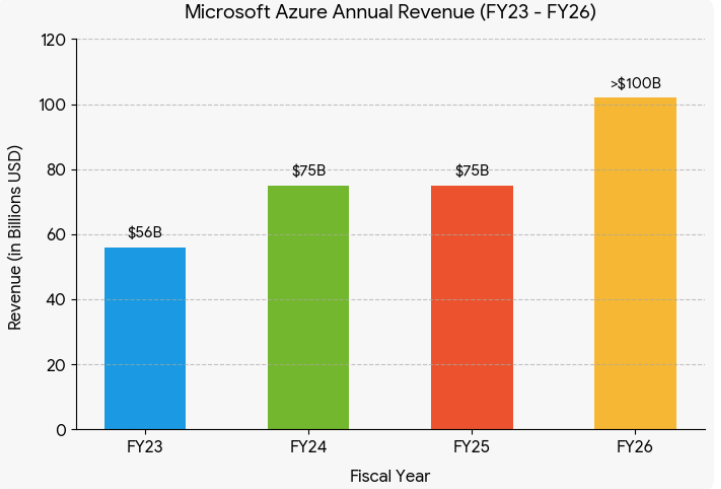
Source: Microsoft
Nvidia is changing the economics of AI expansion
Success has created a new constraint. The biggest bottleneck is no longer finding customers. It is finding enough high-bandwidth memory to build the next generation of AI systems. Nvidia has warned that ongoing memory shortages are pushing up component costs and squeezing margins, with specialized data-center chips expected to become roughly 15% more expensive as supply remains tight.
That puts companies like Microsoft in a different position Demand is still there. The cost of serving that demand is climbing much faster than it was earlier in the AI cycle.
The next phase looks much more expensive
This is where the AI trade becomes more complicated. Microsoft has already committed enormous amounts of capital to data centers, power infrastructure and AI hardware, while Nvidia continues selling nearly every advanced chip it can produce.
For investors, that changes what they watch during earnings
Revenue growth alone is no longer enough. They also want to know whether higher chip prices, memory shortages and infrastructure costs begin limiting returns on those investments.
The challenge is not unique to Microsoft. Amazon, Alphabet and Meta are expanding AI infrastructure at the same time, meaning they are all competing for many of the same components.
The next AI battle is shifting from demand to execution
The market has already accepted that companies want AI. Now it wants proof that they can keep building it without losing profitability.
Microsoft has shown that cloud demand can scale into a $100 billion business. Nvidia has shown that demand for AI chips remains stronger than supply. The next chapter depends on whether those two stories can keep moving together.
If cloud revenue keeps accelerating while infrastructure costs stabilize, the AI investment cycle becomes easier to defend. If costs keep rising faster than deployment, investors may start paying less attention to how much AI companies sell and more attention to how much it costs them to keep growing.
Technical Outlook
Microsoft no longer looks like a stock trying to recover. It looks like one trying to build on its trend. The correction held above the long-term rising trendline, buyers reclaimed the 126-day moving average around 435, and the move through the 470-490 area removed the ceiling that had rejected several earlier rallies. That sequence usually changes the tone of the chart because buyers stop reacting to weakness and start defending higher ground.
550 is where the next test begins
The next real test sits near 550. That was the level where sellers took control before the previous correction, so it is the first place where profit-taking could become more active again. The difference this time is that the rally is arriving with a stronger structure underneath it. Higher lows keep building beneath price, the long-term trendline is still intact, and momentum looks much healthier than it did during the earlier recovery attempts. The only sign of caution is that price has stretched further away from its longer-term averages after a sharp rise.
Scenarios Ahead
The 490-500 area has become the line buyers need to protect. Holding above that zone keeps the breakout intact and leaves 550 as the next destination on the chart. If that level finally gives way, the recovery starts looking much bigger than another bounce and shifts attention toward fresh highs.
A pause would not change the bigger picture
If the rally stalls near 550, the first expectation is a slower market rather than an immediate reversal. The 490-500 zone becomes the first place to watch, with 435 sitting underneath as the stronger long-term floor. As long as those higher support levels continue holding, buyers keep the advantage even if the stock spends some time catching its breath before the next move.
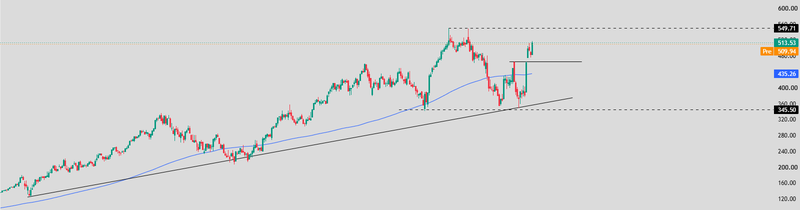
Source: Trading view


