
 Support
 Could Trump capital gains tax cut reignite the AI stock rally?
Donald Trump’s floated proposal to cut capital gains taxes and expand home-sale tax exemptions is being discussed primarily as a political strategy ahead of the November 2026 midterm elections. Markets, however, are starting to view it through a very different lens. For investors focused on technology, the proposal lands directly in the middle of the biggest debate on Wall Street: whether the AI boom still has enough liquidity and earnings support to keep expanding.
Lower capital gains taxes could increase the appeal of owning equities, particularly high-growth technology stocks.
Higher stock valuations would make it easier for AI companies to raise capital for data centers and chip infrastructure.
The same policy could eventually create inflation and deficit concerns that bring the Federal Reserve back into focus.
Why the market is paying attention
A capital gains tax cut does not automatically make companies more profitable. What changes are the after-tax return investors receiving from taking risks.
If investors can keep a larger share of their gains, equities become relatively more attractive than bonds, cash and other assets. In practice, that tends to support sectors where investors are already expecting strong future growth.
Right now, that means artificial intelligence
The proposal would arrive at a moment when many of the market’s most valuable companies are spending enormous sums on data centers, networking equipment, advanced chips and cloud infrastructure. Lower taxes on investment gains could encourage both retail and institutional investors to commit more capital to those businesses.
Why AI companies would benefit disproportionately
The connection to the AI trade goes well beyond short-term market sentiment. Many of the companies leading the AI boom are financing expansion against exceptionally high equity valuations. When a company can issue shares at a richer valuation, it can raise the same amount of capital while giving up a smaller percentage of ownership.
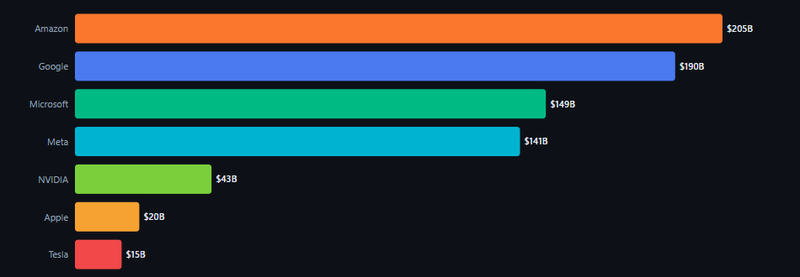
That matters because the sector is still in the middle of one of the largest infrastructure buildouts in modern corporate history. The major hyperscalers are collectively on track to spend roughly $750 billion on AI-related capital expenditure, including data centers, advanced chips, networking equipment, power infrastructure and cooling systems. In that environment, higher equity valuations become a strategic advantage rather than simply a stock-market benefit.
They make it easier to finance additional data centers, secure more computing capacity and continue expanding AI infrastructure without relying heavily on debt markets at a time when borrowing costs remain elevated.
Viewed through that lens, a capital gains tax cut would do more than reward existing shareholders. By potentially attracting additional capital into high-growth technology stocks, it could help extend the financing cycle that has been supporting the broader AI infrastructure boom and reinforce the market’s willingness to fund large-scale AI expansion.
Source: Value add
The policy could also intensify bubble concerns
This is where the proposal becomes more complicated. The AI debate is no longer only about technology. It is increasingly about liquidity, fiscal policy and the availability of cheap capital.
A tax cut that pushes more money into already expensive technology stocks could amplify the very concerns that have made investors uneasy in recent months. If valuations rise faster than underlying earnings, the market may begin to look less like a growth story and more like a liquidity-driven expansion. The proposal therefore has the potential to act as an accelerant rather than a cure.
The Fed remains the missing piece
The more important question is what happens if the policy succeeds too well. Stronger wealth effects, firmer consumer spending and larger fiscal deficits could add to inflation concerns at a time when the fed is still trying to keep price pressures under control.
If markets begin to believe that easier fiscal policy will force the Fed to maintain higher interest rates for longer, the initial boost to technology stocks could eventually reverse.
That is the historical pattern investors are watching most closely
Speculative technology cycles rarely end simply because enthusiasm fades. They usually come under pressure when the cost of capital rises, and future earnings are discounted more heavily.
History suggests tax cuts can amplify market liquidity
Investors looking at Trump proposal are also revisiting two important episodes when Washington reduced capital gains taxes and equity markets responded much more positively than many expected.
In 1997, Congress cut the maximum long-term capital gains tax rate from 28% to 20%. Before the change took effect, some strategists warned that investors would sell aggressively to lock in existing gains. Instead, the opposite happened. Liquidity remained strong, risk appetite improved and high-growth technology stocks became some of the biggest beneficiaries of the late-1990s rally.
Inflation did not surge immediately, but it gradually moved higher over the following two years, rising from 1.7% in 1997 to 2.7% by 1999.
A similar pattern appeared in 2003, when the Bush administration reduced the top capital gains rate from 20% to 15%. The cut encouraged a wave of asset transactions and injected additional liquidity into equity markets at a time when investors were recovering from the dot-com collapse and recession.
Again, inflation accelerated over the next two years, climbing from 1.9% in 2003 to 3.39% by 2005. These episodes do not prove that capital gains tax cuts automatically create inflation. They do show that lower taxes on investment gains can coincide with stronger asset prices, increased market liquidity and firmer inflationary pressures over time.
Why this matters for the AI trade
The proposal sits at the intersection of the two forces that have defined the AI rally: abundant liquidity and expectations of extraordinary future growth.
Lower capital gains taxes could strengthen the first force by pushing more capital toward equities. Higher inflation or deficit concerns could weaken the second by bringing tighter monetary policy back into the conversation.
For now, investors are treating the idea as a potential bullish catalyst for technology. The more interesting question is whether it would ultimately extend the AI cycle or sow the conditions that make the next correction more dangerous.
That is why the market is not viewing Trump’s tax proposal as a tax story alone. It is increasingly being treated as part of the broader debate over how long the AI boom can keep outrunning concerns about valuation, inflation and the cost of capital.


