
 Support
China memory chip expansion could challenge US tech profits
CXMT does not need to overtake Micron, Samsung or SK Hynix in advanced AI memory to change the economics of the industry. It needs to add enough conventional DRAM supply to challenge the scarcity supporting current prices.
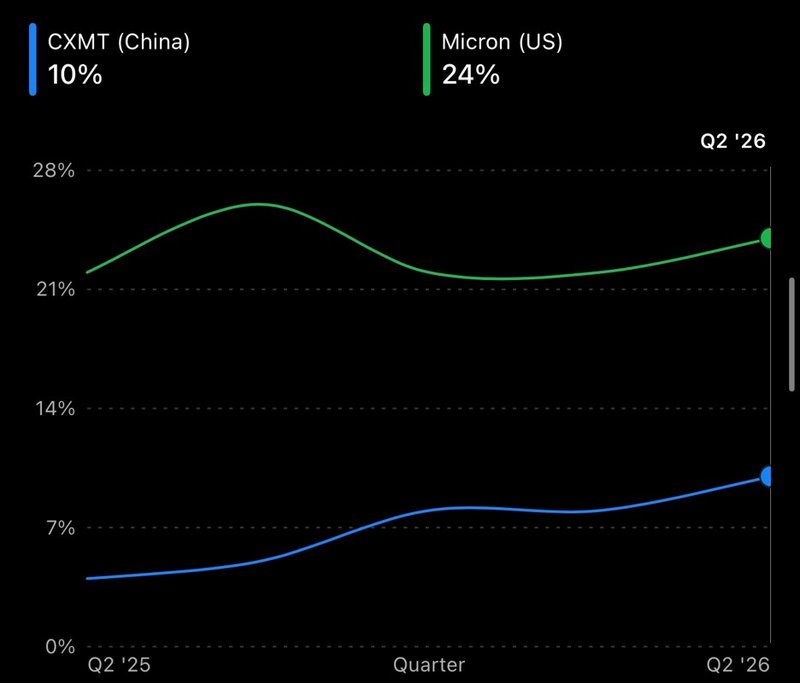
CXMT DRAM revenue share rose from 4% in Q2 2025 to 10% in Q2 2026.
The current profit boom is supported not only by growing demand, but also by limited supply.
The competitive threat is not yet equal across all memory products.
China’s CXMT is gaining ground in the global memory market
CXMT DRAM revenue share rose from 4% in Q2 2025 to 10% in Q2 2026. But the bigger concern isn’t whether China can immediately compete in advanced AI memory. It’s whether expanding Chinese production could eventually weaken the pricing power supporting the industry’s record profits.
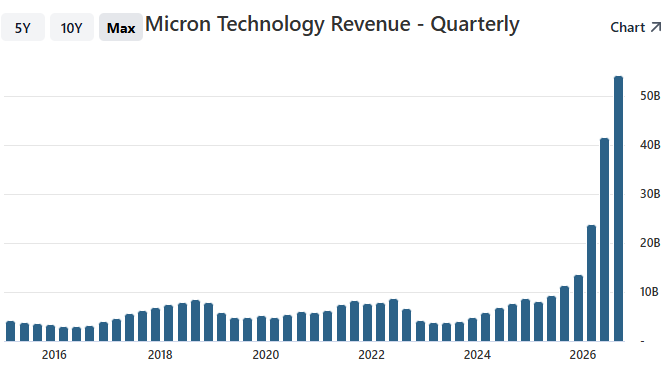
That pricing power has been particularly important for US-based Micron, whose quarterly revenue surged from $11.3 billion to $54.2 billion over the same period. As American technology giants increase AI infrastructure spending, manufacturers have shifted capacity toward high-bandwidth memory (HBM), tightening conventional DRAM supply and pushing prices higher. These conditions are also creating opportunities for CXMT to expand.
Washington’s semiconductor restrictions have encouraged China to accelerate domestic production. Although CXMT still faces technological barriers in advanced memory, increasing conventional DRAM supply could eventually pressure prices and margins.
For US investors, the impact may be mixed
Lower memory prices could hurt Micron while reducing infrastructure costs for American AI companies. The question is whether China’s expansion will weaken US technology earnings or simply redistribute profits between memory manufacturers and their biggest customers.
Source: Counterpoint Research
The AI boom is creating its own competition
The memory shortage is partly a consequence of how manufacturers have responded to AI demand. Advanced AI systems require high-bandwidth memory (HBM), which place specialized demands on production and packaging. As suppliers allocate more resources to these higher-value products, conventional DRAM supply can become tighter, pushing prices higher across the market.
For Micron, this has been an unusually favourable cycle. Its revenue reached $52.23 billion, while its cloud and core data-centre memory businesses recorded substantial growth. The company’s results demonstrate how strongly AI infrastructure spending is flowing through to memory suppliers.
Source: Stock analysis
But high margins invite competition
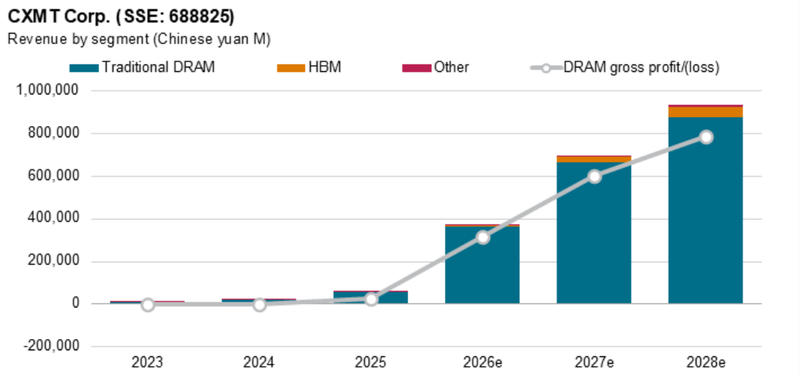
CXMT can concentrate on conventional DRAM, where additional production may eventually ease supply constraints, even while it works to close the technological gap in HBM. If Chinese output grows faster than demand, the industry could face downward pressure on prices before CXMT becomes a major supplier of the most advanced AI memory.
This is the central risk for investors
The current profit boom is supported not only by growing demand, but also by limited supply. If that scarcity diminishes, revenue growth and margins could slow even if data-centre investment continues to expand.
HBM remains the dividing line
The competitive threat is not yet equal across all memory products. HBM requires advanced manufacturing, packaging, reliability and close integration with AI processors. SK Hynix, Samsung and Micron have established positions in this segment, while CXMT still faces technological and equipment constraints.
CXMT is targeting production of 12-layer HBM by 2027, reaching that milestone would be significant, but producing a component is not the same as matching established suppliers in performance, yields, volume and qualification by major customers.
The more immediate pressure may therefore come from conventional memory rather than direct competition in the highest-end AI segment. Additional Chinese DRAM could influence pricing across parts of the market, while the established suppliers continue competing for HBM contracts. That creates a split outlook for Micron and its peers: demand for advanced AI memory may remain strong even as pricing power weakens in more standard products.
Source: Visible Alpha
US technology companies could benefit from the same shift
The consequences extend beyond memory manufacturers. Lower DRAM prices would put pressure on suppliers’ margins, but they could reduce hardware costs for cloud providers and other companies building AI infrastructure. The distribution of profits across the technology sector could change without the underlying AI investment cycle ending.
That outcome would also complicate the political logic of US semiconductor restrictions. Limits on China’s access to advanced equipment may slow CXMT’s progress in leading-edge memory, but they have not prevented the company from expanding its conventional DRAM business. China’s growing domestic market and policy support provide additional incentives to increase local production.
For investors, the question is no longer simply whether AI demand will keep growing. It is whether demand will grow quickly enough to absorb new capacity without eroding the margins that have made memory stocks so profitable.
CXMT’s expansion does not guarantee an imminent downturn
Building capacity takes time, and advanced HBM remains difficult to replicate. But the market is moving towards a point were supply growth matters as much as demand growth. If China can add meaningful volumes of conventional DRAM while the leading suppliers remain focused on AI memory, the next phase of the boom could bring lower costs for technology companies and less pricing power for chipmakers. The AI story may remain intact, but the distribution of its profits could look very different.


