
 Support
Micron’s AI boom is creating a memory supply crunch
Micron’s latest results are not simply another record quarter for a semiconductor company. They point to a deeper change in the economics of the memory market, AI demand is now competing directly with the industry’s ability to produce enough memory.
Micron expects memory and storage conditions to remain tight through fiscal 2027 and 2028.
Most of its 2027 HBM output is already committed to customers.
Long-term supply agreements increased to $32 billion from $22 billion in June.
Micron’s results expose a capacity problem
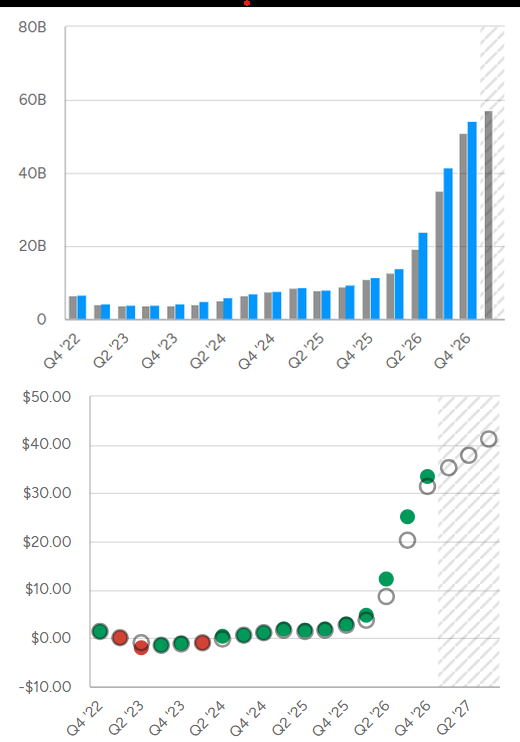
Fourth-quarter revenue reached $54.23 billion, up 379% year on year, while adjusted EPS climbed to $33.42 from $3.03 a year earlier. Micron expects tight supply-demand conditions to persist through fiscal 2027 and 2028. At the same time, customers are securing future output much earlier. Long-term agreements have risen to $32 billion, with much of the increase backed by cash deposits. Most of Micron’s 2027 HBM production is already contracted.
That changes the relationship between memory producers and their customers
In a conventional memory cycle, buyers benefit from abundant supply and falling prices, while manufacturers compete for volume. Today, large AI customers are competing for certainty instead. They are effectively paying to secure future capacity before it becomes available.
That is a sign that memory has moved from being a relatively interchangeable input to becoming a strategic constraint.
Source: Earnings hub
Why is HBM changing the semiconductor cycle?
The answer sits inside the DRAM market. HBM is critical for AI accelerators because it allows processors to access large volumes of data at very high speeds. But producing more HBM is not independent of the rest of the memory market. HBM and conventional DRAM draw on the same wafer capacity, so shifting production toward HBM can restrict the supply of standard DRAM. Samsung expects HBM to consume almost 30% of industry DRAM wafer capacity next year, compared with around 20% currently.
This creates a different kind of semiconductor bottleneck
The issue is no longer simply whether Nvidia, AMD or other chipmakers can produce enough accelerators. Each accelerator also needs memory around it. As AI systems become larger, the amount and performance of memory required per system rise as well.
That means stronger AI demand can tighten several parts of the semiconductor supply chain at the same time.
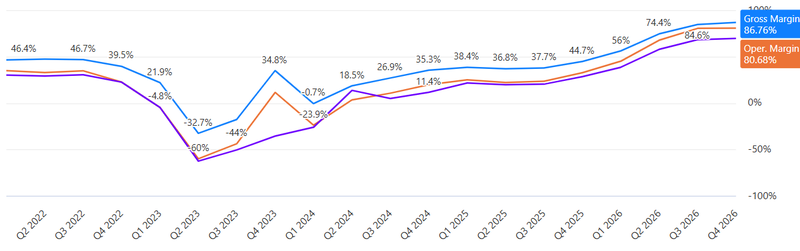
The 87% margin tells us something about pricing
Micron’s gross margin is also important because memory has historically been one of the most cyclical areas of semiconductors.
When supply exceeds demand, prices fall rapidly and margins can collapse. When producers cut capacity and demand returns, pricing can move just as sharply in the opposite direction.
The current margin shows the market is nowhere near a conventional glut
More importantly, the combination of high margins and customers signing multiyear supply agreements suggests that buyers are prioritizing availability over price. Micron is benefiting from that shift, but the implication extends across the memory industry. Stronger pricing gives manufacturers the financial incentive to expand production, while customers have an incentive to lock in supply before that new capacity arrives.
Source: Stock analysis
Why does more capital spending not solve it immediately?
Micron is responding aggressively. Capital expenditure reached $27.37 billion in fiscal 2026, and the company has outlined further manufacturing expansion, including major investments in the United States and Japan.
But semiconductor capacity does not respond to price signals overnight. New fabs require substantial construction, equipment installation and production qualification before meaningful volumes reach customers. That creates a timing mismatch... demand can accelerate in quarters, while supply may take years to respond.
This is the part of the cycle that matters most for investors
High margins today encourage capacity expansion tomorrow. But if AI demand continues growing while that capacity is still being built, the additional supply may arrive too late to prevent another period of tight pricing.
When does the memory cycle finally turn?
That remains the longer-term risk. The memory industry is still cyclical, and today’s margins will eventually attract investment. The question is whether the next wave of capacity reaches the market before AI demand starts to normalize.
For now, Micron’s guidance points in the opposite direction. Management expects another strong fiscal 2027, with first-quarter revenue of $61.5 billion and non-GAAP gross margin of approximately 86.25%.
That makes Micron more than memory stock
MU is increasingly a read-through on the AI infrastructure cycle itself. The stronger the AI buildout becomes, the more memory capacity it consumes, and the harder it becomes for the semiconductor industry to return quickly to the oversupply conditions that traditionally end a memory boom.


