
 Support
 Micron earnings outlook: will AI spending stay strong enough?
Anthropic CEO Dario Amodei called for the AI industry to slow the pace of model development, a proposal supported by OpenAI CEO Sam Altman and Elon Musk. The market reaction was immediate: Micron fell more than 5% as investors questioned whether slower model training could eventually reduce demand for high-bandwidth memory.
The company reported third-quarter fiscal 2026 revenue of $41.46 billion.
The company expects roughly $10 billion of capital expenditure in fiscal fourth quarter 2026.
Major AI companies continue investing heavily. Micron itself says supply constraints may persist beyond 2027.
The market reacted before the orders changed
Amodei is not calling for AI development to stop. His proposal focuses on pacing increasingly capable models, stronger independent testing and greater coordination over safety standards. OpenAI has separately said it supports mandatory, capability-based safety requirements while continuing development.
That distinction matters for Micron
A slower training cycle could reduce the pace at which hyperscalers deploy new computing capacity. But AI infrastructure spending does not depend entirely on training.
Inference is becoming an increasingly important source of memory demand as AI models move from experimentation into everyday commercial applications. Analysts have already suggested that spending could shift from training infrastructure toward inference workloads rather than disappearing altogether.
The market therefore appears to be pricing a possible change in the composition of demand before there is evidence of a material decline in total demand.
Micron enters this debate with extraordinary pricing power
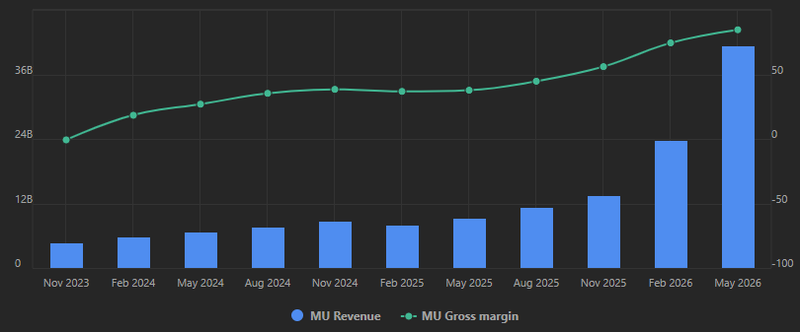
Micron's recent results explain why investors reacted so sharply. The company reported third-quarter fiscal 2026 revenue of $41.46 billion, while its cloud memory business generated $13.77 billion and achieved an 83% gross margin. Micron also secured $22 billion of commitments from 16 strategic customers as major buyers attempted to lock in memory supply amid persistent shortages.
This is not a normal semiconductor cycle
AI data centres require enormous quantities of DRAM and high-bandwidth memory, while supply expansion takes years because new production capacity requires major capital investment. That imbalance has given Micron unusually strong pricing power. The risk for investors is therefore not necessarily collapsing revenue.
If AI companies slow the pace of model training, even temporarily, memory shortages could ease. More available supply would weaken Micron's ability to push prices higher, particularly if competitors also bring additional capacity online.
Source: Fullratio
The $27 billion investment decision raises the stakes
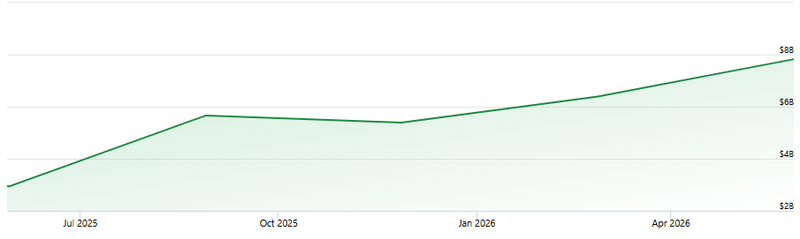
Micron is responding to today's shortage by spending heavily. The company expects roughly $10 billions of capital expenditure in fiscal fourth quarter 2026, taking full-year fiscal 2026 capital spending to approximately $27 billion. It also expects quarterly capital expenditure in fiscal 2027 to exceed the fourth-quarter level as it expands clean-room capacity for longer-term demand.
That creates an uncomfortable timing question
What happens if Micron adds capacity just as AI demand becomes less aggressive?
The answer depends on whether the slowdown is cyclical or structural. A temporary pause would probably be manageable. The industry could simply experience a period of inventory rebuilding before demand accelerates again.
A genuine reduction in AI infrastructure intensity would be much more serious. Micron would then face the classic semiconductor problem: large, fixed costs meeting weaker pricing.
Source: FinanceCharts
Wall Street still expects extraordinary earnings growth
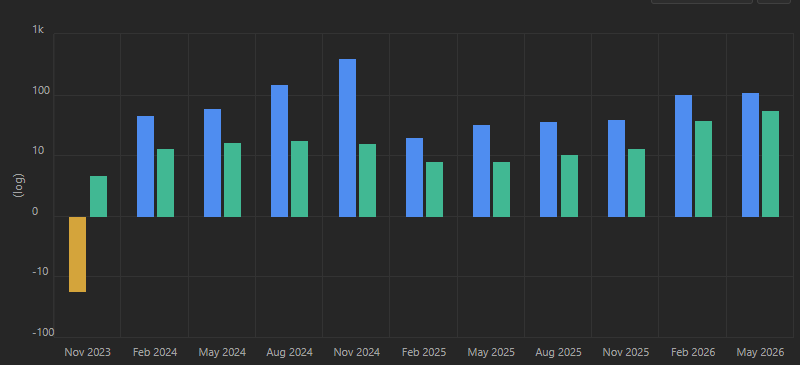
For now, forecasts remain extremely bullish. Analysts expect Micron's fiscal fourth-quarter revenue to reach roughly $50.4 billion, close to the company's own $49–$51 billion guidance range. Adjusted earnings expectations are around $30.89 a share, compared with $2.84 a year earlier, illustrating just how extraordinary the current memory cycle has become.
Micron itself expects fourth-quarter revenue of $50 billion, gross margin of approximately 86% and adjusted earnings per share of about $31.
That leaves the stock facing a difficult setup
Expectations are already extremely high. A company does not need to report bad numbers for the share price to fall. It only needs to be suggested that the next stage of growth will be less explosive than investors had assumed.
Source: Fullratio
The bigger threat is not AI safety it is AI economics
The current sell-off may therefore be asking the wrong question. The key issue is not whether AI companies support stricter safety rules. It is whether the enormous economics of AI infrastructure remain strong enough to justify another wave of spending.
For now, major AI companies continue investing heavily. Micron itself says supply constraints may persist beyond 2027, while long-term customer commitments provide some visibility into demand. That makes an immediate collapse in memory demand unlikely.
But the market is right to become more selective
When margins approach extraordinary levels, investors begin looking for the point at which supply catches up with demand. The AI slowdown debate could accelerate that process.


