Support
Nasdaq advances as Fed maintains rates and Microsoft beats expectations
The Nasdaq advanced following the Federal Reserve’s decision to pause interest rate hikes, alongside robust fundamental earnings from Microsoft, which exceeded expectations driven by substantial growth in its Azure cloud segment.

The Federal Reserve held its benchmark interest rate steady at 3.75%–4.00% via a 10–2 vote, easing valuation cost of capital pressures across equities.
The central bank cited strong economic growth, robust private investment, and resilient consumer spending, whilst highlighting persistent inflation above its 2.0% target.
Microsoft reported $92.28 billion in revenue and earnings per share (EPS) of $4.89, surpassing market expectations.
The Azure cloud segment recorded 48% revenue growth, underpinning strong net margins and driving a post-market stock rally.
Date: 29 October 2026 (GMT+3)
The Federal Reserve decides to hold benchmark interest rate steady; Nasdaq rises
The Nasdaq futures contract (NQ) advanced by 0.59% to 29,984 points after the Federal Reserve (Fed) decided to maintain its benchmark interest rate within the 3.75%–4.00% target range, aligning with market expectations. The decision passed by a 10–2 vote, with two dissenters—Fed Governor Lisa Cook and Cleveland Fed President Beth Hammack—voting in favour of a 25-basis-point interest rate increase.
Notably, Fed Chair Kevin Warsh highlighted that the Federal Open Market Committee (FOMC) observes strong economic growth in the United States, driven primarily by solid private investment and domestic consumption. Furthermore, FOMC members noted that employment has remained resilient; however, inflation has persisted above 2% target for over five years, prompting the central bank to remain firmly focused on curbing price pressures.
Higher interest rates typically exert downward pressure on equities, as elevated borrowing costs complicate corporate growth initiatives and expansion projects. Market valuations are similarly affected, as higher discount rates reduce intrinsic values by elevating the cost of equity within valuation models. Furthermore, in a high-interest-rate environment, Treasury yields become increasingly attractive to institutional investors seeking enhanced risk-adjusted returns, thereby weighing on equity markets due to potential capital reallocation.
Consequently, a neutral monetary policy stance by the US central bank is viewed favourably by equity markets, as expectations of further rate increases are effectively paused.
Microsoft delivers solid quarterly earnings report, driven by robust growth in Azure cloud segment
The Nasdaq futures contract gained further momentum following a strong quarterly earnings report from Microsoft that surpassed market forecasts for both total revenue and earnings per share (EPS).
The technology giant reported total revenue of $92.28 billion, exceeding the consensus estimate of $90.62 billion, alongside EPS of $4.89, which outperformed analysts’ expectations of $4.71. These results represent year-on-year (YoY) revenue growth of 18.81% and an annual EPS expansion of 18.40%.
Notably, strong financial results were primarily driven by 48% revenue growth in the Azure cloud division, as cited by CNBC. Microsoft’s earnings release highlighted robust profitability, with operating income reaching $45.9 billion (representing a 49.7% operating margin) and net income standing at $36.6 billion (a 39.6% net margin). These figures reflect YoY increases of 21% and 18%, respectively. Consequently, Microsoft shares rose by approximately 3% in extended trading.
Technical analysis of the Nasdaq futures contract
From a technical perspective, the Nasdaq contract retains a broader long-term bullish structure. However, a detailed examination of price action reveals notable shifts in underlying momentum:
- Trend Context: Over an extended horizon, the Nasdaq exhibits a classic ascending structure defined by a succession of higher highs and higher lows. The index continues to trade above its 200-day Simple Moving Average (SMA), reinforcing its primary bullish trajectory. In the short term, however, the index is facing selling pressure that has pushed price action below its 50-day and 100-day SMAs.
- Momentum Indicators: Both the Moving Average Convergence Divergence (MACD) and the Relative Strength Index (RSI) are trending downward, indicating that short-term bearish momentum may persist. Nevertheless, both indicators are approaching potential inflection points, suggesting caution regarding the sustainability of the downside movement.
- Resistance Levels: Should the index regain short-term bullish momentum, the first key resistance level lies at 30,800 points, followed by a secondary resistance level at 31,500 points—the current all-time high.
- Support Levels: If the 29,095 support level is breached to the downside, the next major structural floor is at 28,050 points, which converges with the 200-day SMA
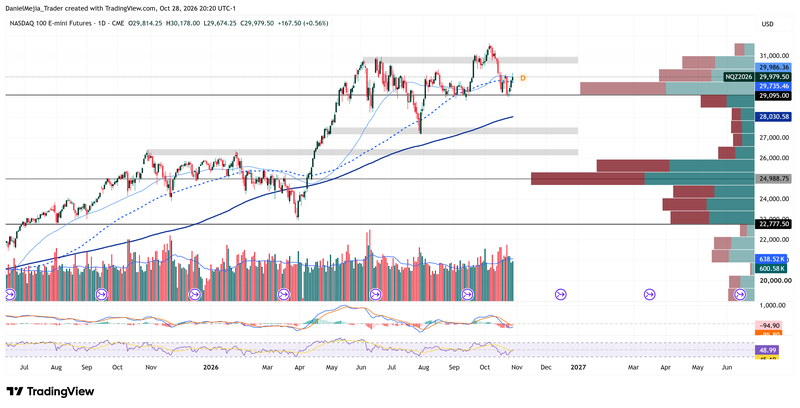
Figure 1. Nasdaq Futures Contract (2025–2026). Source: Data from the CME Exchange; author’s analysis conducted via TradingView.