
 Support
Nvidia analysis: Jensen Huang says AI demand is still accelerating
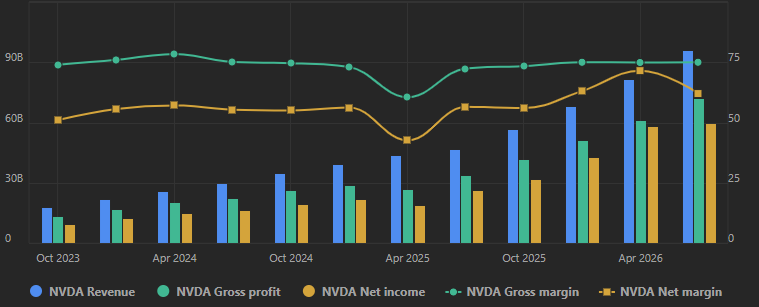
Jensen Huang has pushed back hard against the latest wave of AI warnings just as the market is starting to question how much longer the infrastructure boom can run. He says there is a “0% chance” AI destroys the world by 2030 and argues that the more dramatic predictions are not grounded in science. At the same time, Nvidia is still forecasting another record quarter, with revenue expected to reach $108 billion.

Nvidia expects $108 billion fiscal Q3 revenue.
Q2 revenue reached $96.2 billion, up 106% year over year.
Data-centre revenue rose 117% to $89 billion.
Huang says AI demand is still accelerating, with supply remaining a bottleneck through fiscal 2028
Huang is challenging the slowdown narrative
The latest debate started after Anthropic CEO Dario Amodei called for a slower pace of frontier-model development, citing safety risks and proposing independent evaluations and greater coordination between AI companies. OpenAI's Sam Altman and Elon Musk have also backed elements of the push.
Huang takes the opposite view
He argues that AI safety should be handled through engineering, testing and existing liability laws rather than a broad slowdown. He also questioned the motives behind some of the industry's warnings, saying companies calling for new restrictions may have “ulterior reasons.”
That is Huang's interpretation, not an established fact, and the companies involved have publicly framed their proposals around safety and oversight.
For Nvidia, the disagreement has a direct business angle. Slower frontier-model development could eventually mean slower demand for the computing infrastructure that powers those models.
Nvidia's numbers are saying something different
The latest results do not show a slowdown yet. Nvidia's Q2 revenue hit $96.2 billion, with data-centre sales reaching $89 billion. The company expects another $108 billion next quarter and has already said that demand for its new Vera Rubin platform is accelerating. It also expects roughly 70% revenue growth in fiscal 2028.
The most interesting number is not revenue, it is supply
Nvidia says supply is expected to remain a bottleneck through at least the end of fiscal 2028. That means the current constraint is still how quickly the industry can build and deliver the infrastructure, rather than a lack of customers willing to buy it.
That weakens the argument that the recent AI warnings have already translated into lower hardware demand.
Source: Full ratio
The market is starting to separate AI software from AI infrastructure
A slowdown in frontier-model research does not necessarily mean a slowdown in AI computing. Companies are still deploying AI agents, enterprise models and inference systems into existing businesses. Reuters recently reported that neocloud providers are raising GPU rental prices as demand remains strong, while Nvidia continues expanding capacity with hyperscalers and AI companies.
That creates two different AI markets. One depends on increasingly powerful models. The other depends on putting AI into everyday commercial use.
Nvidia needs both, but the second could continue expanding even if the first becomes more cautious.
The real test is whether spending keeps producing revenue
That is why Nvidia's $108 billion forecast matters more than the argument over whether AI is dangerous.
The infrastructure cycle is now too large to judge simply by chip shipments. Nvidia's customers are committing enormous sums to data centres, networking and power, while companies across the sector are carrying much higher capital requirements.
For now, Nvidia's figures still support the idea that AI demand is expanding rather than fading.
But the bar is moving
If revenue keeps climbing at this pace, the investment cycle has room to continue. If hyperscalers eventually slow spending, Nvidia's growth would feel that change almost immediately because so much of its revenue is tied to data-centre demand.
Huang is effectively betting that the debate over AI risks will not become a debate over AI spending. So far, the numbers are on his side. The next few quarters will show whether they stay there.
Nvidia's AI growth is facing a much higher valuation bar
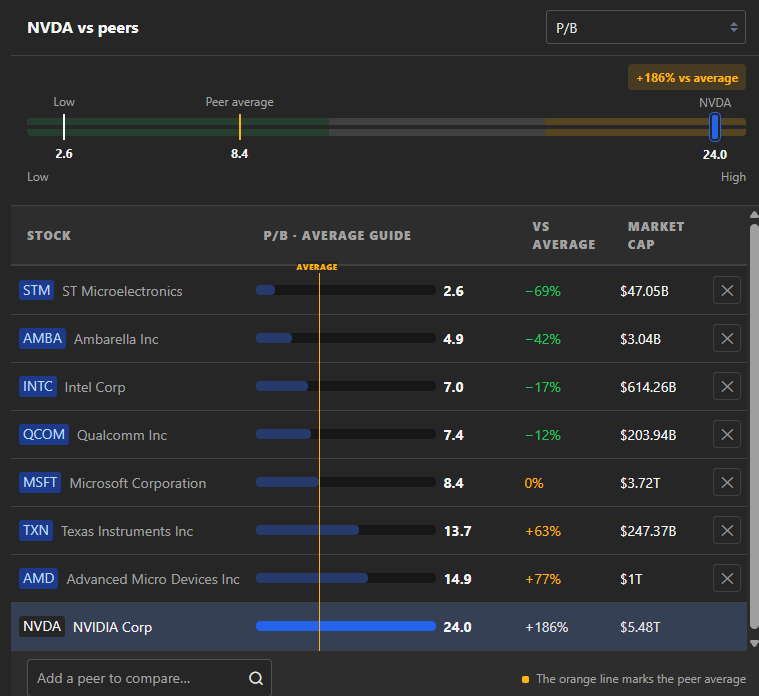
Nvidia's numbers still point to powerful AI demand, but the stock is being priced on much more than revenue growth. The valuation chart shows Nvidia trading at around 24 times price-to-book, versus 8.4 times for the peer group, 186% above the average. AMD sits at 14.9 times, while Intel is at 7.0.
That gap explains why Nvidia needs more than another strong earnings beat. With the company forecasting $108 billion in quarterly revenue, investors are already paying for a large part of the next stage of AI expansion.
The harder question is whether earnings and cash generation can keep growing quickly enough to justify a premium that is now far above its semiconductor peers. For Nvidia, the AI story remains strong, but the valuation leaves much less room for disappointment.
Source: Full ratio


